
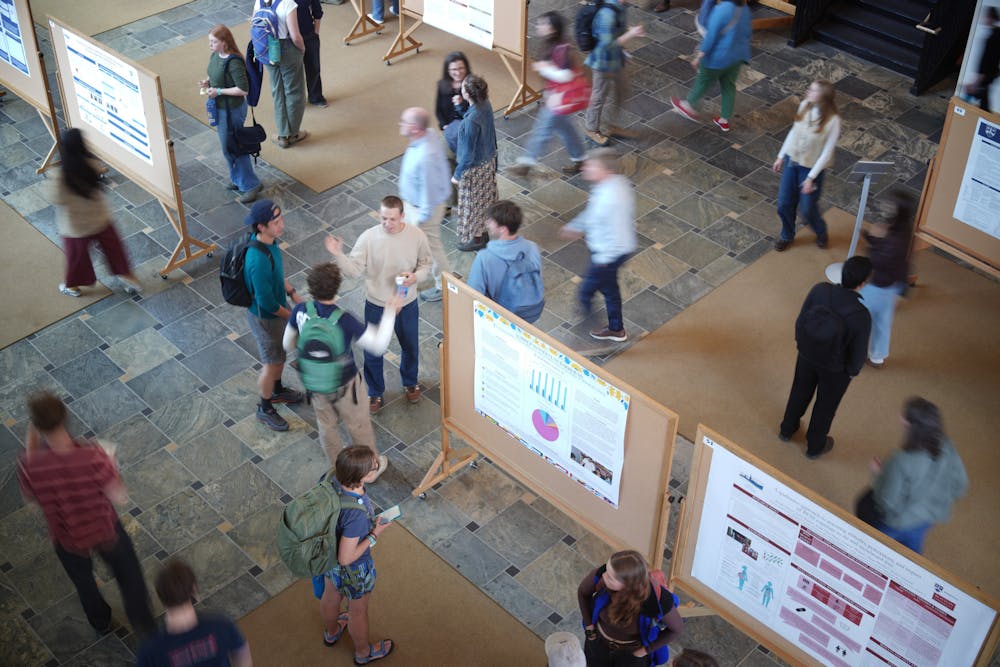
On Friday, April 17, Middlebury College hosted its 19th Annual Spring Symposium, highlighting student research over the past academic year. McCardell Bicentennial Hall (BiHall) became the host to all majors and disciplines, as students led 12-minute oral presentations, poster presentations in the great hall, and even a welcome dance performance.
This symposium served as a living “Ode to the Liberal Arts.” What began nearly two decades ago with just 16 students has become a key part of the college academic calendar. This year, over 250 students, including 158 seniors and 15 First Years, presented original research ranging from connecting hormonal menopause blockers to female Alzheimer's risk to the original work of John Dewey.
“I feel like on the surface, everyone is so busy with their academics,” Annabella Giorg Hyun ’27 said. “But then when you get down to it, everyone has their own personal interests, and it’s beautiful to see it all come together.”
As community members, parents, faculty, and staff came together to celebrate student research, the morning opened with an interpretive dance performance by members of the Dance Company of Middlebury, who wore white and orange outfits.
Global Research, Local Impact
Rob Ambat ’26, student intern at the Rohatyn Center for Global Affairs, presented his thesis on a pressing geopolitical crisis: the local economic impact on South China Sea territorial disputes.
“I was able to educate the broader Middlebury community about issues that are personally important but do not necessarily get much coverage in the mainstream media,” Ambat said in an interview with the Campus. “It was an enriching experience to both share something I’ve put so much work into, and get glimpses into the breadth of incredible academic work being done on campus.”
On another floor of BiHall, 10 students from the German Department shared their J-Term trip to Germany and Namibia. Their research took them from Hamburg, Germany, to Swakopmund, Namibia, to examine the impact of the 20th-century genocide of the Herero and Nama people. The students met with hotel workers, local activists and professors to understand how German influences still shape Namibian society. Presenters discussed the impact of German influence on modern-day Namibia: in architecture, with Bavarian Chalets permeating Swakopmund, and business, with the branding of the supermarket chain Wormannbrock reading “making your life better since 1894.”
“I got really excited during my presentation,” Christopher Facteau ’28, a participant in the Namibia trip, said. “I got to talk about what I think is one of the coolest, most interesting things happening in the world because I don't think many people know about it. I had to be able to share what I have learned from my own research as well as from my own experiences, which felt like the pinnacle of liberal arts.”
Students from the Rohatyn Center for Global Affairs, professors from the Economics department and Senior Febs packed into BiHall 219 to watch Luke Parkerson ’26.5, a former Rohatyn Global Fellow, presented about the democratic implications of the expansion of fiber optic cables in Nigeria and South Africa. In his presentation, Parkerson identified how expanding fiber optic networks increased government contact in rural areas.
“It’s very satisfying and inspiring to see my students present, and I just feel really proud of them. They're doing great work,” Amit Prakash, visiting assistant professor of global studies, said in an interview with The Campus.
For many students, the symposium not only serves as a way to show off their hard work but also as a celebration of community.
“It was outstanding, really great, to see students, both of whom I know and who are new to me. One of my favorite things is watching them and their peers really being encouraging and supportive,” Tim Mosehauer, senior assistant director at the Center for Careers and Internships, said in an interview with The Campus.
“Having people to come over to ask questions makes me feel like research is important. It makes me feel like the work that I’m doing is sort of like a contribution, and it feels like a very small community, like a family that supports each other. That makes me really happy to continue my project with my professor. and be more like curious about other types of types of research,” Estaban Catano Molina ’27, a presenter, said.
Molina participated in a multi-year study of Vermont maple sap microbial colonization patterns in maple sap to better understand how sap environmental factors impact the seasonal fluctuation of bacterial strains.
Likewise, the symposium unites the Middlebury community, giving students windows into their peers’ hard work. Belin Tate ’26 spent a semester last spring in Kenya tracking hyenas and helping farmers protect their sheep flocks. Presenting at the symposium allowed Tate to showcase her hard work.
“I don’t know what my friends study all day and looking around I get to learn more. It’s like a taste into their life and their research, and it’s so cool to see that. Hopefully they get to care a little bit more about hyena conservation,” Tate wrote in a message to The Campus.
In a room moderated by President Ian Baucom, Heba Qalandari ’28 presented on the Cartesian dualism explored in the mind and body in alchemy. Qalandari asked audience members to challenge contextual versus methodological learning and question what it means to be an expert. She explained how growing up, she discovered alchemy by mastering SAT math study cards because she could only answer questions with math instead of asking new questions. In the sparsely filled classroom dotted with anthropology professors, we all learned how to dismantle our own perceptions of the world.
“I just realized that things are not as solid or defined as they seem. I just liked that alchemy is connected to that mental and spiritual,” Qalandari mentioned in her presentation.
The ‘Six-Minute’ Transformation
For the community members who help moderate, it’s a great way to get educated about niche biology, groundbreaking neuroscience or the sustainability challenges of living in rural America. Some even wish that it were made even more accessible by posting student presentations online.
The event even drew praise from former Vermont Governor Jim Douglas ’72, who noted the college's evolution since his own graduation.
“We didn’t have a symposium when I was a student here many years ago,” Douglas remarked. “It’s a tremendous opportunity for students to talk about their research and get questions or reactions to it. It’s a program that is a great one for the college. I regret that the time is so brief.”
For the faculty watching from the sidelines, the symposium is a study of student growth. Professor of Anthropology Michael Sheridan, a co-organizer of the 2026 student symposium, noted how the thesis and senior research presentation process fundamentally transforms his students.
“The highlight for me is always watching students realize that they are the experts of their topic,” Sheridan remarked. “It happens at about the six-minute mark...you see a transformation come over them when they realize, ‘I can do this.’...that emerging expertise is exactly why we’re here to celebrate.”
“The symposium is not about scholarly exploration, really, it’s about presenting people,” Sheridan added.


