
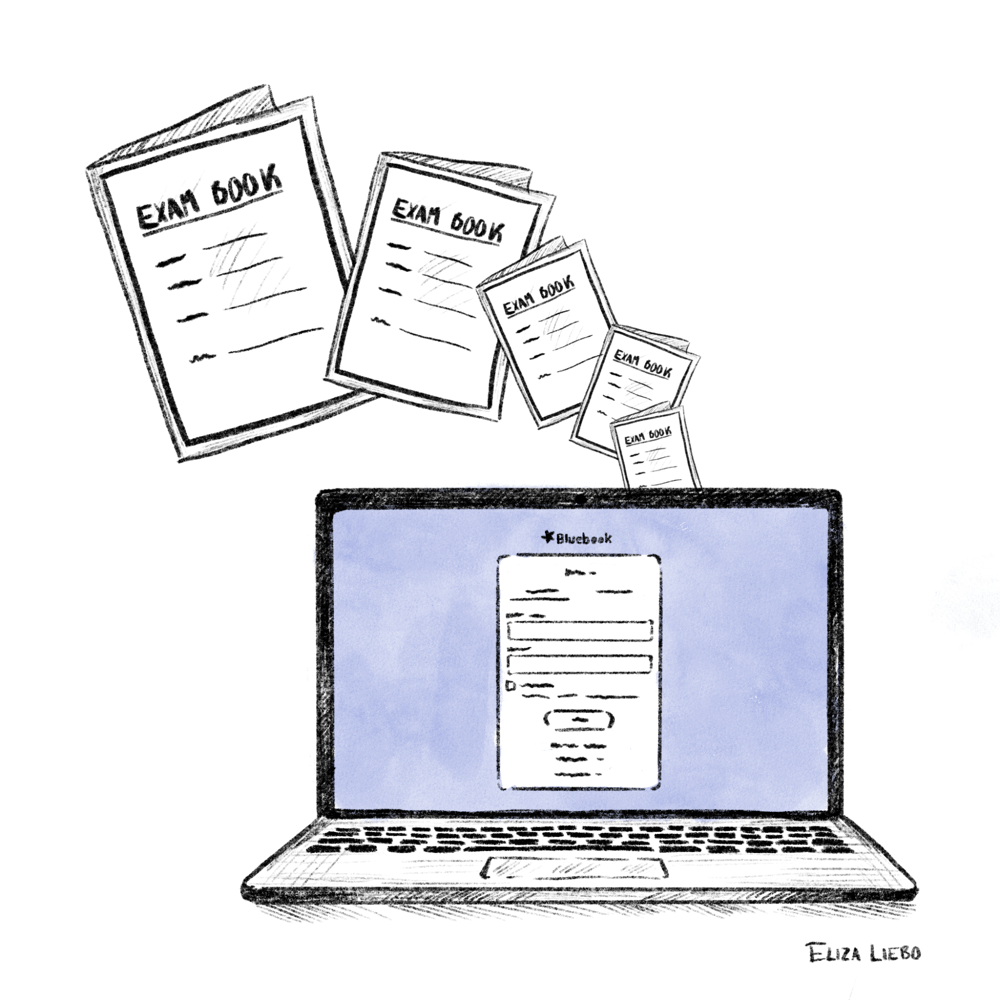
Three and a half years after ChatGPT’s launch, the proliferation of large language models (LLMs) and their use by students has changed much of the student experience, including approaches to exam formats. Some professors are holding firm on using blue books to test students' knowledge, particularly in introductory courses, even as they explore ways to incorporate artificial intelligence (AI) tools in the future.
As per last year’s Zeitgeist, 65% of Middlebury students self-report breaking the honor code, reflecting the rising prevalence of cheating.
Assistant Professor of Political Science Caleigh Glenn approached this semester’s syllabus seeking to outline a qualified policy on AI use in her courses, but ultimately decided on a blanket no-use policy.
“My concern with encouraging a proliferation of [AI] use is that because it can be very powerful, it can also be very easy to reach for when things get hard,” Glenn said. “Writing is hard. It’s hard to sit down in front of a blank piece of paper and come up with an idea and come up with a nice way of putting it all together. That's the process of writing. I see writing as thinking, and that's sort of what we're doing here.”
In her Introduction to International Politics course, Glenn assesses students through a mix of blue-book exams and shorter at-home writing assignments to evaluate both the substantive knowledge and the skills she wants them to take away from the course.
Professor of Political Science Matthew Dickinson has always administered exams through blue books and has no plans to change that approach.
“I’ve consistently used in-class blue book exams for my introductory and intermediate courses since I started teaching here more than 25 years ago, so I’ve not changed how I administer tests in those classes due to AI,” Dickinson stated in an email to The Campus.
However, Dickinson believes that AI has led some of his colleagues to reconsider their own exams.
“Anecdotally, however, it appears that many of my colleagues who used to rely on take-home exams or written papers are now switching to bluebooks. At least one has moved to oral examinations,” he said.
From the student perspective, the turn to blue books and handwritten exams is apparent to Peter Jenkins ’28.
“In some of the classes that are more quantitative, we’ve now had to write out our code rather than type it because of cheating concerns. In my Computer Science class, we had people come in to speak with us about how ridiculously widespread cheating in our class was. In economics, our stats tests are now in person, too,” Jenkins said.
Asked how that affects his experience in testing situations, he stated that it generally slows down his workflow.
“It's way more difficult to write an exam out than type it out. Especially if it's a long one, there's been times where I literally have to take a three-minute break to massage my hand during the exam. If you have to write out a six page essay it's brutal.”
Other students see blue books as a way to demonstrate comprehension skills in an AI-proof sitting.
“I think it's a good type of exam because it evaluates your ability to structure your knowledge under conditions of stress,” Youhn Bernardin-Duparc ’28.5 said.
More specifically, Bernardin-Duparc cited his psychology professor, who uses biweekly quizzes to practice the material consistently, and appreciated that he explained his reasoning at the beginning of the semester.
French and Francophone Studies Department Chair Professor Julien Weber explained that his department has been having conversations about the use of technology in its classrooms, given the rise of tools such as Google Translate, years before LLMs. Across the department, there has been a shift towards more in-class written assignments, in which students bring an outline and produce an essay within a class period.
“It’s a conscious decision to move to low-tech. There’s been a reversal, for sure, and a realization that memorization is very important and that having a notebook and a pen is actually more helpful for students,” Weber said.
Dickinson, too, sees great value in continuing blue book examinations.
“The value of in-class bluebook exams, to me, has always been that it rewards students who have put in the effort to attend lectures and engage in careful reading of course materials. That hasn’t changed with the advent of AI.”
Luke James Power '28 (he/him) is a News Editor.
Luke previously served as a contributing writer and as a news editor of "The Anvil" Middlesex school. He is majoring in economics and history. He is also a senior analyst with the Middlebury Student Investment Committee, and enjoys skiing, squash, and golf. He lives in Manhasset, NY.
Noor Khan '28 (she/her) is a News Editor.
Noor is a History and Political Science double major. She was an editorial intern at the Los Altos Town Crier for the summer of 2025.


