
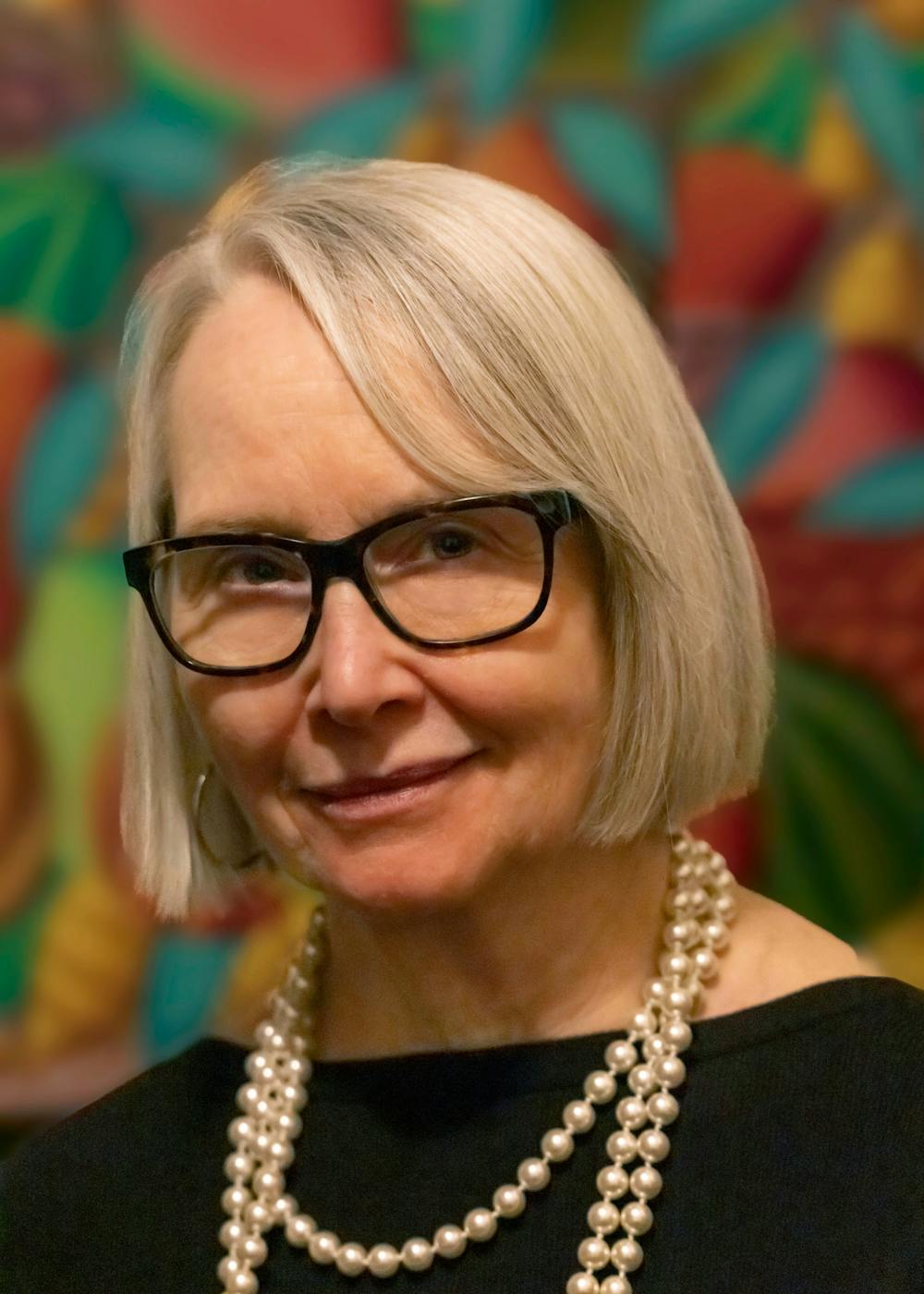
President Ian Baucom announced on Jan. 22 that Executive Vice President and Provost Michelle McCauley will step down from her position on June 30, concluding a tenure spanning three decades of teaching and institutional leadership at Middlebury.
McCauley will take a sabbatical beginning July 1. Her next steps, she said, will either be a leadership role at another institution or a return to teaching and research. The college has begun the search for its next provost but has not yet shared further details.
McCauley arrived at the college in 1995 as an applied psychologist in the Psychology department, with a particular focus on applying psychological theory to societal challenges. Her early research in legal psychology focused on eyewitness memory and children’s courtroom testimony, noting that children’s accounts were not widely taken seriously in U.S. courts until the late 20th century.
“Much of my early work was this combination of understanding how to support individuals in telling their stories, but doing so in a way where the accuracy of what was being said would allow them to be good witnesses,” McCauley said in an interview with the Campus.
She also oversaw Middlebury’s Conservation Psychology Lab, which she founded to investigate the psychological underpinnings of pro-environmental behavior. The lab has worked closely with Middlebury's Sustainability Solutions Lab and has long served as a training ground for undergraduate thesis students. She also co-founded the Vermont Center for Behavioral Science Research on Climate and the Environment in 2021, extending the lab work beyond the college.
Beyond her academic work, McCauley became the first director of the Kathryn Wasserman Davis Collaborative in Conflict Transformation. The Collaborative launched in December 2021 with a $25 million anonymous gift, stewarded by former President Laurie Patton, and McCauley formally became director in January 2022 with an immediate mandate to build.
"The first six months, everything we needed to be — I needed to find the leaders for each of the pillars," McCauley said. "I'll kindly pay you tomorrow for a hamburger today. I was asking for work in a window where the grant had not hit our institution yet."
Much of what made the launch possible, McCauley noted, was the groundwork already laid by Professor of Political Science Sarah Stroup through the Engaged Listening Project, a program that provides faculty- and student-facing staff with dialogic practice training, funded by the Mellon Foundation. When McCauley stepped away from the Collaborative to take on the provost role, Stroup stepped in as director — a transition McCauley described as seamless.
"Honestly, [Stroup] could not have been a better person there. Just perfect for the moment in every way,” McCauley said.
The collaborative has since expanded significantly, with student programming embedded into the first-year experience, travel opportunities and a growing focus on external partnerships with nonprofits and NGOs.
In July 2022, the former Provost and Edward C. Knox Professor of International Studies and Political Science, Jeff Cason, passed away unexpectedly. McCauley was asked to step in that summer as interim Executive Vice President and Provost. She was officially appointed to the role in 2024.
Her tenure as provost was first marked by the end of Covid-19 pandemic restrictions, and it was a time within our academic administration of abrupt and significant transition. Prior to Jeff Cason's passing, Vice President of Academic Affairs and Dean of Faculty and Charles A. Dana Professor of Gender, Sexuality & Feminist Studies, Sujata Moorti had begun a planned sabbatical, according to McCauley, a leave that followed Moorti's tenure guiding Middlebury through the pandemic. Jim Ralph, Rehnquist Professor of American History and Culture, stepped in as interim VPAA/DoF while Moorti was away. However, following her sabbatical, Moorti chose to direct her focus toward her faculty work and scholarly pursuits rather than return to administration.
Jim Ralph stayed in the interim VPAA/DoF role for the year and then spent the following two years as Dean of Faculty when we divided the roles and hired Jeremy Ward, Albert D. Mead Professor of Biology, as Vice President of Academic Affairs in summer of 2023.
The college underwent a leadership transition last year when President Laurie Patton departed to lead the American Academy of Arts and Sciences. Stephen Snyder, Dean of Language Schools and Vice President for Academic Affairs, as well as Kawashima Professor of Japanese Studies, was named interim president while the Board of Trustees conducted a search that ultimately resulted in the hiring of Baucom.
“I'm very grateful to Jim [Ralph] for the support that first year as we worked with an amazing team … just lots of transition, I guess, is the way we described this period". McCauley noted.
McCauley also added that the pandemic left a significant financial strain on the college.
“Where higher ed is coming out [of the pandemic], and folks are really tired, and they've done tremendous work, and morale is tough… COVID was expensive for this institution.”
When post-pandemic enrollment surged beyond what campus housing could accommodate, McCauley spearheaded a first-year program in Copenhagen, sending a cohort of incoming students abroad to ease the pressure while the college worked to improve its overenrollment.
During her time as Provost, the college announced a $10 million annual reduction to patch a 15-year-long financial deficit. This reduction almost universally came from reducing staff and faculty benefits. Alongside Interim President Steve Snyder and Executive Vice President of Finance and Administration David Provost, McCauley was one of the public-facing administrators behind this budget cut, which saw 94% of faculty pass a motion calling for a total reversal of the planned budget cuts. Following this vote, over 300 faculty, staff, and students alike protested outside Old Chapel, presenting the motion, alongside an 800-signatory petition to McCauley.
As she reflected on her time at the college, McCauley commented on Middlebury’s ability to weather different financial, political and social crises.
“I can get upset about whatever the situation might be today, and I realize that these big windowsills and windows, so many people before me, have looked out with different challenges, right? Whether we're talking about the Civil War, the pandemic of the early 1900s, I mean, these are these things [that] repeat,” McCauley said.
In her 31 years at Middlebury, McCauley has seen the college change while retaining some of its old traditions. She notes that while the college has made an effort to increase access for diverse students over the past few decades, she believes it has been fostering cross-cultural dialogue since the inception of the language schools in 1915.
“There are a lot of different ways to talk about inclusion and access, but I think about being 110 years of the language schools that were really developed with this understanding. That was a piece, not the only piece, but a piece of thinking across cultural differences.”
When asked about her faith in the future of Middlebury, McCauley noted that she is “all in on Middlebury’s future directions.”
The rise of Artificial Intelligence (AI) and its use in higher education was something of a potential concern. McCauley noted that AI’s prevalence in high schools may diminish the quality of students, as more and more students rely on it for academic tasks.
“This question of how AI will change what it needs to be educated? And it is clear that we must have humans who are deeply knowledgeable, and, not unlike training yourself for a marathon, you actually have to do the work to build the muscles to be able to run. You have to do that to become [an] expert in the loop … I am very worried about the junior high and high school students who are smart, because it's the smart students who, if they don't want to do the hard work, [will use AI]. I can't police that.”
McCauley noted her support for the humanities and languages, particularly emphasising that languages are essential for developing cultural understanding.
“I said to a group of first-years, at the time, there was just the Willy Wonka movie was out again. And I'm like: “We've all got the, if you're here, you've got the golden ticket. You may not realize it, but it doesn't matter. You do.”
Yuvraj Shah '26 (he/him) is a Managing Editor.
He has previously served as the Senior Opinions Editor. He is a joint major in History and English Literature. He was awarded a $5000 Mellon Humanities For All Times Grant through the Axinn Center for the Humanities and is conducting research about the citizenship rights of the British Kenyan Asian diaspora. He studied abroad at Keble College, University of Oxford. He is a Senior Fellow at Middlebury College Admissions, a Residential Advisor, and Arts Events House Manager. He is a member of Middlebury College’s new 10-year plan development committee. He has previously interned with the New England Review and the Middlebury Magazine. He is an international student from Nairobi, Kenya, and London, UK. He is a UWC Davis Scholar.

Mandy Berghela '26 (she/her) is Editor-in-Chief
Mandy has previously served as the Managing Editor, Senior Local Editor, a Local Section Editor and Staff Writer. She is majoring in Political Science with a minor in History. She currently is Co-President for the Southeast Asian Society and an intern with the Conflict Transformation Collaborative. Last summer, Mandy interned with U.S. Senator Kirsten Gillibrand and participated in the Bloomberg Journalism Diversity Program.


