
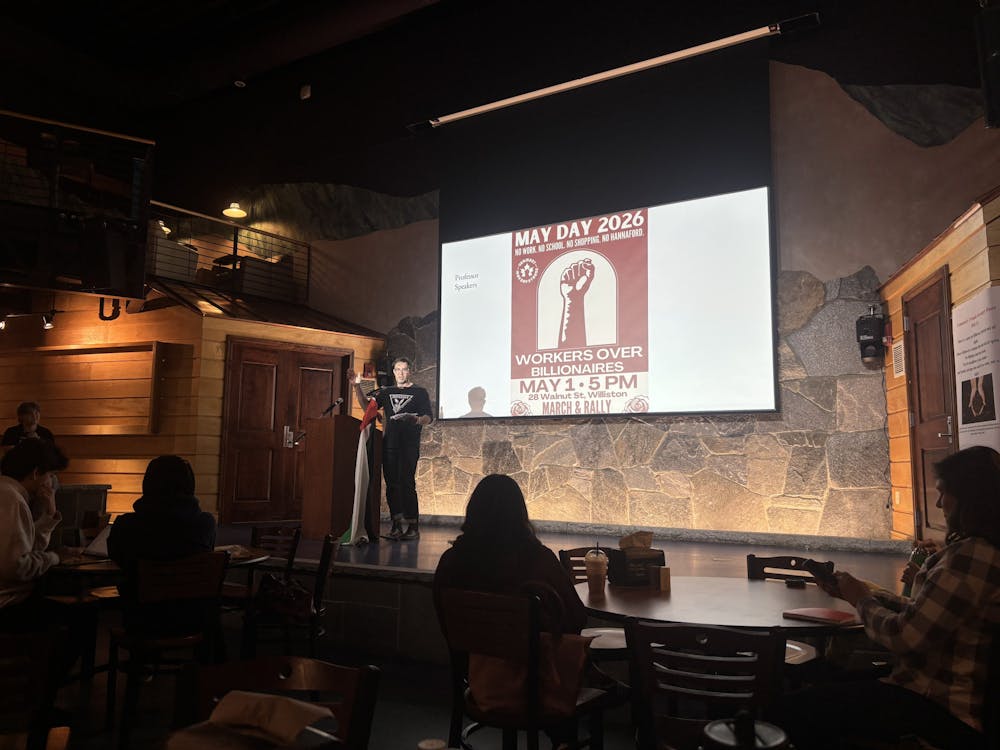
On May 1, the student organization Migrant Justice held a May Day Teach-In in the Grille, hosting a variety of student groups and faculty, staff and student speakers to discuss labor rights on campus and beyond. As various speakers took the stage, four student activist organisations simultaneously tabled in the back, offering resources and ways to get involved with their work.
May Day, also known as International Workers’ Day, commemorates martyred labor movement activists from the 1886 Haymarket Affair in Chicago. Although the holiday originated in the U.S., it is largely celebrated internationally, while the majority of Americans celebrate Labor Day instead, which falls on the first Monday of September.
With rising concerns surrounding the rights of migrant workers, fair treatment of staff and faculty and the stifling of labor mobilization nationwide, the teach-in addressed a wide range of labor issues. Representatives from Migrant Justice kicked off the teach-in by emphasizing the importance of solidarity with workers on campus who feel their labor is invisible.
“Students comply with the culture in which labor is completely hidden from us and seen as separate,” a Migrant Justice representative said. “We are made to forget that our learning environment is also a faculty and staff working environment.”
Associate Professor of Sociology Jamie McCallum followed, describing the long and complicated history of May Day and labor movements in the U.S., highlighting the early protests that led to the establishment of the eight-hour workday. As an academic, McCallum’s work centers labor and work issues across the world, and he went on to encourage students to get involved with the labor movement in any way they could.
“Solidarity is a verb. We don't have to think of something as being in solidarity or an act of solidarity. Solidarity is like practice. You learn how to do it, and it takes time and energy,” McCallum said.
Continuing to elaborate on the theme of solidarity in labor movements, Assistant Professor of Gender, Sexuality and Feminist Studies Cynthia Gao highlighted the “bread and roses” slogan, touted by female textile workers in the early 20th century as a way to push for labor improvements beyond simple wage or hours reforms.
“The slogan bread and roses reminds us that struggle itself produces new joys, new forms of beauty, through the building of bonds based on solidarity and collectivity, rather than competition,” Gao said.
She closed her speech by reciting the 1912 poem in its entirety, before student workers were invited to give their accounts of the working environment on campus. Of the three accounts, two were anonymous and read aloud by other students. Across all three accounts, students cited the invisibility they felt working in myriad positions, but especially in the dining halls, where their peers would ignore them if they saw them in uniform.
“This campus doesn't work on its own, and the people who make it work shouldn't feel invisible,” one student said.
Student workers encouraged their peers to acknowledge their labor by simply saying hello, treating staff, students or not, with respect.
“This small talk might be uncomfortable, but it's a mutual recognition of dignity and personhood, which is worth every second,” another student wrote.
Professor of Luso-Hispanic Studies Patricia Saldarriaga, who signed off on a 2020 open letter to the college regarding the issue of wage compression, elaborated on the origins of hatred, often felt by the “other,” or immigrants in the U.S.
“What we need to confront is not just prejudice, but the systems that teach us what to fear and who to fear,” Saldarriaga said. “If hate circulates, then it can be interrupted, and that interruption is a political responsibility.”
Associate Professor of Film and Media Culture David Miranda Hardy, who currently serves as president of the Middlebury chapter of the American Association of University Professors, then took the stage. Hardy was closely involved with last spring’s faculty and staff-led walkout, which protested Middlebury’s recent budget cuts. He described his experience growing up as a refugee from political unrest in Chile, and his subsequent involvement in protests upon his return, and applauded Middlebury students for putting together the teach-in.
“If we are to recover democracy in a way that is even better than before, in a way that is more responsive to the needs of the people, it's going to be through your work, through young people,” Hardy said. “I'm so excited to see young people working collaboratively, collectively, to make a better world.”
Representatives from various student organizations then stood together onstage and detailed their commitment to one another, despite the differences in their own specific missions. Sunday Night Environmental Group, Middlebury’s ACLU chapter, or Firewall, Students for Justice in Palestine, and Migrant Justice were all present.
“Although the content of our meetings differ, we are all united by a fight for justice and a need for coalitions. Our missions each connected a struggle for workers' rights, because none of us are free until all of us are free,” Firewall member Sanza Parzybok ’28.5 said.
Each student organization outlined their goals for the labour movement and overall activism on campus, including expanding the Milk with Dignity campaign, which advocates for more equitable conditions for dairy workers; the boycott of the artificial intelligence platform ChatGPT; and highlighting the struggles of Palestinian laborers. They concluded by encouraging attendees to stop by the tables in the back if they wanted to get involved.
The teach-in concluded with a few more student speakers, one of whom highlighted the recent unionization of employees at the nearby Porter Medical Center, who successfully attained a 20% wage increase as a result of their organization. The final two speakers encouraged Middlebury students to separate themselves from the “extractive relationship” the college can have with the world.
“We must align ourselves against the exploitation of the workers of Addison County, and against the imperial village that we benefit from in the heartland of the United States,” Renée Butler-Jancose ’26 said.
As Middlebury continues to grapple with staffing, budget cuts, and the escalation of immigration pushback, the presence of labor activism on campus may see significant changes over the next few years. Teach-in organizers encouraged students to join in with their work, emphasizing its value in the increasingly volatile labor rights landscape.
Kai Arrowood '29 (he/him) is a News Editor.
Kai previously served as a staff writer. He is a prospective English and Sociology joint major. Aside from The Campus, Kai is a copy editor for Middlebury Geographic and an avid participant in National Novel Writing Month.


