
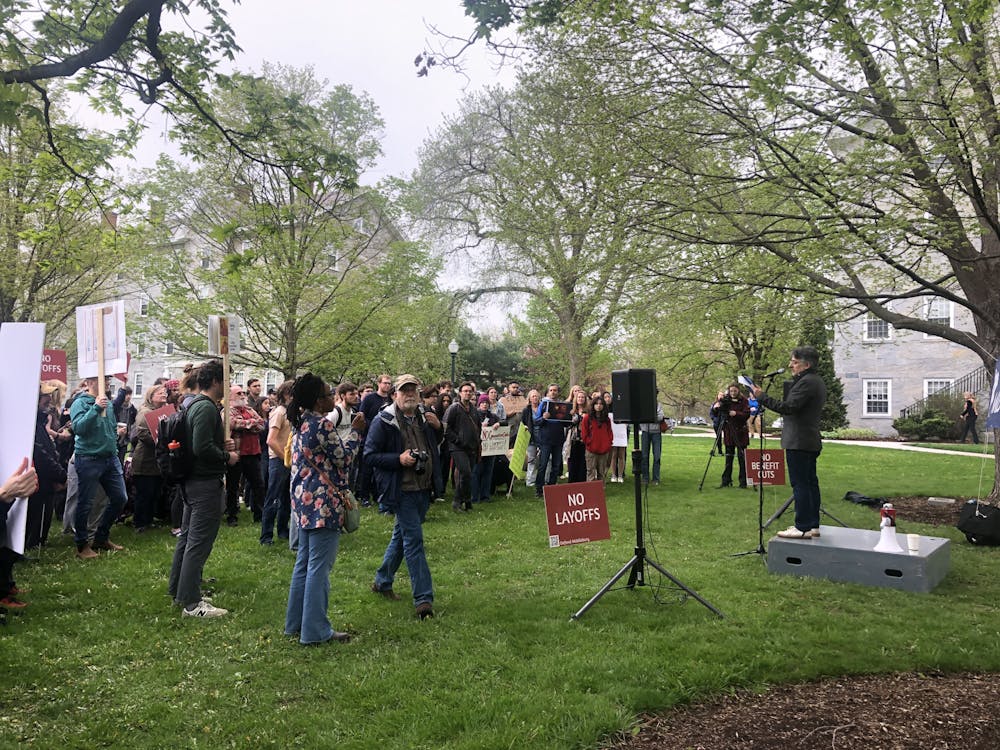
Over 300 Middlebury community members walked out of classes and their jobs on Thursday, May 8 to rally outside of Old Chapel in protest of recent budget cuts. About 10 faculty members, staff members and students addressed the crowd calling for reversal of changes to retirement benefits, in addition to dissociate from Monterey, staff unionization and community solidarity in the face of future changes.
The protest was organized by the self-titled “Econ 12” — referring to the dozen senior economics faculty that have been leading the charge against budget cuts through a petition and boycott of commencement — as well as members of Middlebury’s chapter of the American Association of University Professors (AAUP).
“Our working conditions are your learning experience,” said David Miranda-Hardy, associate professor of Film and Media Culture and president of AAUP. “That's why we're here today, to urge our trustees and administrators to change course.”
The walk out was purposefully scheduled to occur on the same day as the Board of Trustees’s spring meeting on campus. At the end of the event, one of the organizers delivered a petition with 800 signatories and the recently passed faculty motion to Provost Michelle McCaulley, one of the administrators who announced the budget cuts last month.
Crowd members held signs with messages such as “Defend Middlebury,” “Sell Monterey, Midd Profs Deserve Fair Pay” and “Labor + Students = Power.”
During the protest, Terry Simpkins, director of discovery & access services, pointed out that the college’s financial deficit is not caused by staff or faculty, but by the college administration.
“Decisions are made in secret and presented to staff as a fait accompli. No input from us is sought. No adjustments considered, no delays entertained,” Simpkins told the crowd. “The only way we can be guaranteed the next time a crisis comes to be part of the conversation and have an actual say in the solution is by forming a union.”
Miranda-Hardy told The Campus after the protest that he and the AAUP support the renewed drive to unionize among college staff. The most recent effort failed two years ago, he added, due to a lack of organization rather than a lack of commitment from the Middlebury community.
“I think we need to consider a new push for that because the problem is that there is a void now in representation of the workers for labor issues,” Miranda-Hardy explained.
Audiovisual Technical Director Ethan Murphy shared that as a long-term staff member at the college, he felt betrayed by the cuts to his retirement package and the college’s failure to incorporate staff into the decision-making process.
“We shouldn't be made to feel guilty about spending on long promised benefits or be made to believe that layoffs are the only alternative. I'm saying no to cuts. I'm saying no to layoffs,” Murphy added.
Assistant Professor of Gender, Sexuality, and Feminist Studies (GSFS) Cynthia Gao also spoke at the walk out, addressing protestors from her perspective as a first year faculty member at Middlebury. She shared her frustration with the college’s recent decision to cut junior faculty’s eligibility for college housing from eight years to four, placing the burden for finding a home in Vermont’s tight housing market on untenured professors.
“When new junior faculty raised it with the administration, we were told that we shouldn't worry about it because it won't affect us,” she said. “I don't believe in benefits for some, I believe in benefits for all.”
In an interview with The Campus after the event, she explained that the protest was not only about opposing recent budget cuts, but also about building collective power to respond to broader political and institutional challenges.
“I was told that this is actually the first public labor action on campus perhaps ever, or at least in recent memory,” Gao said. “ I'm really heartened that there is a sort of more collective push to fight both the cuts and also to meet the political moment.”
Faculty Council Chair Jason Mittell echoed the faculty motion against the college’s plan to increase their enrollment target from the historical 2,500 to 2,650. Until this announcement, Faculty Council had been told as recently as February that the college intended to return from over enrollment to its former numbers. Speaking directly to students, he encouraged them to speak out against this change impairing the small college experience they were promised.
“File some complaints. Tell them that you're not happy with their customer service. Tell them that this is not what you signed up for. Tell your friends who are still in high school this may not be what they want to sign up for,” Mittell added.
Students Freddi Mitchell ’25 and Josh Harkins ’25 spoke to the crowd about the value of their personal connections with faculty and staff at a small institution and the damage the budget cuts may cause to these relationships if they reduce morale.
“We hope the board and the administration will realize that these cuts do not strengthen our experience, but only detract from it,” Mitchell said.
Mentioning that $8.7 million of Middlebury’s deficit comes from the Middlebury Institute of International Studies at Monterey (MIIS), she criticized how its purchase was motivated by financial interests, not by the interests of students.
“As two students studying international politics and economics, we don't want to be pushed to a Masters program at Monterey just to save an institution that has been failing from the start,” Mitchell added.
After the protest, Harkins said he also objected to Monterey’s aggressive recruiting tactics on campus and wanted to show solidarity with faculty and staff on Thursday.
“I thought it was important to speak out because everything at Middlebury College is connected,” Harkins told The Campus. “And so it was important to speak out, to show that we as a community support each other.”
Professor of Economics Caitlin Myers, one of the “Econ 12” that organized the walk out, said that there has been discussion among faculty of continuing boycotts beyond this spring’s commencement to incoming college president Ian Baucom’s inauguration in November if their demands are not met.
“I think that I'm worried that the administration thought there’d be a fresh start with a new president and then we would be able to move on. But in my opinion, this is not something that’s just going to go away,” she said in an interview with The Campus.
Associate Professor of Writing and Rhetoric and GSFS Catharine Wright and Professor of Modern Languages and Literature Gloria González Zenteno told The Campus that they were encouraged to see collective action from all employees beginning to form.
“Faculty and staff have been trying to make their voices heard for a while,” Wright said. “Now, I think faculty and staff solidarity has been building over the last five years because we've recognized that we have a lot in common.”
Wright and Zenteno also pointed out that the budget cuts will further threaten Middlebury’s understaffed departments, job appeal to talented staff and faculty, and student experience.
“Many talented colleagues in my department left because they got a better offer from somewhere else,” Wright added. “I think Middlebury students had a particular acute loss.”
A college spokesperson acknowledged the protest in a statement to The Campus this afternoon.
“We value the perspectives of all of our faculty, staff, and students and are actively engaged in conversations with our constituents across Middlebury. We first communicated with our community about our structural deficit and related cost-saving measures in early April and have continued the conversations and provided updates since that time,” the spokesperson wrote.
Several administrators stood off to the side of the crowd, listening to the speakers criticize the Senior Leadership Group and Board of Trustees.
At the protest, students handed out red laminated cards with information about constitutional rights and guidance for community members if they are approached by immigration officers. The card advises them to keep classroom, office and dorm doors closed and to defer any immigration officers to the Office of General Counsel.
The creation of these cards was previously funded by a grant from the Center for Community Engagement (CCE), but one organizer said that last week, the Office of General Counsel retracted this funding, claiming that ICE has criminalized the distribution of this kind of guidance. Since then, students have taken a grassroots approach in laminating the cards without official school support.
“Other schools, students, faculty, and administration are handing out this information to their campus publicly,” a student passing out the cards told The Campus. “Middlebury College is taking an exceptionally conservative approach.”
A student who attended the protest and asked to remain anonymous told The Campus that they walked out of class to show solidarity in the light of what they called disrespectful cuts to professor and staff compensation.
“I think it’s disrespectful to staff and students alike, and I don’t think this is the right step for the new president to be getting off to,” the student wrote to The Campus. “Even if some cuts need to be made somewhere, breaking a promise made to employees and staff to do so is not the right way to do it.”
Editor’s Note: Professor of Film & Media Culture Jason Mittell is faculty advisor to The Campus. He played no role in the publication of this article.
Correction 5/9/25: This article has been updated to better reflect Faculty Council Chair Jason Mittell's role title. A previous version of this article called him the Faculty Council President, a role that does not exist.
Correction 5/10/25: This article has been updated to better reflect the student group distributing informative cards. A previous version of this article said that the cards were created through Migrant Justice at Middlebury. The students distributing the cards are affiliated with Migrant Justice Vermont but the distribution of the cards was not.

Ryan McElroy '25 (he/him) is the Editor in Chief.
Ryan has previously served as a Managing Editor, News Editor and Staff Writer. He is majoring in history with a minor in art history. Outside of The Campus, he is co-captain of Middlebury Mock Trial and previously worked as Head Advising Fellow for Matriculate and a research assistant in the History department. Last summer Ryan interned as a global risk analyst at a bank in Charlotte, North Carolina.
Madeleine Kaptein '25.5 (she/her) is the Editor in Chief.
Madeleine previously served as a managing editor, local editor, staff writer and copy editor. She is a Comparative Literature major with a focus on German and English literatures and was a culture journalism intern at Seven Days for the summer of 2025.
Hugo Zhang '28 (he/him) is a News Editor.
Hugo previously served as an Online Editor. He intends to major in Economics and Geography. He enjoys cartography, traveling, and history. Last summer, he studied at Sciences Po Paris and traveled across Europe. He has also conducted research on ethnic minority policies, economic transformation, and urban planning in Northeastern China, also known as Manchuria.


