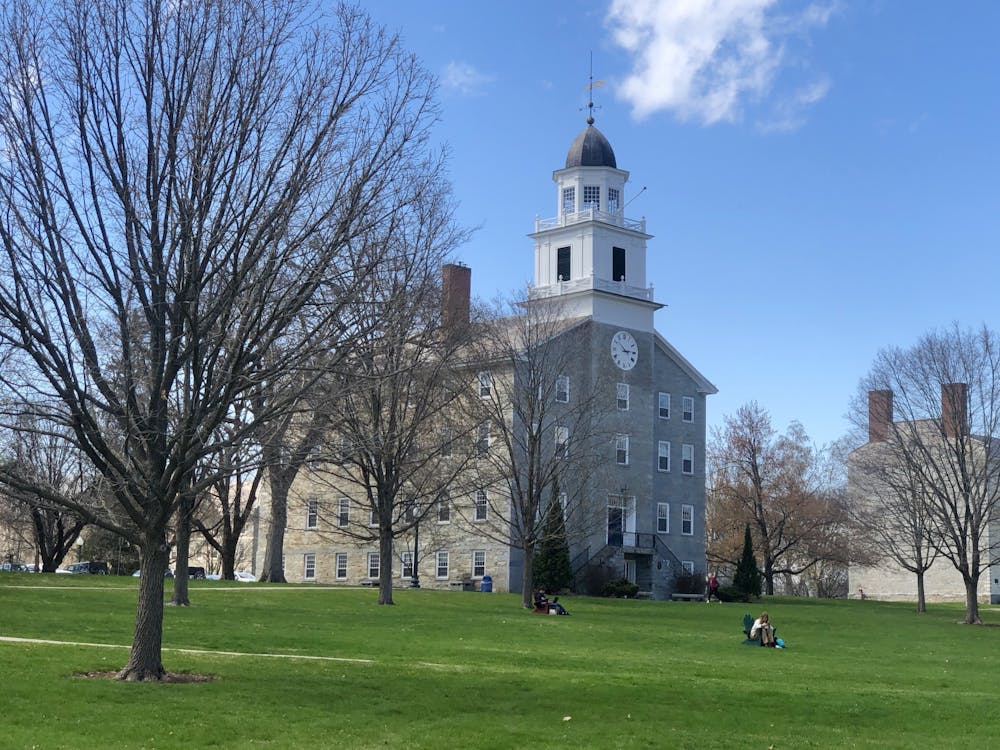
In a plenary faculty meeting on Friday, April 18, 94% of the nearly 200 faculty members in attendance voted to pass a motion demanding that the administration and Board of Trustees reverse the recently announced compensation cuts for employees and enrollment increase.
The motion calls on the administration to collaborate with elected faculty committees to address Middlebury’s $14.1 million deficit without unjustly impacting employees and students. It also directly urges incoming president Ian Baucom to state his position on the new financial measures. Of the 175 voting attendees, 164 voted in favor of the motion, eight voted against it and three abstained.
The motion — which was co-sponsored by the Faculty Council and Middlebury’s chapter of the American Association of University Professors (AAUP) — was in response to the email sent to community members on April 2 titled “The Budget, Our Way Forward.” In the announcement, Interim President Steve Snyder, Provost Michelle McCauley, and Executive Vice President of Finance and Administration David Provost stated that the college would reduce long-term faculty and staff’s 15% retirement match to 11%. Faculty members hired after 2017 already have a maximum 11% match rate.
The college also announced that undergraduate enrollment projections will grow to 2,600–2,650 without a parallel increase in faculty or staff positions, among other cost-saving measures. The motion argued that these changes will significantly reduce overall faculty compensation while adding to their workloads, further injuring already teetering morale, engagement and trust.
Separate from the motion, at least 12 faculty members from the Department of Economics pledged to boycott college-wide events last week, including Commencement, until the college reverses the measures.
Before voting, several faculty members stood up to air their grievances over the measures and express their support for the motion. Almost every person who spoke was met with an uproar of applause from their colleagues.
One faculty member pointed out that salaries have not been adequately adjusted in the past five years to account for inflation. In addition, they stated that the four percentage point reduction of the retirement match is equivalent to a salary demotion to a lower position — a shift from a full professorship to an associate professorship, for example.
“If the leadership makes these decisions and they cannot say, ‘It is not normal and acceptable to lose so much money in real compensation over a decade that you effectively get demoted for all your dedication and service, and that you’re no better off now than you were a decade ago,’ then we have to realize that none of our futures, not us 600 [faculty], not the rest of everyone else, none of our futures mean anything to college,” the faculty member said. “If we accept that, then there is no reason for them to do right by anyone else down the road.”
Among many criticisms was that no faculty were invited to the discussion about the new cuts. The announcement of these changes came as a complete surprise to faculty members, especially considering administrators have previously told faculty that their salaries are not the reason for the college’s deficit.
“Without faculty, there’s no college. You don’t have an accreditation without faculty, you cannot confer degrees. Without us, there is no Middlebury… And yet we continue to be overworked, asked to do more with less,” one faculty member said. “It is clear that faculty are viewed as an infinite resource from which more and more labor can be extracted.”
Multiple faculty members expressed disappointment that Snyder, Provost and McCauley were not present at the meeting to hear their prepared remarks despite having been invited. Faculty Council Chair Jason Mittell clarified that the administrators cited a prior commitment to account for their absence.
“I think it’s really important to support this motion so that we can at least get back to a negotiation approach where we can talk about what we think the core responsibilities are, so that we can have actual faculty governance, so that we can actually sus out what we think the least painful options are of a relatively unappetizing set of options,” one faculty member said.
Faculty members considered what this effort to find an alternative method to fix the budget deficit might look like, discussing open collaboration with Human Resources on how to reduce costs. Negotiations surrounding hiring freezes and cuts to employee health insurance plans were broached as options that some faculty could potentially support if included in the planning. But others took issue with the idea that professors should feel obligated to work to alleviate the deficit just to avoid their pay being cut.
“It’s not our job to plan our future cuts. That’s not our responsibility. In fact, I would say it would be irresponsible for us to take that role on,” a faculty member said. “And so I think we should be very cautious about proceeding in a way that we’re anticipating or expecting to cave.”
According to the motion, the Faculty Resources Committee has been discussing ways to help the college’s deteriorating financial situation with the administration in recent years, who have repeatedly assured Faculty Council that the college would aim to return to the low 2,500s as an enrollment target.
Minor disagreement arose over the enrollment aspect of the motion. Some faculty members think the college should allow an enrollment slightly above the historic norm of approximately 2,500 if it means saving money. Enrollment from this fall was 2,774, so aiming for 2,600–2,650 would be an overall decrease from the current number of students.
“While the last four years have been an absolute disaster, I’m less concerned about 100 more students on campus given the staffing levels we have,” a professor said. “I’m really, really concerned about the compensation half more than the increase in the students. I think one’s a much bigger problem than the other.”
However, others maintained that growing the norm for enrollment, even if the actual number of students on campus will be less than it is currently, is still a damaging breach of Middlebury’s original mission to remain a small, liberal arts college and places a strain on the student and employee experience.
“For me, the ultimate question is, why would we want to go above our historic norms, besides money?” Mittell asked.
One professor asked why the underperforming Middlebury Institute of International Studies at Monterey (MIIS) was not addressed in the motion, as one professor estimated it has cost the college $250 million since its acquisition. The April 2 email cited under enrollment at the Institute as the cause for $8.7 million of this year’s deficit. The representative from AAUP said that Monterey will be addressed at a later faculty meeting in May.
Economics faculty members spoke at the meeting about their boycott of commencement, encouraging their colleagues to join them while acknowledging the difficulty of the decision to do so.
“There's nothing we can do that will be visible that won't also have some damage, and I think that we’ve got to choose very carefully what we do, and I think this is a reasonable thing,” an Economics professor said.
They also shouted out their petition, which is open for any member of the Middlebury community — faculty, staff, students and alumni — to sign at go/savethebenefits/ to denounce the budget cuts. As of this Tuesday morning, over 500 people had already signed it, according to Professor of Economics Andrea Robbett.
Another Economics professor mentioned believing that the motion alone will not be enough to change the administration’s decision, but that a boycott will send a stronger message.
“You must ask yourself what you are prepared to do to hold the administration’s feet to the fire here,” the professor said.
The reduction in faculty compensation comes at a time when higher education faces considerable threats, as the Trump administration recently revoked federal funding from several top universities who failed to comply with lists of their demands. Faculty at the meeting cited worries about even deeper cuts in the future if the federal government implements a higher endowment tax and if fewer international students — who are a significant income source for universities — enroll at the college due to fears of sudden visa revocations.
The AAUP is set to meet with the incoming president in July and will begin preparations for that meeting this week. In this unique transitional period for the college, Middlebury faculty said they are prepared to raise their concerns with the new president head-on.
“I don't think I have ever felt so strongly that our love and our dedication towards our students is being exploited, that there is simply a belief that we will take anything and keep going because we put in those hours because we care about them,” a faculty member who has been at the college for 20 years said.
Editor’s Note: Faculty Council Chair Jason Mittell is the advisor for The Middlebury Campus. He had no role in the publication of this article.
Madeleine Kaptein '25.5 (she/her) is the Editor in Chief.
Madeleine previously served as a managing editor, local editor, staff writer and copy editor. She is a Comparative Literature major with a focus on German and English literatures and was a culture journalism intern at Seven Days for the summer of 2025.