
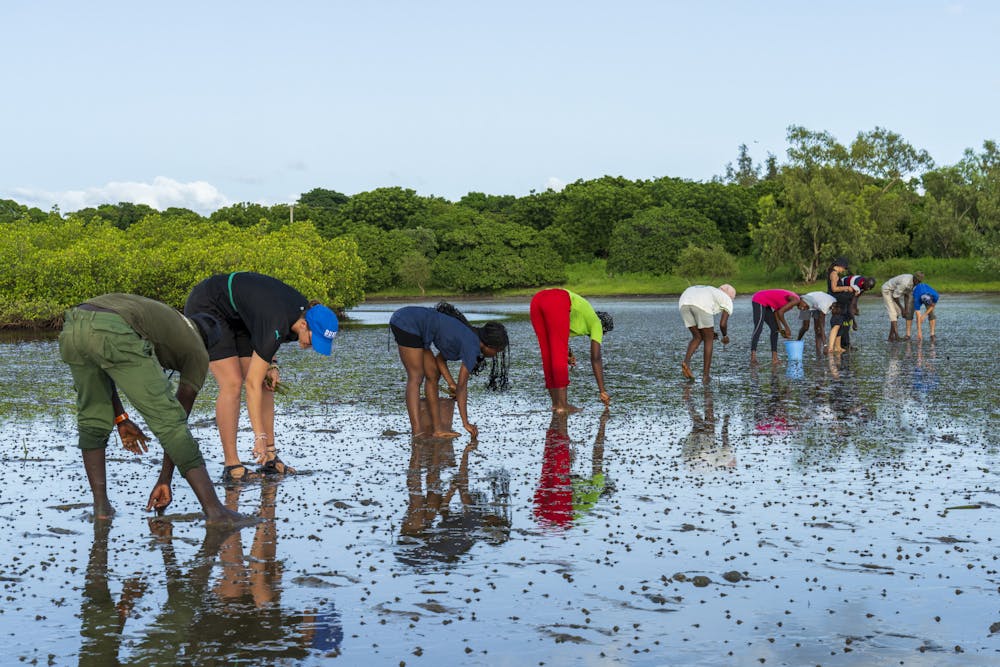
In an April 7 press release from the Peace Corps, Middlebury College was ranked No. 7 among small colleges nationwide on the agency’s 2026 list of top volunteer-producing institutions.
Since its founding in 1961, the Peace Corps has sent nearly 250,000 Americans abroad to work on locally driven projects in education, health, agriculture, environmental sustainability and youth development. In the past fiscal year, nine Middlebury graduates served in nine countries — Armenia, Colombia, the Dominican Republic, Kyrgyzstan, Mongolia, North Macedonia, the Philippines, Thailand and Togo. This year, several graduating seniors are expected to begin Peace Corps service.
Altogether, 549 Middlebury alumni have served as Peace Corps volunteers since the program’s founding.
The rankings are based on the number of alumni serving during a given fiscal year, according to Peace Corps Communications Specialist Kelsey McMahon. The 2026 list reflects service between Oct. 1, 2024 and Sept. 30, 2025, using data self-reported by volunteers across institutions of varying sizes.
Peace Corps volunteers typically serve for 27 months, living and working in communities abroad, collaborating directly with local partners. The program is often described by the agency as “the toughest job you’ll ever love,” a phrase echoed by both current and prospective volunteers.
For many Middlebury students, the decision to apply to the Peace Corps is both personal and academic — but increasingly, it is also shaped by a difficult job market for recent graduates.
Recent reports show that the entry-level job market is among the weakest in decades, with fewer opportunities for young workers and rising barriers to entry. At the same time, entry-level roles are shrinking or requiring years of prior experience.
Programs like the Peace Corps offer another pathway. According to McMahon, the experience is designed to build both practical and interpersonal skills that extend beyond the duration of service.
“Students see the Peace Corps as a powerful opportunity to put their education into practice while continuing to grow both personally and professionally,” McMahon wrote in a message to the Campus. “For some, service becomes a valuable bridge: it strengthens graduate school applications, clarifies career goals, and provides real-world experience with global issues.”
Clay Rosser ’26, who was accepted into the Peace Corps in Cambodia as an educator, said that while the current job market played some role in his thinking, his decision ultimately centered on what he would gain from the experience itself.
“I mean, yeah, the job market isn’t great right now,” Rosser said in an interview with the Campus. “But for me, it was more about doing something meaningful and challenging — something where I could grow and actually take a lot away from the experience. You’re not saving the world, but you are directly helping people’s lives, and I think that’s something valuable to do right after college.”
For many students, language learning plays a central role in shaping their interest in the Peace Corps, offering a pathway to deeper cultural understanding.
Both of Zane Barnwell ’26’s parents served as Peace Corps volunteers — his father in Sierra Leone and his mother in Jordan — shaping his early understanding of international service. Barnwell, who was accepted into the Peace Corps’ Morocco youth development program, said his interest in service abroad deepened at Middlebury, where studying Arabic led him to see language as a gateway to cultural understanding.
“I think that it was hard at first to study Arabic and feel so removed from the culture in this formalized setting, but then I met these amazing professors who had had these experiences abroad,” Barnwell said in an interview with the Campus. “I realized I could have this opportunity to not only apply Arabic but to engage with a community that was supportive and teach me new ways to live.”
Although Barnwell will pursue a Fulbright Program fellowship after graduation, he said he was drawn to the Peace Corps for its emphasis on community-based work.
“I want to work with kids and be an educator, but also just a good person,” Barnwell said. “Peace Corps is one of those opportunities that is really challenging, but also one of the best ways to do meaningful work and make an impact in a community.”
Ashley Aparicio ’26’s interest in the Peace Corps developed gradually over the course of her time at Middlebury.
“Peace Corps was never really something that I thought about until my sophomore year,” Aparicio wrote in a message to the Campus. “But I knew that after graduating I wanted to spend some time abroad working or traveling before settling in the States.”
After researching the program, Aparicio found that its long-term benefits stood out.
“I found that the Peace Corps provided a strong network of alumni and assisted volunteers in pursuing higher education, which pushed me even further into applying,” Aparicio wrote. “I decided to commit because I want to take some time for myself to figure out what I would like to do when I decide to apply for jobs. Also, being placed in a foreign country is definitely going to help me expand my view about life.”
Aparicio will begin her service in Indonesia in Sept. 2026, where she will work in the education sector as an English teacher for grades 7–12, helping develop curriculum and support local classrooms.
For some students, however, the decision to pursue the Peace Corps comes with an awareness of its limitations. Rosser pointed to structural constraints of the program, noting that its relatively short service period can limit its long-term impact.
“If you want lasting change, you need people who are there for much longer than two years,” he said. “That’s definitely a limitation of the Peace Corps — but it’s better than nothing, and I still think it does a lot.”
In a time of economic uncertainty and a difficult job market, the appeal of the Peace Corps lies not in its ability to solve global challenges, but in the opportunity it offers to engage with them directly. Programs like the Peace Corps provide a different kind of starting point, one defined less by immediate outcomes and rather by a willingness to step into the unknown.

Mandy Berghela '26 (she/her) is Editor-in-Chief
Mandy has previously served as the Managing Editor, Senior Local Editor, a Local Section Editor and Staff Writer. She is majoring in Political Science with a minor in History. She currently is Co-President for the Southeast Asian Society and an intern with the Conflict Transformation Collaborative. Last summer, Mandy interned with U.S. Senator Kirsten Gillibrand and participated in the Bloomberg Journalism Diversity Program.


