
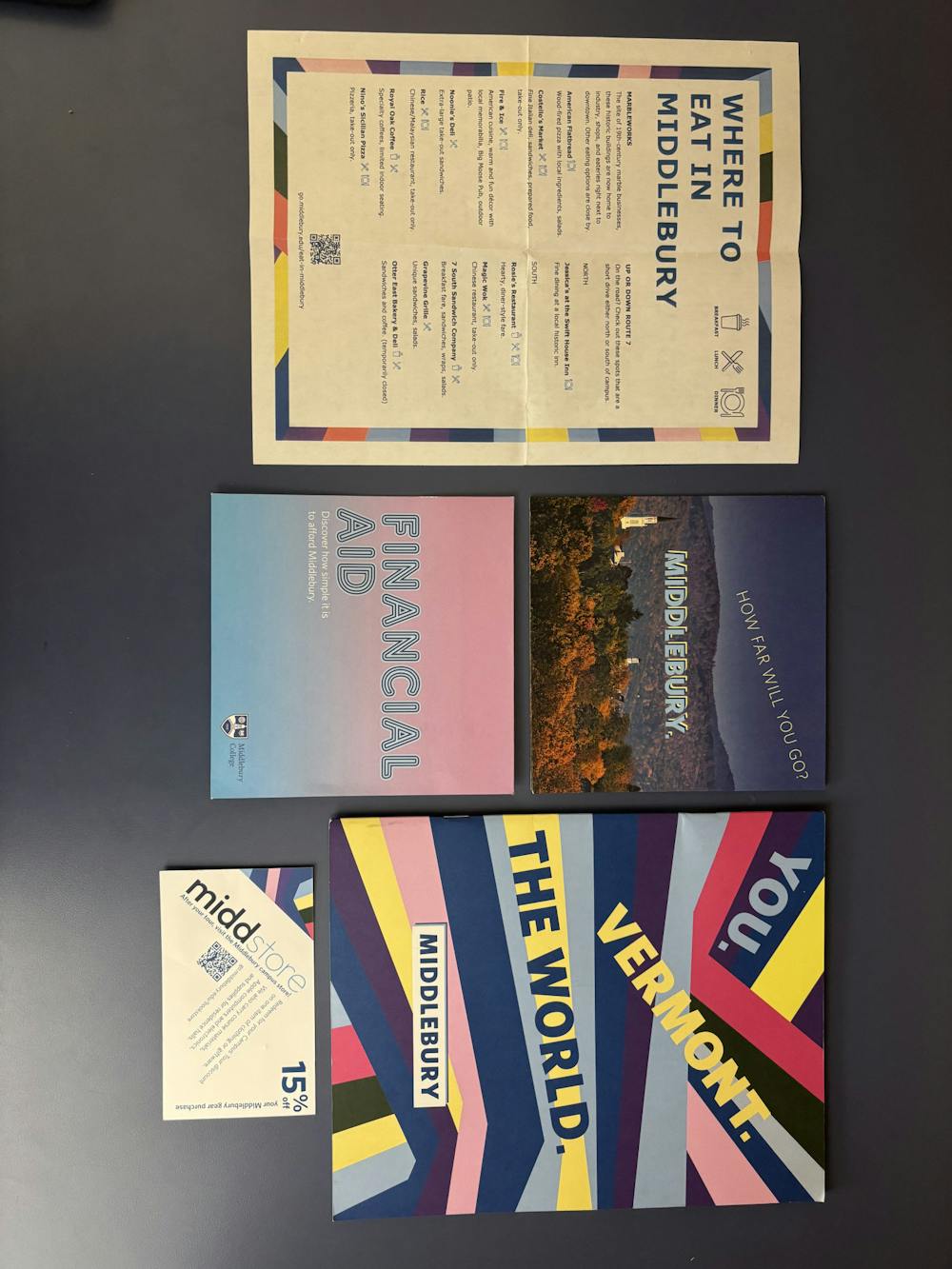
For the 11,458 students who applied to become members of the class of 2030 and 2030.5, a range of new visuals, written materials and communication styles met them, whether they visited the college in person or only interacted with Middlebury online.
Replacing a set of advertising materials that had been in circulation for nearly five years, the new visuals focus less on Vermont imagery and make greater use of student testimonials, academic offerings, and college life, and are a collaborative effort between the Office of Admissions and the Office of Communications and Marketing.
“So much of Middlebury's previous marketing material was very focused on, like look at how beautiful this place is, look at these pretty buildings, and that's great. Certainly, this is a beautiful place, but we didn't think it was necessarily doing anything beyond just showing off pretty buildings,” said Shannon Palmer, associate director of admissions, in an interview with The Campus. "We wanted it to feel a little bit less like something that you might pick up at a B&B [an Airbnb].”
The central focus of the new admissions material uses a color palette inspired by some of the shades of photos taken around the college campus.
“One of the light blues was taken from a sky shot, I think one of the pink values was taken from a sunset shot. And so we wanted to have the colors feel reflective of this place too, but also be fun and bold and graphic,” Palmer added.
Visitors to Middlebury College’s admissions office at Emma Willard House are presented with an updated large viewbook, titled “You. Vermont. The World,” which includes the new color palette.
However, this is not limited to students who physically visit Vermont. Counsellors travel with updated advertising materials, including a more compact, square viewbook.
“When we are traveling, we'll take information along with us, including that big view book … and then the square travel piece, which was born out of a need for having something lightweight for travel, because we are traveling significant distances,” Palmer said. “If you're traveling internationally, you want to have something lightweight. So the travel piece is designed to be easy to carry and have a lot of information kind of packed into that.”
A large part of this refreshed communications push centers on the visitor experience at Emma Willard.
Wall graphics, which previously featured artwork and photographs of Vermont landscapes, are being gradually replaced with practical information to help students learn more about the college, including student demographics and details about Vermont's seasons.
One graphic, focusing on locally sourced ingredients at Middlebury Dining, informs visitors about the 5,283 gallons of Vermont milk consumed on campus each year, along with statistics on local ice cream, eggs, beef, apple cider, cheese, apples and creemees.
Additionally, the office contains new fact sheets covering undergraduate research opportunities, Febs, academic culture, pre-health and pre-law advising, and engineering programs at Dartmouth and Columbia.
“We want people to feel like the visit experience is not only just like walking around and looking at a nice campus, but also that they're really getting information out of it and drawing attention to the things that, you know, you can't squeeze into a single tour in your half-hour information session,” Palmer added.
The new multi-color communications style is seen in a variety of places across the Admissions office, including college-store discount coupons, “Where to Eat?” handouts, and even directional signs.
“The positive feedback we’ve received from near and far suggests that it’s resonating with students and their families, especially the color palette, which was inspired by a Vermont sunset, just one of the many unique characteristics of this very special place that the work is designed to evoke,” said Avery Waxman, associate vice president for marketing.
For students who cannot visit Vermont before applying to Middlebury, these new marketing materials are available online and are being rolled out across social media channels.
For the college, high-school visits are limited by geographical ability, cost factors, and the knowledge a particular group of students may already have about Middlebury.
“I think for myself and for a lot of the other counselors, we try to balance going to places where we know that we'll have a lot of students who are interested in Middlebury and there's strong interest already with kind of what I would consider travel that is exposing Middlebury to a new audience or to a region or to a section of a city, for example, that might not know about us as much. So each of us plans our travel, hoping at its core to understand the region that we work with,” Palmer said.
While the college does work with print communications, it produces significantly less paper than many peer institutions, relying heavily on email communications.
"Our yield emails, for example, are much more focused on things that students probably care about as they're figuring out their college decisions, right? What is the return on investment going to look like in terms of internship opportunities? We have a separate parent flow that answers questions about what it looks like to join, to have your student come in and be in housing,” Palmer added.
The acceptance rate for the classes of 2030 and 2030.5 was 17%, a marked increase from the 13.9% for the classes of 2029 and 2029.5. This comes at a time when high school students are applying to more colleges and universities than ever before, thereby decreasing yield rates for colleges across the country.
"We're now seeing students applying to Middlebury who are applying to a much broader range of schools. It's not just the traditional, you know, everybody is applying to Middlebury, is applying to other NESCACs kind of vibe,” Palmer noted. “We'll have students turn us down for a huge range of other schools, and some of those schools have really significant marketing kind of machines built into them that Middlebury, as a smaller institution, doesn't necessarily have.”
The new multicoloured marketing template is being rolled out across yield events, as the college is currently seeking to secure enrollment deposits from its admitted students.
“This refreshed 'identity' is being brought to life across all of the digital and traditional channels we typically use to engage prospective applicants —- including within Emma Willard itself —- and has also been applied to the communications received by admitted students for the classes of ’30 and '30.5,” Waxman added.
In this past admissions cycle, admitted students received postcards from current students and “love letters,” in which regional admissions counselors provided personal information to students.
However, as the applicant pool for Middlebury College continues to shrink, a new communications and marketing campaign is helping the college reach areas where it has traditionally seen fewer applications, in the face of an impending demographic cliff affecting the states from which the college has yielded the most students in the past.
“Middlebury has historically drawn from areas that are being heavily impacted by that demographic cliff. So that doesn't help. Middlebury is located in a state that is aging,” Palmer said. "However, we have a very strong endowment, we have awesome students, we are a selective institution that will always make our class. We have many thousands more students applying to Middlebury than we can ever have space for.”
Nevertheless, the college has continued to successfully fill each of its admitted classes, and is now equipped with a new set of marketing material, as admissions counselors begin recruiting the class of 2031 and 2031.5.
"As we look ahead to the next application cycle, we will continue to lean into this refreshed look and feel that we believe truly distinguishes Middlebury, Vermont and our place in the world,” Waxman said.
Yuvraj Shah '26 (he/him) is a Managing Editor.
He has previously served as the Senior Opinions Editor. He is a joint major in History and English Literature. He was awarded a $5000 Mellon Humanities For All Times Grant through the Axinn Center for the Humanities and is conducting research about the citizenship rights of the British Kenyan Asian diaspora. He studied abroad at Keble College, University of Oxford. He is a Senior Fellow at Middlebury College Admissions, a Residential Advisor, and Arts Events House Manager. He is a member of Middlebury College’s new 10-year plan development committee. He has previously interned with the New England Review and the Middlebury Magazine. He is an international student from Nairobi, Kenya, and London, UK. He is a UWC Davis Scholar.


