
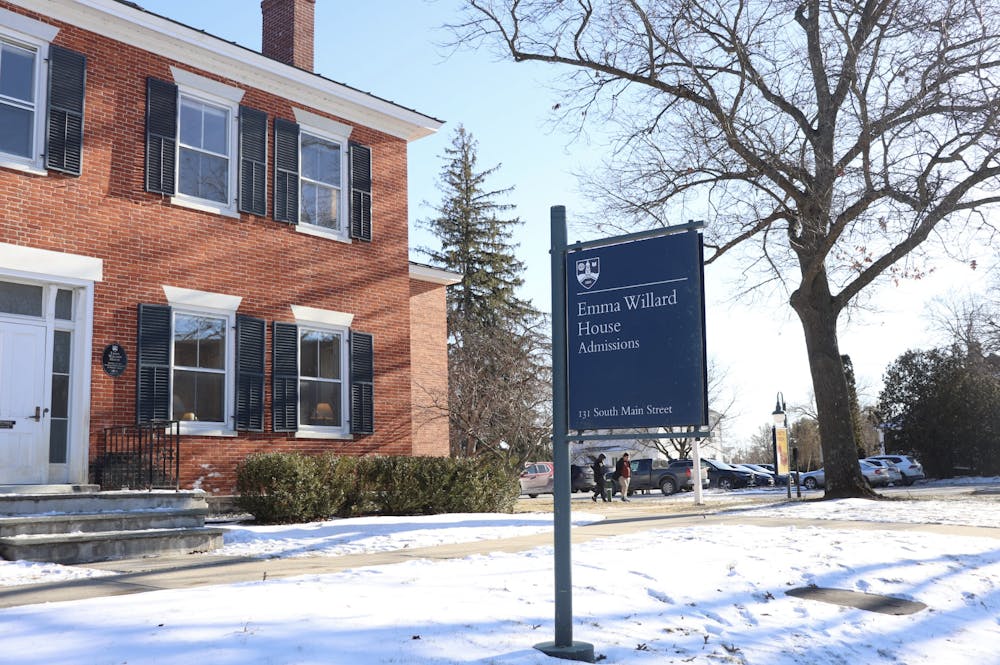
The college announced on May 1 that it had received 11,831 applications for the class of 2029 and 2029.5, a six percent drop from last year’s 12,540. Meanwhile, the overall acceptance rate increased to 13.9% from last year’s 12%.
In the Regular Decision round this spring, the college admitted 1,136 students, adding onto the 519 students who were accepted through binding programs including Early Decision I and II, QuestBridge, The Posse Foundation and College Track. This marked a record large admitted class of 1,655 admitted students, compared with last year’s 1,500. The number of students who were admitted from the binding programs maintained a similar record as the classes of 2027 and 2027.5.
The college expects to welcome 640 new students this September and 115 Febs in early 2026. These figures are higher than Middlebury’s normal enrollment pattern of 600 additions in September, followed by 100 Febs. By increasing the size of incoming first year classes, the college has said it hopes to generate revenue to escape its $14.1 million deficit through increasing total student enrollment to around 2,600-2,650.
“The Admissions Committee reviewed every submitted application from a highly qualified group of students who have demonstrated their rigorous academic preparation, personal fortitude, and deep curiosity for ideas,” wrote Dean of Admissions Nicole Curvin in the announcement. “They are ready to join Middlebury’s dynamic global community.”
Despite the decline of the overall figures, the college received a record high number of international student applications. Admitted applicants represent 73 countries — 22 countries more than last year — and speak 95 languages, coming from 1,112 high schools around the world.
“I think the increase in international applicants shows that Middlebury is gaining recognition globally, likely because the school treats international students fairly well,” Ivy Tan ’28 said in an interview with The Campus. “You can actually tell that, compared to many other liberal arts colleges, Middlebury does have a relatively diverse student body.”
Domestically, 49 states as well as the District of Columbia and Puerto Rico are represented by the admitted class, marking seven more states represented compared with last year. Eighteen percent of admitted students were first-generation, a two percentage point rise from last year.
This year, the college awarded $19.7 million of financial aid to the incoming class.
“Middlebury meets the full demonstrated need of all admitted students and is committed to providing access through a variety of resources to academic, social and pre-professional opportunities,” the announcement read.
Middlebury is a test-optional school, meaning the college does not require applicants to submit their standardized test scores. This is the college’s fifth year being test-optional, which many students take advantage of — 44% of admitted students this year did not submit their scores. Two years ago this testing policy was extended to next year’s admits, the class of 2030.
Middlebury’s admissions team has organized several events to recruit new students, including Preview Days in April and other live virtual information sessions.
“Throughout the month of April, Middlebury Admissions welcomed hundreds of admitted students and their families for Preview Days programming including class and dining hall visits, tours, and special programming that highlighted distinctive campus experiences. Admitted students met with faculty, staff and students to experience all that Middlebury offers,” the college’s announcement shared. “There were also virtual events providing a flexible way for admitted students to connect with each other and to the rest of the Middlebury community.”
Despite an increased acceptance rate and a decline in applications — particularly domestic ones — Curvin emphasized the strength of Middlebury’s applicant pool and the college’s continued appeal to high school students.
“Our application count today remains well above the number we typically received pre-2019 [which was below 10,000]. Since 2015, we have received 33% more total applications,” Curvin wrote. “Like many institutions, we saw record application increases during the COVID years bolstered by our new test optional pilot program.”
She noted several factors that influence application numbers, including the decline in domestic high school graduates and increasing competition among peer elite liberal arts institutions. Middlebury, she added, continues to monitor its applicant pool closely to determine the appropriate acceptance rate.
“Colleges consider their admit rate each year based on the application volume, market shifts/student behavior and external factors,” Curvin wrote. “This year we were closely watching the impact of federal policies related to higher education.”
Some students expressed concern over this year’s increased acceptance level and decline in applicants.
“For the domestic applications dropping, I think a bigger thing would have to [be standing] by like the political views and how people are perceiving Middlebury as a whole,” Carlos Alvarado ’28 said.
He also thought that Middlebury’s recent drop in ranking from 11 to 19 in the U.S News & World Report national liberal arts colleges ranking could have contributed to this decrease in applications, as it is a factor influencing high school students’ college choice.
“That was such a big drop. We were from 11 to 19, and I feel like that plays a big role because it's like when you're in high school, you're excited to apply to colleges, especially top colleges,” Alvarado said. “And then you look at the ranking and like, ‘Oh, I don't see myself going to a number 19 school.’ I feel like that takes a bigger effect into how student life is portrayed here and how our academics are also kind of reflected on.”
More detailed admissions data for the incoming class of 2029 and 2029.5 such as racial breakdowns and median test scores will be compiled in the fall.
Hugo Zhang '28 (he/him) is a News Editor.
Hugo previously served as an Online Editor. He intends to major in Economics and Geography. He enjoys cartography, traveling, and history. Last summer, he studied at Sciences Po Paris and traveled across Europe. He has also conducted research on ethnic minority policies, economic transformation, and urban planning in Northeastern China, also known as Manchuria.


