
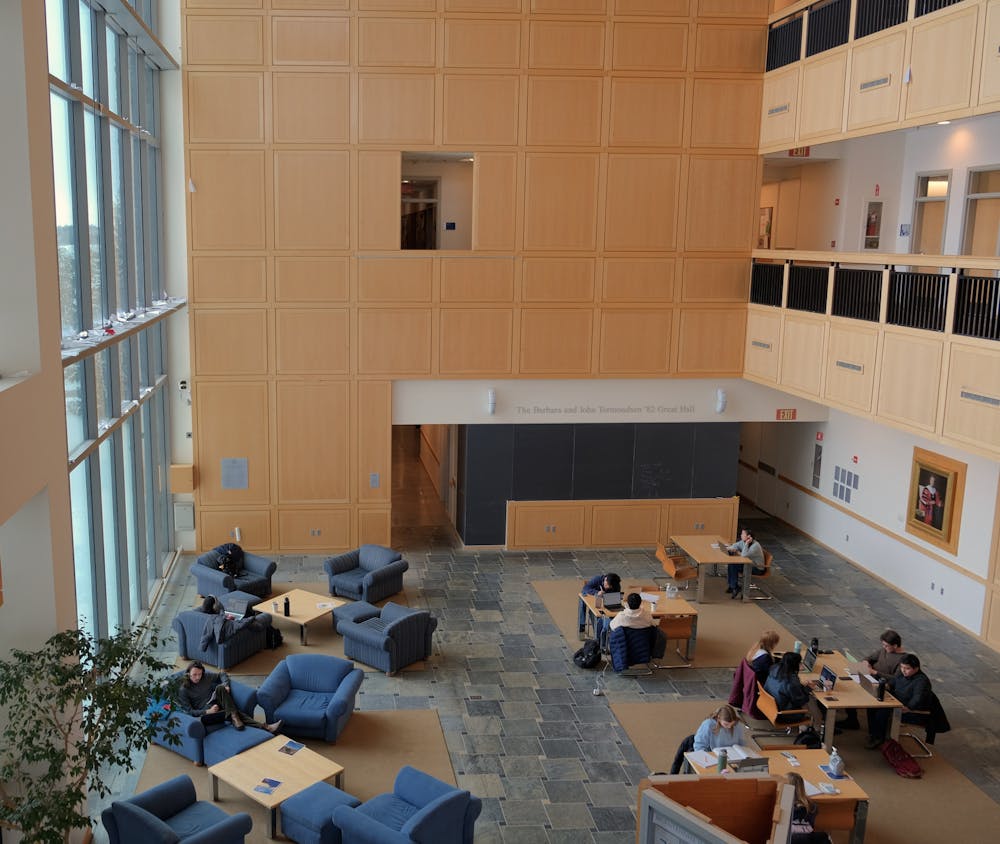
In Jan. 2025, the Armstrong Science Library in BiHall closed to make way for the development of the new Quantitative Center, or “Q-Center.” Though the design of the space was finalized only this semester, the Q-Center has quickly become a popular place for faculty and students to gather and collaborate.
The Q-Center is an extension of the Center for Teaching, Learning and Research (CTLR) and was created to expand access to academic support in quantitative disciplines while encouraging students to seek help. The space offers a variety of resources for students and faculty, including large tables and whiteboards for group problem-solving, private rooms for quizzes and exams, a computer lab and plotter printer, and drop-in tutoring sessions for STEM courses. Faculty members may also hold office hours or teach classes in the Q-Center.
Despite its focus on STEM subjects and its location in BiHall, the Q-Center is designed to serve a broad range of students across campus. The center also hosts drop-in sessions for Oratory Now and the Center for Careers and Internships (CCI). While the upper level is primarily intended for collaborative work with tutors and instructors, the lower level remains a quiet study space, similar to the former Armstrong library, with study nooks suited for focused work.
Students say the space has quickly become a regular part of their study routines. According to Lucy Chivers ’29, the Q-Center has been one of her most frequently used study spaces over the past year.
“The Q-Center in BiHall is likely one of my most used spaces,” Chivers said “Over the past 2 semesters, I’ve studied, printed papers, and received Calculus tutoring at the Q-Center. The center has some incredibly comfortable chairs and tables to work at, and they’re typically open and quiet.”
The Q-Center hosts a majority of TA hours for STEM subjects. Mishal Lalani ’26, who is a teaching assistant (TA) for Molecular Genetics, said the center is better for both students and TA’s compared to its previous use as a library. “The Q-Center is nice because all TA sessions are centralized, making things more organized. Students can hop between other TA hours because we are all in the same room, rather than going to different rooms or sometimes different buildings, which we couldn't do when the space was a library,” Lalani said in a message to The Campus. “It’s also nice that we have these large whiteboards to teach students on.”
Faculty members have also found the space useful, particularly as an alternative setting for office hours. Tim Juvshik, assistant professor of philosophy, teaches Introduction to Modern Logic and regularly holds office hours in the Q-Center.
“It’s easier to have the big table with a whiteboard where we can all sit around and work on a problem together, rather than having individual students come talk to me about the problem set one after another,” Juvshik said.
Jill Strube, center coordinator for the CTLR who recently relocated from Davis Family Library to the Q-Center, believes the space encourages collaboration among students and faculty. Speaking about the shift away from traditional office hours, she said the environment allows for more informal and interactive learning.
“It’s just such a better vehicle for learning for everybody. It really adds to the student experience,” Strube said. “I think it’s less formal than office hours used to be. That’s part of coming to Middlebury — getting to work closely with people.”
At its core, the Q-Center emphasizes collaboration and community in the learning process. Unlike Davis Family Library, which is known for its quiet atmosphere, the Q-Center’s layout encourages students to talk through problems and work together. According to Strube, the space is often “a hive of activity,” with students working through physics problems, getting help with calculus homework and studying together.
The center has also become a gathering space for students meeting professors or classmates before and after class. For Juvshik, whose classes take place in Twilight Hall, the location has created a new sense of connection within BiHall.
“For me personally, it’s a nice space that’s an alternative to being kind of isolated in this building,” Juvshik said.
With the entrance located on the second floor in the Great Hall, the Q-Center is quickly becoming an integral part of BiHall. Located right outside the doors of the Q-Center is the So-Full Sisters coffee cart, which has complemented activity in the Q-Center and helped develop a cozy, warm, and bright study atmosphere.
“Students will come — and not necessarily STEM students —will come and grab a coffee and go, ‘Oh this is a really cool place. Can we study here?’” Strube said. The Q-Center’s central location invites students in to take advantage of all their available resources, and the center has also provided employment opportunities for students who work at the front desk.
Though these changes are still early in development, the Q-Center has already proven to be an invaluable resource for students and faculty, supporting an engaged and community-centered learning process and encouraging students to seek help when needed.
“The staff there is really really helpful… It’s great. It is a useful, like one stop shop,” Juvshik said.
Feedback from students and faculty has been overwhelmingly positive, and the staff at the Q-Center are tuned in to the community's needs to continue improving.
“I think we learned a lot during the fall semester. And therefore we could make some really positive changes for the spring semester…We’re asking for student input, we’re asking for faculty input, you know, is it working? What’s working? What’s not working? So we want to constantly get better,” Strube said.
Editor’s Note: Managing Editor Yuvraj Shah ’26 contributed reporting to this article.


