
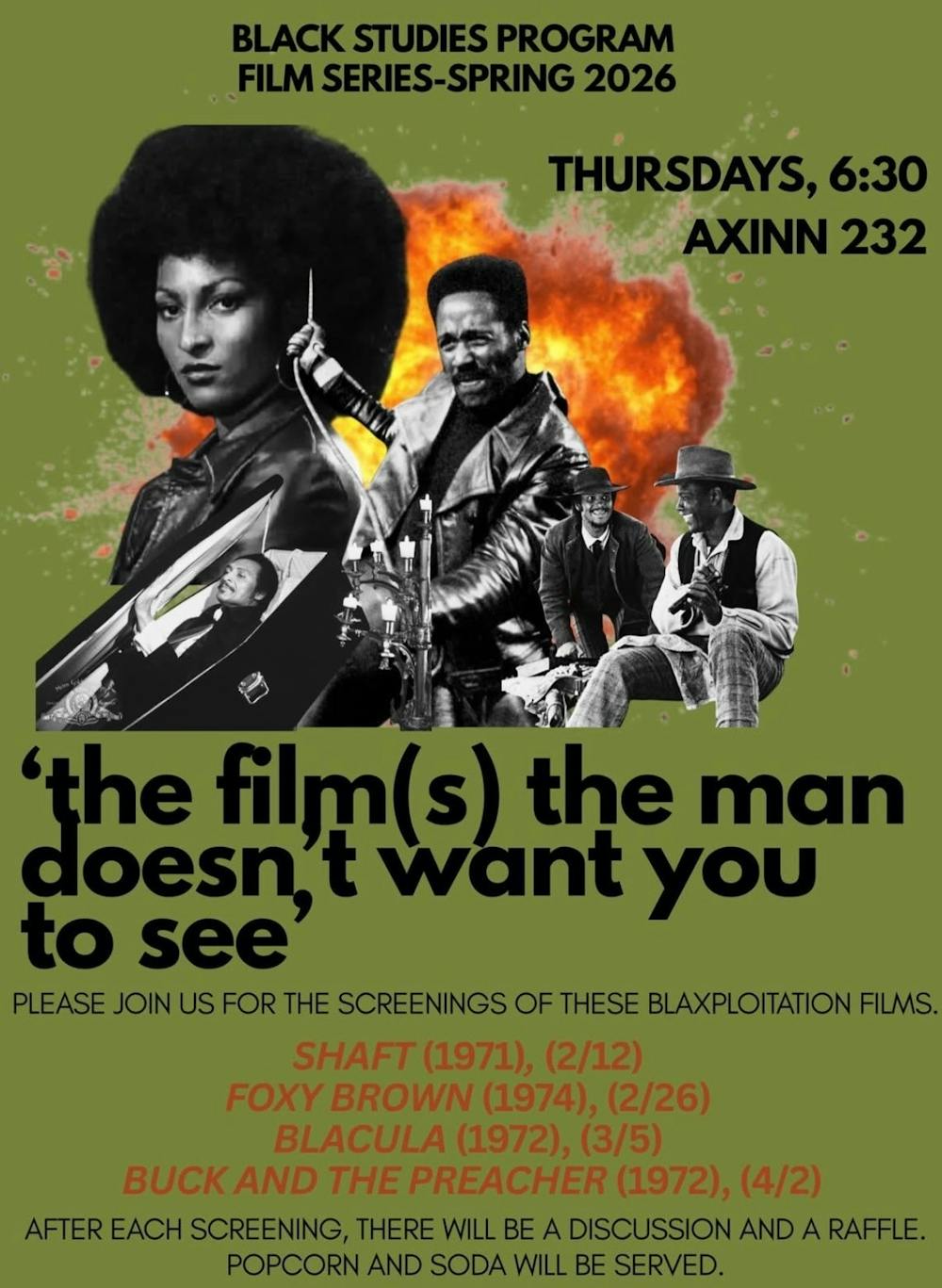
“The film(s) the man doesn’t want you to see” is printed boldly across the poster, cueing a familiar logic in Black film history: exposure does not guarantee legitimacy. It gestures toward the 1970s film landscape, a decade often canonised through the rise of New Hollywood auteurs, even as a parallel film economy flourished in drive-ins and grindhouse theatres. Within that space, Blaxploitation emerged on Hollywood’s periphery, placing Black protagonists at the centre of narratives about resistance to a corrupt white establishment, often condensed into the figure of “the man.”
Blaxploitation films circulated widely and remained critically marginal. With nearly 300 Blaxploitation titles released, little of that popularity translated into critical legitimacy.
In response to this, Middlebury’s Black Film Series has positioned itself as a site of recontextualisation. The series revisits films shaped by long-standing patterns of dismissal and restores them to public view within an institutional setting that once excluded them. This year’s screening of “Foxy Brown” on Feb. 26, carried those dynamics into the present, foregrounding forms of Black expression long marked as excessive or disposable and examining the conditions under which they have endured.
Film scholar Ed Guerrero, author of “Framing Blackness: The African American Image in Film”, noted that Blaxploitation’s commercial success and genre excess were used by mainstream critics and studios at the height of the genre’s popularity to delegitimise the films aesthetically, thus framing ‘popularity’ as vulgarity and market appeal as evidence of cultural irresponsibility.
Curated by Associate Professor and Director of the Black Studies Program Jerry Philogene, the series draws on her work in diasporic visual culture to attend to images that move unevenly through history and institutions. The screening was further supported by Professor of Luso-Hispanic Studies Enrique Garcia, who secured a copy of the film, and contextualised in conversation with Assistant Professor of Film & Media Culture Natasha Ngaiza, whose expertise in film and media studies situated “Foxy Brown” within a broader cinematic moment shaped by the political economy. Framed in this way, the event presented the film as part of a sustained Black cinematic tradition whose marginalisation has been institutional and thus renders its screening at Middlebury as an intervention into both American film history and the campus’s ongoing negotiation of Black cultural presence.
“I think it’s a great thing to have these films hold space at a PWI [predominantly white institution], especially one as small as Middlebury. A lot of people here don’t really interact with Black media beyond contemporary stuff that’s catered to them. I don’t think most people are going out of their way to watch films like “Foxy Brown” or “Shaft.” So having these movies hold space, and having discussions afterward about what they’re doing and how Black people are represented, is really important,” Che DeFreitas ’27, Black Studies major and former BSU president’ ‘24-25 and viewer said.
Released in 1974 and directed by Jack Hill, “Foxy Brown” arrived at the height of the Blaxploitation cycle.
The film follows Foxy, a woman driven by revenge after her boyfriend, a federal agent, is murdered for attempting to expose a criminal network involved in drugs and human trafficking. Its visual language draws heavily on the conventions of the genre: stylised violence, heightened choreography, and overarching sexual tones. Foxy occupies the centre of the narrative, moving through spaces structured to consume her image while actively working to dismantle the systems that organise them. The visual framework through which Black female sexuality has been interpreted in Western culture predates cinema itself. In the early nineteenth century, Sarah Baartman was publicly displayed and scrutinised as a spectacle — her body used to define Black sexuality as deviant and positioned in direct opposition to white ideals of femininity and purity. These logics carried forward into American film history, where Black women were repeatedly confined to a narrow set of archetypes.
“Foxy Brown” enters this representational history and works through its inherited limits. Foxy’s sexuality remains highly visible and narratively productive, thus enabling movement, access, and even control within the film’s world. The film simultaneously holds agency and exploitation within the same visual field by sustaining its tension and leaving unresolved conditions.
“I think the point of these films, especially for the time they came in, was really to showcase black people in these cool character roles. When, for years, black people, and especially black women, are in character types of a mammy, or they're relegated to slave roles, or, like, just not any kind of interesting character. They have these characters that have autonomy to them. And Foxy Brown, especially for black women, like that, is a huge character, because she is able to utilize for the first time in any kind of serious movie, she has her own autonomy,” DeFreitas said.
“She moves through life like she's a she's a fucking badass, and she gets what she wants, she's able to stick it to the man, which is the point of a lot of these Blaxploitation films, but at the same time being portrayed in the ways that a lot of black characters ultimately become repetitively represented through,” he added.
“I liked “Foxy Brown”. I thought it was a very fun movie, and I think that when we think about Black Studies, and we think about what movie we would watch for a Black Studies class, it feels like it will be sad or slow or hyper-intellectual. But this displayed very theoretical concepts in the field in a fun, vivid, and very artistic way.” Arsema Lecko ’26 said. “Everything from the fashion, to the hair, to the editing was very entertaining, and I think it was a very good reflection of what those movies meant at the time when it was produced and released.”
Lecko, Black Studies major and former BSU president’ 23-24, described the significance of this film to Middlebury and the overall media industry.
“ This [Middlebury] is the last space I would think to encounter these types of movies. I think especially in the discussion we were talking a little bit about the depictions of Black people in those movies. They are prostitutes, they are pimps, and they are drug dealers. We are at a time in film and media where there is an emphasis on Black people needing to be perfect characters. They always need to represent the community and put their best foot forward […] I think it is good to not have the best depictions because it shows nuance. Like the brother of Foxy was a drug dealer, yes, but as he explained, it was because of structural oppression as a Black man. He did not feel like he could fit into roles that would allow him to live an ethical life. I think that just because they are bad depictions does not mean that they do not have nuance,” they said.
Nevertheless, the film does not evade critique. Foxy’s actions are ultimately organised around devotion to a murdered male partner, and the film’s central antagonist is a woman who profits from sexual exploitation, choices that complicate any straightforward feminist reading. This tension surfaced most sharply around the ending. After praising the film and the Blaxploitation series, Lecko went on to say, “[Foxy] was a very empowering figure and she went on this whole role of independence, and it was very impressive and inspiring as a Black woman,” before describing the final confrontation as “a disappointing turn in the movie because it showed how male-centred everything was.”
In that moment, Foxy’s refusal to kill the film’s white antagonist registered less as feminist justice than narrative limitation.
“She wasn’t trying to get vengeance for the prostitution or abuse of women, or vengeance for her own assault. She was getting vengeance simply because her boyfriend got killed by them,” Lecko added.
The ending pushes this discomfort further. With the support of her Black Panther allies, Foxy enacts a brutal form of justice that refuses to close. Castration replaces death, spectacle replaces moral resolution; when Foxy declares that death would be too easy, the scene lands as evidence of the cyclical nature of violence within systems that offer few alternatives.
By revisiting “Foxy Brown”, Middlebury’s Black Film Series did more than screen a cult classic. It reopened a chapter of Black film history that has long been visible without being fully reckoned with. For Black students at Middlebury, the screening affirmed that these films matter simply because they reveal how Black presence has been negotiated and asserted on screen. In bringing that history back into view, the series asked audiences to sit with what endures, what remains unsettled and why those questions still demand attention in our current climate.


