
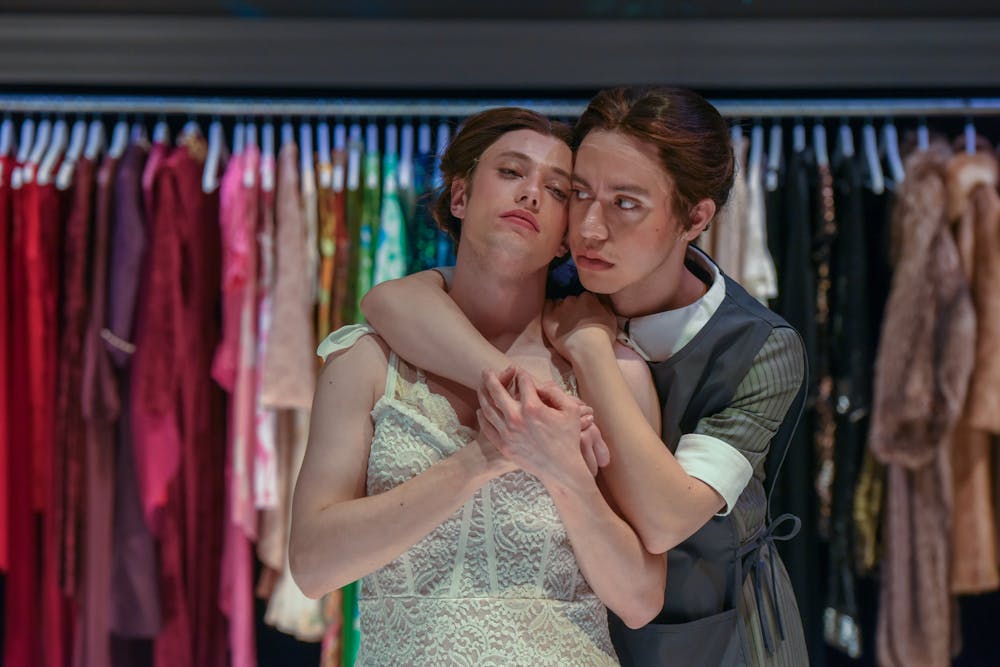
In a mirror maze of performativity, reality blends into fantasy until the two become nearly indistinguishable. This is on full display in Jean Genet’s absurdist play, “The Maids,” which was produced by the Middlebury Theatre Department this past weekend. It depicts two sister maids engaging in dramatic role-playing scenes while serving the larger-than-life Madame. Directed by Professor of Theater Cláudio Medeiros ’90, the production ran from April 9–11, and served as the senior acting work of Ryan Ulen ’26 (Claire) and Zeph Santiago ’26.5 (Solange), as well as senior work in costume design for Juli Valle ’26.
The play opens with one of the sister maids, Solange, running her face against the fabric of dozens of dresses, regarding herself in the reflection of a hand mirror. The mirror contained a hidden camera, projecting a live feed of her reflection onto a screen for the audience.
“We were looking for ways to make this play resonant for students, and we were thinking about social media and portraying somebody that you were not or idolizing somebody or wanting to be somebody,” Medeiros said. “The question was how to integrate that into the dramaturgy in a way that would make sense, and it wouldn’t feel like we were adding technology in a gratuitous way.”
The production included three cameras: two mounted on the walls and one an iPhone hidden inside the hand mirror. The group was opposed to simply using an iPhone, so the show’s sound designer, Stefan Arnarson, who is also the associate technical director at the Town Hall Theater, suggested hiding it in a mirror.
Claire roleplays as Madame and Solange as herself, kowtowing to Madame before pretending to strangle her to death. When they finish roleplaying, we learn that the two are equals as maids and sisters, despite their struggle for power with one another. They both reflect — united by their status and mixed up by Madame — and contrast with each other. Solange, the older sister, harbours bitterness towards Madame and rejects their status. She acts occasionally as a stabilizing force for Claire, who vacillates between intense power, lust and adoration.
“Claire is a shy, timid, and beautiful woman who aspires to public acclaim, glory and recognition. She wants to be in control, as much as she is controlled by her older sister. She is obsessed with the beauty, sweetness and goodwill of her Madame, and through roleplaying as her, she believes she can become her.” Ulen wrote in an email to The Campus.
“The dynamic between Solange and Claire was far beyond any normal sisterly bond. Solange and Claire are all that they have; they have no choice but to be extremely close: there are no secrets, privacy or space between the two, for better or for worse,” Santiago wrote in an email to The Campus.
Both characters are constantly dwarfed by Madame. Even in her absence for the majority of the play, her wardrobe sprawls across the set.
“Thinking about what Madame would want to have in her closet and how it would be arranged was very important to her character. I’m really happy with how it turned out; it really spoke into what Madame thinks about clothes,” Valle wrote in an email to The Campus. “The set, being a very clean white, allowed for the costumes to pop even more.”
Together, the two maids have sent a report that led to Monsieur, Madame’s lover, being imprisoned. They learn that Monsieur has been released, and plot to murder Madame in fear that they will be caught. When this scheme fails, Claire plays Madame once again and drinks the poisoned chamomile they prepared to kill Madame. Reality and fantasy blend together until, at last, Claire becomes Madame through death.
“It is Claire’s suicide that makes her performance of Madame real — because only when Solange kills her does the game become real,” Ulen wrote.
“When Claire defies Solange or disagrees with her, Solange loses her temper and has several long speeches where she bears down on Claire to remind her of the insults Madame throws at them and the permanence of their lower-class status. These scenes were emotionally taxing to perform, but admittedly, it was also fun to be able to just completely let loose and be angry on stage,” Santiago added.
The playwright, Jean Genet, is well-known for his experimental and avant-garde theater, particularly dealing with structures of power. Abandoned by his mother at birth, Genet grew up in foster care and spent time in prison for theft. His representation of sexuality and class was particularly groundbreaking.
“Genet was writing nearly a century ago in a time where gay men were far more persecuted, and gay men had to perform in a certain way in order to mask that they themselves were homosexuals, so the idea of performativity was not strange or unfamiliar to queer culture,” Ulen said. “That men play women is the feeling of a gay man having to mask himself and perform as though he was not gay.”
According to Ulen and Santiago, Genet said that if he had his way, he would put a placard in front of the play reading, ‘The Maids are played by men.’
“It reminds the audience that they’re watching a play, they’re watching men play women, not women just existing,” Santiago said. “It invites the audience to then question, instead of just accepting things as they are, why do we perform gender? Why do we imitate people?”
The actors worked towards a physicality of performance, adding to the layers of perception — the camera, gender performance and the acting itself.
“We were looking up drag queens, Norma Desmond, I was like, who are these old Hollywood stars that I could get some inspiration from at being physical and open.” Campbell Keller ’26 (Madame) said.
Though drag influenced the actors' physicality, Valle specifically avoided costume design that translated into drag.
“I don’t necessarily think that I used aspects of queer culture to inspire me, but rather allowed it to just exist within the work. If anything, thinking about it in retrospect, the costume for Madame was definitely something created with the idea of her being on a runway in mind,” Valle wrote.
Rachelle Talbert '28 (she/her) is a News Editor.
Rachelle previously served as a copy editor. She is an English major with an intended minor in Art History. Outside of writing, she volunteers with Page One Literacy and experiments with visual and fiber arts.


