
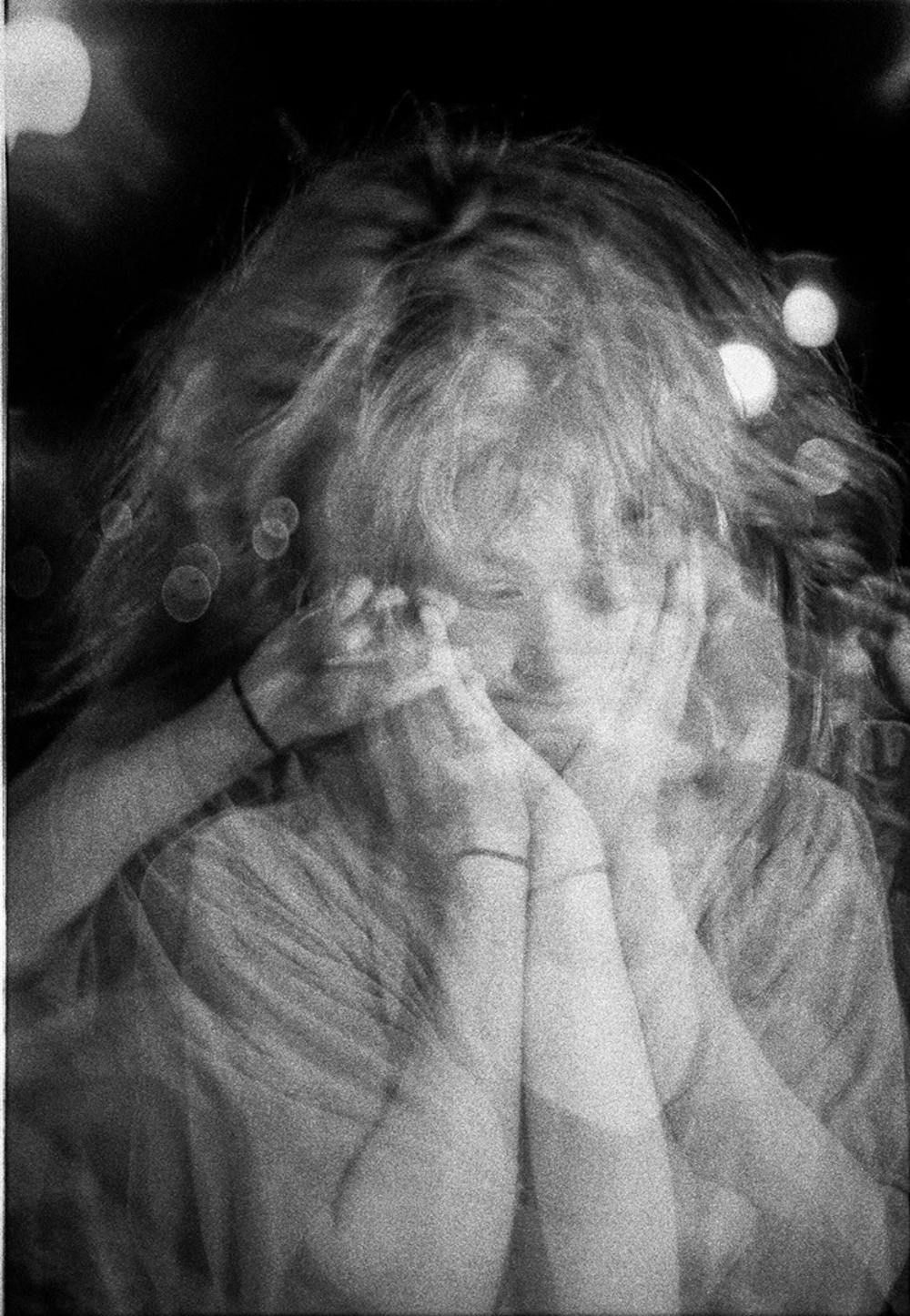
Christy Liang: What drew you to photography?
Devin Santikarma ’26: My parents are anthropologists, and I think growing up between two places, I always thought about how to represent one world to another. Photography is one of the most fulfilling ways to do that, I guess. It embodies the ability to represent someone else's perspective, the ability to really have a glimpse into their world and how they see things in a sort of snapshot moment.
CL: I like what you said about stepping into other people's shoes. Because sometimes I feel the opposite with the lens in between you and other people, as it can become distancing. Do you have something special that brings you closer to them?
DS: The positionality of the photographer matters a lot. I think it shows in work when you yourself have like proximity to what you're photographing versus when you're doing it on something completely different. When Parasite won the Oscar, the director quoted Scorsese. “The most personal is the most creative,” is what he said. And so I think using it to explore your own community and the things that you know the most intimately is how you can get around the more exploitative or disconnected forms of photography.
CL: Have you experimented with how this relational intimacy might inform your work differently?
DS: Yeah, I felt really disconnected from photography halfway through my time here at Midd, and so I took some time off to really delve into that as seriously as I could. I went back to Indonesia for the first time as an adult. Seeing it through a different lens than I did in childhood. And I feel like I really used photography as a way to capture those experiences that I do have proximity to, but also don't, right? It’s about having a bilateral identity. I hope that in making that article on, on Subak, these traditional irrigation methods in Bali, it shows my own proximity to it and the fact that I am also personally invested in it, in a way that's different from a journalist who goes in and goes out. I try to align myself with more visual anthropological methods rather than journalism specifically.
CL: Where do you see ethnographic methods or perspectives come into play?
DS: I think just immersing yourself in the worlds that you're trying to represent. That's actually why I don't do much photography here in Vermont, since I feel pretty disconnected from Vermont. Whereas I felt super motivated to do it in Indonesia because I have a connection to it. Or, when I took photographs of my family during COVID which was a really arduous process, but it really taught me a lot. And I think when you're doing storytelling on yourself, it's the easiest way. It's one of the best ways to learn how to do it with other people.
CL: What are your artistic inspirations? Or who?
DS: I have a part-time job working for this skateboarding media company Skatefol.io, and my boss, Josh Katz, is a skateboarder, but he’s also a top photographer. Ahmed M Badr, my friend, who I met when I was like a kid, and he made a storytelling platform, Narratio.org, that published my earliest photographs. Ocean Vuong. He's really getting into photography now. He just had his first exhibition in New York, which was a collection of photographs with his brother . Even the camera he uses, I have the same one. I like his work and how poetic, personal and self-reflective it is.
CL: Since you mentioned Susan Sontag earlier, do you perceive any tension between scholarship on photography and the creative process? Do you see them as complementary, or does one erode the other?
DS: I think it’s hard because I feel very unqualified to speak on it. My best friend Thomas really helped me with photography — we talk about it all the time. He went to art school, we grew up making skateboarding films together, and he’s working in New York right now. I’ve taken every photography class I can here. I think there is tension. For me, the essence of photography is going out there and experiencing it and trying it yourself. At the same time, though, I don’t know if this counts as scholarship, but finding photo books has really helped me. I really love the work of Alec Soth — getting his book really helped me learn a lot about photography. And more modern photographers like Adali Schell or Sinna Nasseri. I also didn’t even know at first that there could be this fine art world of photography. So it’s hard because everyone’s being like: “You can’t make it as a photographer,” but at the same time, it’s probably easier now than ever to carve out your own career path that’s really specific to you and not binary or one-dimensional. That’s kind of how I see the world from my positionality since I was a kid. I try to, at least.
CL: How about the classes you took? Do you think they helped you?
DS: Definitely. I can’t say enough good things about my professors, Michelle Leftheris and Phoebe Streblow. I think the classes helped me, but also just the process of going out and seeing what could happen with a camera and with myself — like when I was in Indonesia — that was also really important. Not more, but a different kind of learning process. At the same time, I think it’s really great to share your photographs, which I’m really bad at doing. And it’s really great to have people engage with your work — the process of critique, when people see everything that you do. I love that process. And Michelle herself, just knowing Michelle and having her engage in my work, and making my first photo book, that all really helped me have a kind of structure. Because the problem with pushing yourself by yourself is that sometimes it doesn’t come out. That’s also why I like to see photography as more of an art as opposed to a journalistic thing, where the moment you do something, it has to be timely. I’m really excited to share work that I’ve done in Indonesia that hasn’t come out yet, but still exists and is still being made, and unmade and remade. So yeah, taking photography classes helped, especially with that communal feedback.
CL: What makes a photograph “good” for you? Beyond composition, or including it?
DS: I love the compositional factors. I remember I showed my work to a photojournalist in high school, and the first thing he told me was, like, you’re not thinking about light enough. And I think that really changed my perspective in how I photograph. But I think for me it’s also the visual storytelling presence within it. Like, obviously, Ocean Vuong’s work, knowing that these photos — even if they’re not the most technically informed — I mean, they are too, like, they’re great too — but even though this is a new medium for him, it shows his engagement with life and his engagement with the subject that he’s trying to portray. So I think it’s all these other dimensions beyond just the photograph. But I am partial to really good composition. And portraiture, that’s probably where I find the most satisfaction, more than landscape or anything like that.
CL: With portraiture, how do you capture the soulful essence of someone?
DS: I think it’s got to be in your relationship with that person. One of my photography teachers always said you can tell when a photograph is taken by a sibling, because the looks you get are really, really different from anything else. I remember taking photographs of some survivors of this genocide that happened to my family in Indonesia, who are family to me too. I was using this manual, 1950s lens on a high-resolution camera, and it was really hard to focus. I couldn’t just “spray and pray” and make sure everything was exactly lined up in focus, especially with the shallow depth of field. I remember there was this one photo I took of my uncle, in the place where my grandfather, his father, was killed. All the other ones were blurry, but this one photo just managed to be perfectly in focus. So I feel like there’s also an element of mysticism.
CL: Do you feel a discrepancy between the moment as it’s captured and how it felt to be there?
DS: I think for me, eventually, photographs replace memories. Or not fully replace, but photographically, they stand in for them. And the faultiness or politics of memory is obviously a big theme in what I like to photograph, especially with my family coming from this forgotten genocide that has this kind of collective amnesia around it. So I feel like the photographs become the memories. And I think photography essentializes the moment, which is honestly more powerful, because it becomes more accessible. Thinking of Gayatri Chakravorty Spivak’s “strategic essentialism,” you can actually gain more by essentializing your experience. That was something hard for me. Even when I won my first award, I was worried about pandering to this Orientalist view, like selling an exotic vision of Bali. But I think for me now it’s about meeting people where they’re at, being accessible, and then once they’re there, taking them in a direction they weren’t going to go initially. So I brought up the genocide my family went through, where it felt relevant — but it’s about how much you can afford to complicate after that. And that’s one of the hard things about making work about yourself, knowing when to pull in and push back.
CL: Do you intend to become a professional photographer?
DS: I hope I can do visual storytelling in whatever medium allows me to. Whether that’s pursuing something more overtly artistic, like going to art school, kind of depends. I feel like for me it’s about putting out all the work that I can right now, seeing what people resonate with, and then kind of following that. I think with being artistic, your work becomes something bigger than yourself, and seeing how people respond to it will help determine that path. I don’t know — I don’t want to be employed, unemployed — I don’t know. But yeah, that’s my answer.
Christy Liang '28 (she/her) is an Arts & Culture Editor.
She is an English & Religion major who loves long conversations, live music in underground bars, and films that are a little pensive. She's genuinely curious about what goes on in other people's minds. Her column, "Conversational Art," is a series of interviews with student and faculty artists across all mediums.


