
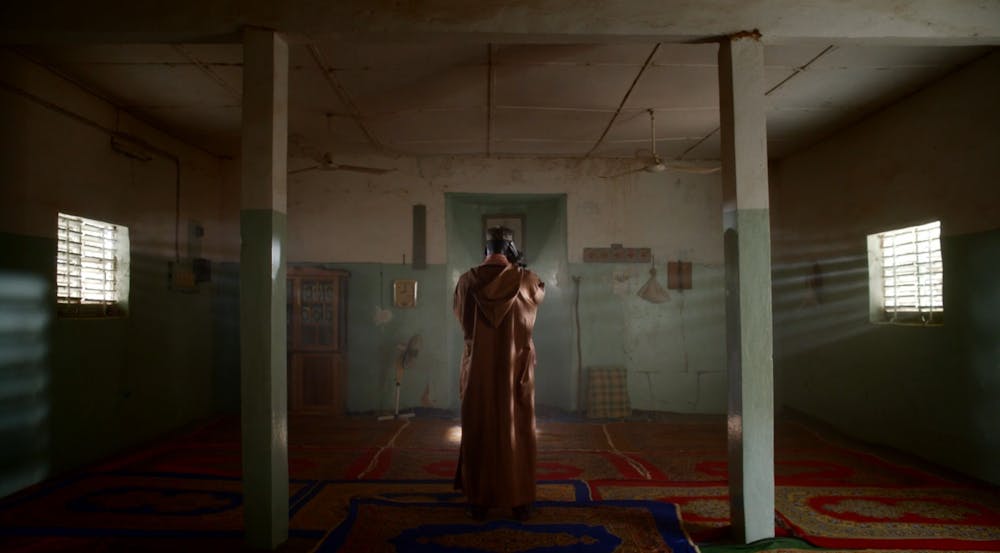
Senegalese writer-director Mamadou Dia’s “Nafi’s Father (Baamum Nafi)” is a personal and gripping examination of political, religious, familial and moral intersections in modern-day West Africa. A debut from Dia, a Visiting Assistant Professor in Harvard's Art, Film, and Visual Studies Department, the 2019 film won the Best First Feature award at the Locarno Film Festival, became Senegal's official Oscar submission and was screened at over 80 festivals worldwide.
The Middlebury community had the honor of watching the film on April 27 in Dana Auditorium thanks to the Black Studies, International and Global Studies and African Studies and the Lois ’51 and J. Harvey Watson Department of French and Francophone Studies. The screening was accompanied by a visit from Dia himself, who studied at the University Cheikh Anta Diop in Dakar, Senegal, before spending eight years as a video journalist across Africa with the Associated Press (AP) and Agence France-Presse (AFP). Dia enrolled in NYU Tisch for an MFA in filmmaking in 2014 and, along the way, found he was disappointed in the United States’ negative portrayal of Islam and West Africa.
He embarked on a mission to reclaim this narrative, rooting his work in daily, personal realities, casting actors for “Nafi’s Father” whom he knew personally. Granting his characters individuality and warmth, Dia highlights Islam as a means of control rather than a choice or universal belief.
In a small town in Northeast Senegal, Nafi, an 18-year-old girl and aspiring scientist who dreams of going to university in Dakar, agrees to marry the son of her father’s older brother, Ousmane. Her father, Tierno, the acting imam, or religious leader, learns of the wedding and is determined to stop it, arguing that she is too young. It is a legitimate concern, but he is unavoidably driven by lingering jealousy of his brother, who his parents favored, a desire to prevent Nafi from leaving the small town and most of all, alarm over his brother’s growing affiliation with a fundamentalist form of Islam, one that is much harsher and more militant. The moral battle deepens, creating tension between Tierno’s tender yet rigid nature and his brother’s hunger for power, rooted in a decades-long sibling rivalry that strains Nafi’s relationship with her father.
As several other reviews noted, the script could have been tightened at points, leaving more room for character development, which led to some leaps in logic that I found. Nafi and Tierno were rich with psychological depth — Nafi was presented as strong-willed yet gentle and compassionate; her father, likewise, is determined to protect the village while battling an illness — but the other characters sometimes felt like props without a clear role.
However, the story was nonetheless engaging, furthered by the striking shots and beautiful colors and shadows, as well as the unexpected, subtle comedic comments sprinkled throughout. The stunning cinematography creates a strong sense of place, offering up a lens through which Westerners can begin to understand West Africa as a real, experienced community rather than an isolated, exotic one. Dia highlights that although religion is a fundamental, unavoidable aspect of his culture, it is not the only thing that defines him and his community, as he has previously alluded to.
It would also be unfair to omit the fact that the debut film was shot in only three weeks on a small budget, as he shared during the post-screening Q&A, which helps explain occasional plot gaps that still allow for an overall impressive debut.
Luckily, there is more from Dia, who became a member of the Academy of Motion Picture Arts and Sciences in 2025: his second feature, “Demba” (2024), premiered at the Berlin Film Festival and examines grief and mental health struggles growing up in Senegal, another deeply personal story: when he was 13, his mother passed away and it was not until the past few years that he realized and understood that he had been depressed throughout most of his adolescence. Currently, he is developing a third feature, “Augustus,” inspired by the life of 19th-century African-American photography daguerreotypist Augustus Washington, who opened the first documented studio in Saint Louis of Senegal in 1860.
Dia has brought a fresh and authentic perspective of West Africa to the United States, one that is seriously needed. I was grateful to learn about this viewing opportunity through my French course, expanding my view of the highly white and Eurocentric understanding of French culture I have often been taught. I am incredibly grateful for the Department’s efforts to dismantle stereotypical and homogenous views of France and the Francophone world, and I hope this work continues.
Maya Alexander ‘26 (she/her) is an Editor at Large.
She is a sociology major and intended French minor from New York City. She loves getting lost in her Pinterest feed and staging spontaneous photoshoots, occasional yoga and a solid iced oat milk maple latte.


