
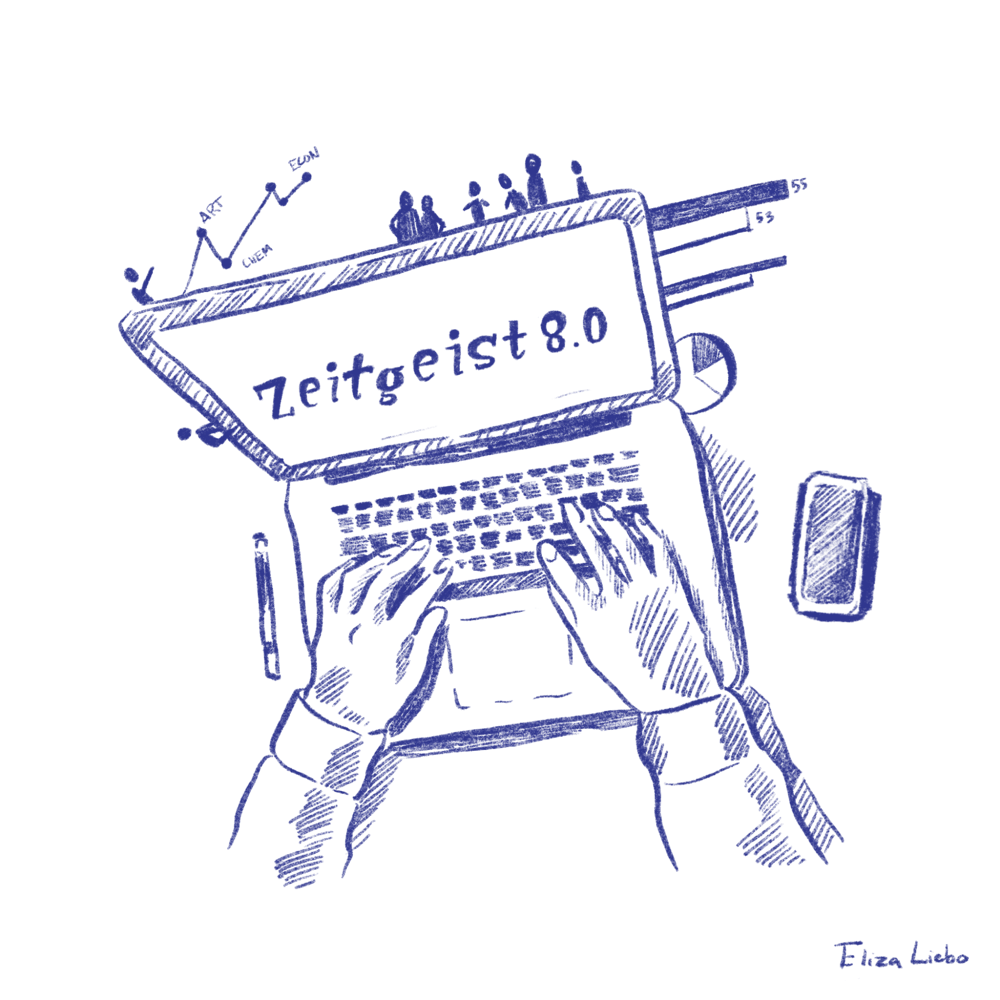
The first time “Zeitgeist” showed up in my inbox, I almost ignored it. It was my first year at Middlebury, and the word meant nothing to me. But I clicked the link out of curiosity. As I read through the questions, I was struck by how different they felt from the ones institutions usually ask. They reflected the kind of questions and conversations I was having with my close friends.
So what exactly is Zeitgeist, why should you take it, and why did it have such an impact on me?
Zeitgeist, by definition, refers to the defining spirit or mood of a particular moment—captured through the ideas and beliefs of the people living in it.
On Monday, March 30, the Middlebury Campus released its eighth annual Zeitgeist survey, available to students at go/zeitgeist. The survey features 60 questions, such as: How often do you use A.I. in your classes? How satisfied are you with the romantic scene at Middlebury? This year, the Campus also introduced questions directly on students' sense of purpose and belonging: Do you feel academically fulfilled? Are you proud to be a “Panther”? Do you have faith in the future of Middlebury?
I remember my first year, in April 2023, reading through Zeitgeist 5.0 results when they were released. I felt a certain level of confirmation scrolling through the data. There were certain patterns that stood out to me that had honestly validated my Middlebury experience. One section, which showed who works paid jobs on campus by financial aid status, made visible a divide I was already living as a low-income, first-generation student. Another showed disparities in who has access to a car on campus, again along financial aid lines.
These were conversations I had often with close friends in similar situations, but they rarely extended beyond those spaces. Outside of that, they were not widely acknowledged. I remember once sitting in Proctor and hearing someone ask, “Wait, people actually use the bus to get to Burlington?” For me, that Tri-Valley Transit bus has always been my primary way of getting there. I remember another moment in class when someone was unfamiliar with what food stamps were, and the explanation that followed revealed how different our starting points were, and probably how different our Middlebury experience is. Casual mentions of family support or financial safety nets are certainly common, often without recognition that not everyone has them. I do believe that there is an underlying assumption of shared access—whether that means having a car or disposable income—and as Zeitgeist data reveals, that assumption does not hold true for everyone.
This is why Zeitgeist matters. What might otherwise remain anecdotal or unseen becomes visible when it is collected across the student body and translated into something everyone can engage with; something that can inform real dialogue and change. This is possible because Zeitgeist is completely anonymous. Responses are analyzed in aggregate, meaning no individual answer can be traced back to a specific person, and the data is not shared with the college, faculty or any outside organization. That anonymity matters. It allows students to answer honestly about experiences that are often difficult to name publicly, such as financial realities, belonging, access and well-being, without the fear of judgment or consequences.
We are living in a moment where data increasingly shapes how we understand our experiences. Across disciplines, information is collected, interpreted and used to tell stories. Zeitgeist operates on this same principle. Using tools like Qualtrics and Datawrapper, we take the thousands of anonymous individual student responses and transform them into a broader, more honest picture of student life at the college. Not the polished version we always see presented in admissions brochures, but the one students are actually living.
That distinction matters to me. There are questions the college is unlikely to ask directly—about the political climate on campus, who has access to a car, or the more personal realities of students’ romantic and sexual lives. This stuff matters too, and in fact, is probably the most interesting. And while the college certainly collects its own data, it is not always shared in full. Zeitgeist is different as its findings are published regardless of how they reflect the college or its students. That transparency is part of what gives it value.
Last year, former Editor in Chief Ryan McElroy ’25 put it well: “The value of Zeitgeist is not only as a passing curiosity or pure entertainment. Rather, the survey represents our best effort to make an empirical, quantitative study of the Middlebury student body at a specific moment in time.”
In practice, that means the strength of Zeitgeist depends on participation. The story the data tells is shaped by who contributes to it, and a dataset is only as meaningful as the range of experiences it captures.
After three years on staff—and now, in my fourth year taking Zeitgeist as Editor in Chief—I do see it as more than a survey. It is one of the few tools we have to represent student experiences both quantitatively and qualitatively. That responsibility, however, does not rest with The Campus alone. It depends on student participation. Whether your experience aligns with dominant assumptions about campus life or not, it is part of the picture. And the more students who participate, the more accurate and more representative that picture becomes. Last year, 1,028 students responded out of an on-campus population of 2,563. That is a significant number, but it should be higher.
Zeitgeist takes less than 10 minutes to complete.
Take it.

Mandy Berghela '26 (she/her) is Editor-in-Chief
Mandy has previously served as the Managing Editor, Senior Local Editor, a Local Section Editor and Staff Writer. She is majoring in Political Science with a minor in History. She currently is Co-President for the Southeast Asian Society and an intern with the Conflict Transformation Collaborative. Last summer, Mandy interned with U.S. Senator Kirsten Gillibrand and participated in the Bloomberg Journalism Diversity Program.

