
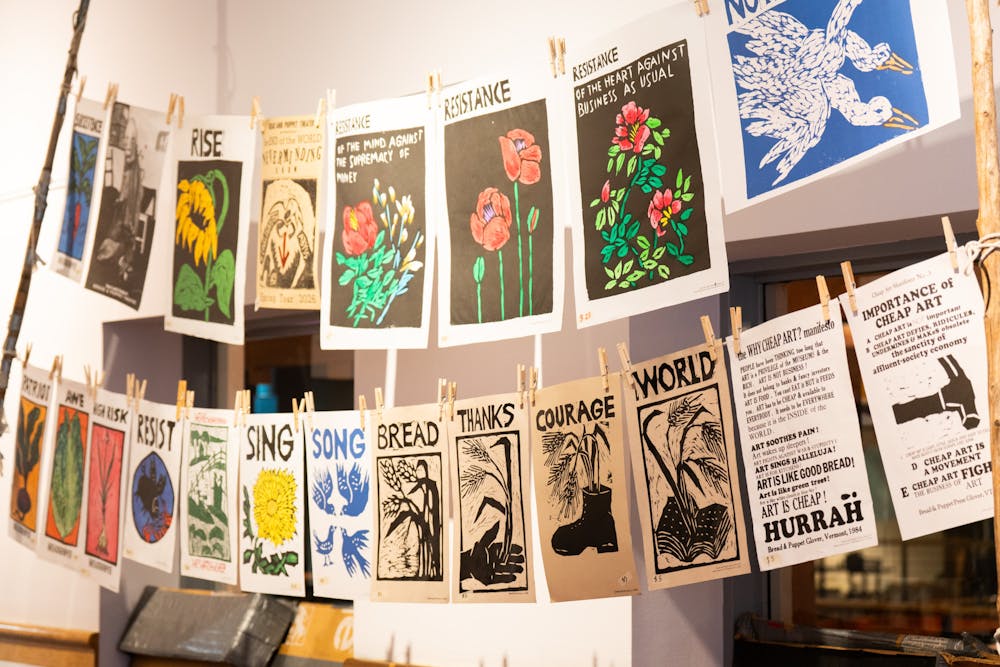
Local Vermont Bread & Puppet theatre, hosted by the Gender, Sexuality and Feminist Studies (GSFS) Department’s annual Gensler Symposium and the Chellis House (Feminist Resource Center), brought their signature craft of humorous but heavy mixed-media puppet performance pieces to campus on Tuesday March 31, as a stop on their larger indoor tour: “The End of the World Neverminding Show.”
The experience was no typical puppet show, ending with homemade bread and garlic spread. “The End of the World Neverminding Show” was an engaging mix of puppets and people narrating, singing and moving as a form of political storytelling and advocacy. The show opened with “The King Story,” which followed a fictional kingdom that saw conflict between a dragon and a warrior. It then segued into a six-act collection featuring vignettes on current issues, including the rise in U.S. Immigration and Customs Enforcement (ICE) raids, the war in Iran and the war in Gaza.
The acts included interpretive dances in which actors held cutouts of a human skeleton and of different professions: bus driver, baker, nurse, gardener, student, taxpayer among others. The fourth act saw actors hold cutouts of men in suits, with each character having a word in place of their face: Innocence, truth, normality, ‘neverminder,’ humdrum, N.Y. Times, compliance. The men in suits were chased out by a pig character dressed up as a police officer.
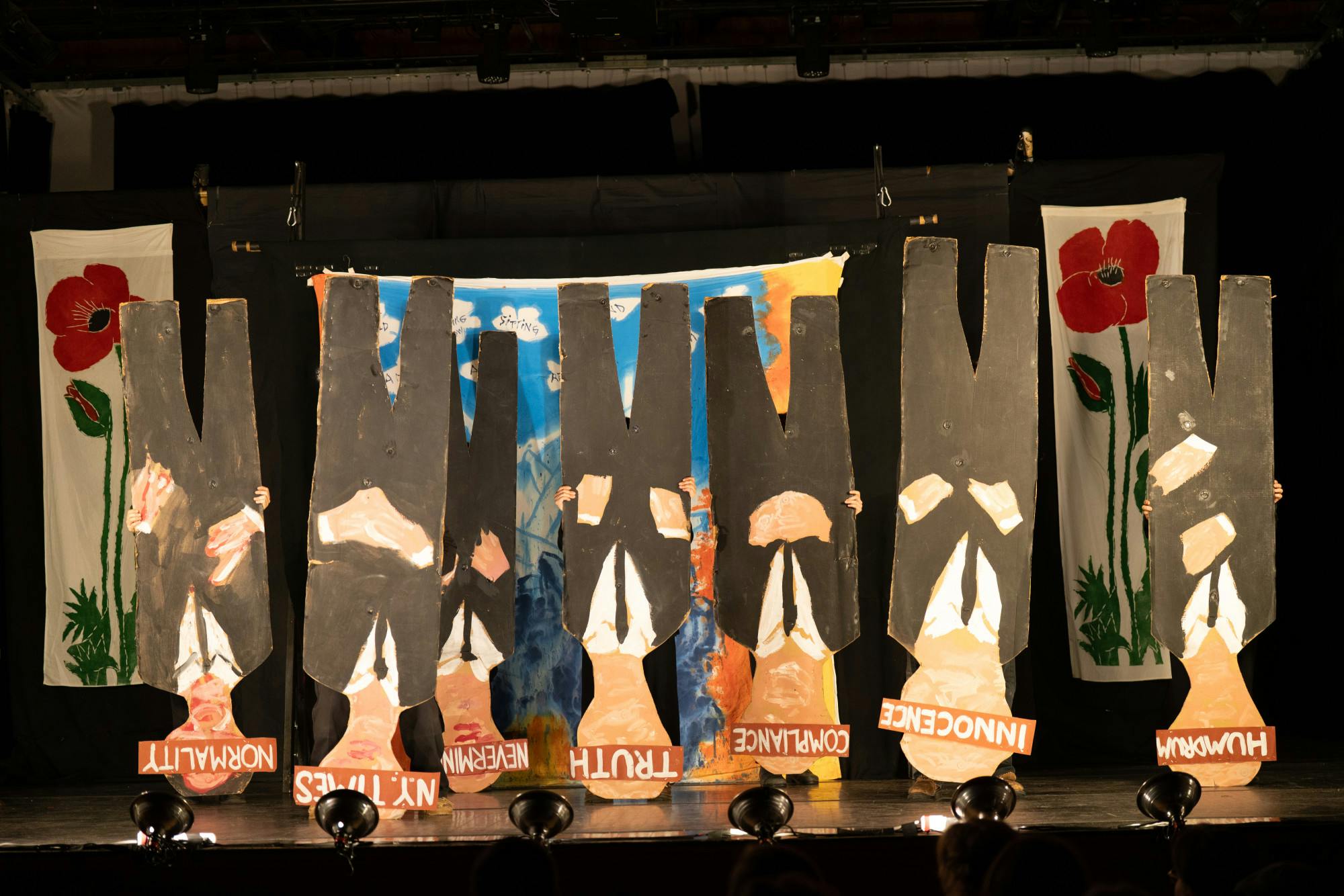
In these interactive puppet scenes, the troupe constantly subverts audience expectations.
“Each puppet was carrying different names, [such as] student taxpayers, bus driver. I suddenly realized that holding those figures actually had another identity on stage,” Artemis Xintian ’28 said in an interview with The Campus, describing her favorite vignette of the evening.
The show covered a range of different emotional experiences; the second-to-last act featured giant puppets that were caricatures of the Statue of Liberty dancing with an equally large Uncle Sam figure. The characters were flipped upside down, before being brought together to resemble a kiss.
“I liked … how comical and sometimes crude and simple it is … it creates a sort of dissonance,” Xintian added.
The show ultimately ended on a hopeful note, with a beautiful final scene that featured the Palestinian Poppy as the futuristic “Not-yet” that is “impatient and unready.”
This dissonance surfaced in other ways, too. Some of the scenes in the show were quite explicit and clear about their message, while others were more symbolic, leaving interpretation up to the audience. There was a short but impactful image after a very intense vignette of a deer in a herd looking up and following a moon. There was a stillness, collectivity and passivity articulated in the image, creating an emotional experience that guided the audience into the next phase of the creation.
These more interpretive scenes were the subject of questions and conversations at the facilitated talk-back after the show. There was also gorgeous merch for sale, and an interactive three-hour workshop the next day, led by the troupe.
The idea to bring Bread & Puppet was the brainchild of Harper Nichols ’25, the director of the Chellis House.
“I saw [Bread & Puppet] for the first time, two years ago… it made me cry. It made me lose my mind. It was super impactful to me as a person and as an artist…It was, like, one of my big goals to bring them to Middlebury,” Nichols said in an interview with the Campus.
This experience is not unique to Nichols.
“I actually went to Middlebury [as a student]. And I remember seeing them at the field house…I'll never forget it. It was a magical experience,” Catherine Wright, associate professor of GSFS and interim chair of the GSFS department, said in an interview with The Campus.
The Gensler Symposium is the event for which the GSFS department and feminist resource center are granted the most funds and resources, and it takes on different capacities each year.
“Usually we bring more academic speakers and professors to come and speak to the work they do, and do workshops,” Nichols said.
Bread & Puppet was clearly a different choice. Even though Gensler has been radical, artistic and interactive in the past, the large crowd Bread & Puppet drew stood out compared to other years, when events were more catered to the people involved with the department.
Between the event being free for students, the variety of co-sponsers — The Committee on the Arts, The Knoll, The Climate Action Program, Sunday Night Environmental Group and by departments in Theatre, Dance, Studio Art, English, Sociology, American Studies, Writing and Rhetoric and the International and Global Studies Gender Track — and Bread & Puppet’s ability to address interlocking justice issues, the event drew a huge turn out, nearly filling Wilson Hall.
“I think that it was really nothing that you can’t think about through a feminist and gender lens,” White said. While gender was not the sole focus, gender issues played out clearly on the Bread & Puppet stage.”
Beyond the main performance, attendees at the troupe’s workshop described it as fun and inspiring.
“It’s really neat to be able to perform and work with the community,” Ocea Goddard, a company member, said in an interview with The Campus.
The workshop was centered on the ancient art form of the “Cantastoria,” where a chorus and a narrator tell a story through gestures, song, sounds and lines that point to a series of cloth or paper tapestries that two people keep flipping as the story progresses. In the workshop, participants were tasked with learning one of the Bread & Puppet ones, making them out of paper with random words and pictures, and then creating their own from scratch.
“I had no idea what’s happening behind the scenes. I wanted to participate in how you transform very abstract thoughts irrelevant to each other,” Xintian said about why she spontaneously signed up for the workshop after the talk-back the night before.
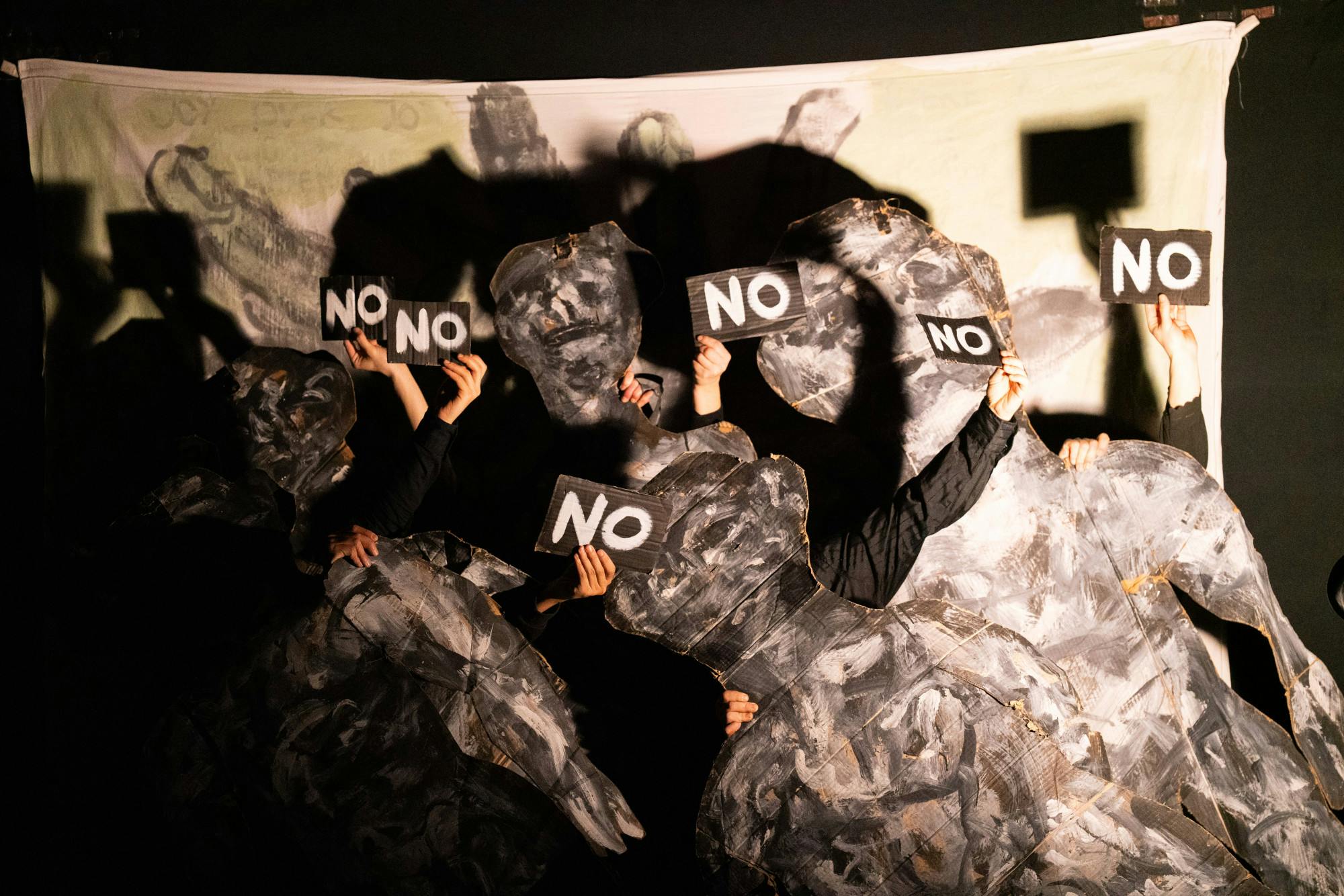
These school visits are not unusual for Bread & Puppet, but they break up the typical tour structure of six shows a week for four weeks with two to three school visits in between. “The End of the World Neverminding Show” is part of their spring indoor tour, which is very different from their outdoor touring circus, which circulates in the fall.
“The spring show is unique in that we get together in March, and then in a couple of weeks, we usually kind of create a show from scratch,” Goddard said.
The resident company works and lives full-time on their farm in Glover, VT, which Bread & Puppet moved to during the 1970s as a part of the “Back to the Land” movement. Like this way of living and being together, the Bread & Puppet process of making is not traditional. While Peter Shuman, artist, activist and author, is the founding artistic director at Bread & Puppet — having founded it in 1963 as one of the first non-profit, political theatre companies ever — the puppeteers are very involved as they create a lot of content for the show and always improve it through tweaking it while on tour. This includes some improvisation, often a lot of the group puppet movement, during the actual show.
“I mean, something that’s neat about working with Bread & Puppet is because we don’t really have such narrow roles; everyone can do everything,” Goddard said.
Bread & Puppet describes puppetry as “the people’s theatre,” an ancient and accessible form of theatre that began on the street. Puppets don’t need expensive resources to be effective; in fact, they refer to their art as “cheap art,” using scraps to create striking and beautiful puppets that are rough around the edges.


