
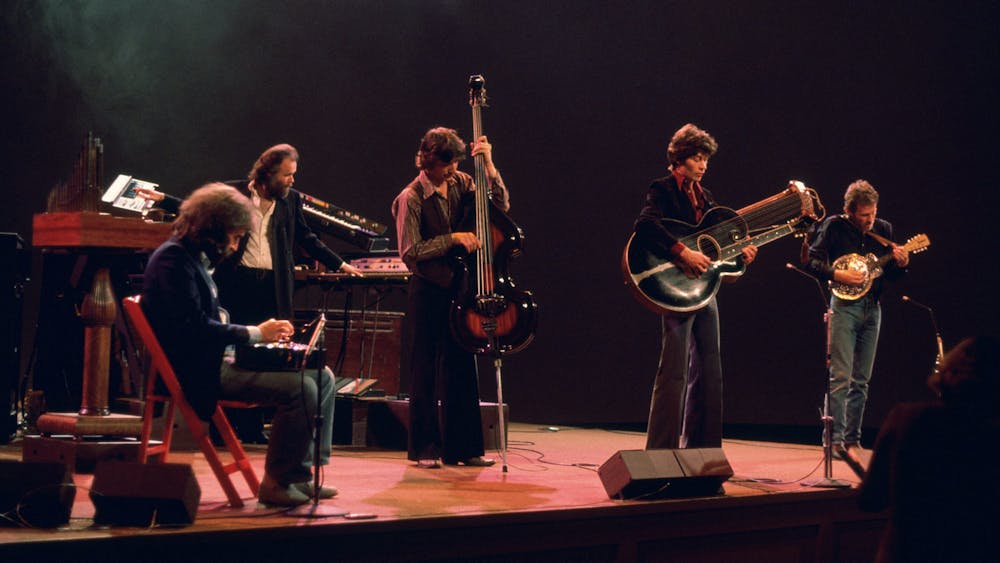
There’s a moment in “The Last Waltz” that comes at about the 34 minute and 53 second mark, at the onset of the last chorus in Neil Young’s performance of “Helpless,” which a friend of mine once singled out, when we were arguing the film’s best scenes, as a jib door to transcendence. He was listening to the recording of that performance one time — alone, outside in the snow, through headphones (did it help that he was under a certain kind of influence?) — and that moment was what took him there, he said. I knew what he was talking about. The verse is ending when Young looks sideways at The Band’s Robbie Robertson and Rick Danko, then looks again, and then, grinning, joins them at their microphone, while Joni Mitchell — somewhere off-stage, glimpsed in silhouette by Martin Scorsese’s camera moments before — finds the wild, wordless current of a high note and rides it above them all as Levon Helm tumbles into his symbol and the crowd’s shouted affection gathers to a crest and, for a few seconds, one collective sound of holy abandon rises out of that perfect chorus of three chords and a one-word refrain to level you.
The concert Scorsese captured in that film — The Band’s guest-filled farewell show, staged in San Francisco on Thanksgiving day, 1976 — is now fifty years old. Like anything you return to enough times, “The Last Waltz” registers, for me, less as “the most beautiful rock movie ever made” (though surely the critic Pauline Kael was right about that, and would be still) than as a collection of moments: a series of verses and phrases, inflections and glances alternately capable of throwing new light on the music.
Maybe that sounds overwrought. But search up the “Helpless” video on YouTube, and see how much there is in just that one performance: the way Rick Danko looks at Neil Young during the first few minutes, mouth slightly ajar, head slightly lowered, hound dog eyes locked in total capture — what do you call that kind of love? And what kind of bliss Robertson is feeling in the second verse, when he looks up at the ceiling of the Winterland Ballroom, with an awe as feigned as it is real, as if he’s looking at the “yellow moon on the rise” and the “big birds flying across the sky”? He and Danko turn to smile at Garth Hudson, who’s doing magic with the Lowrey organ, wheeling above the song like those blue-lit birds above Young’s nameless Ontario town, painting Young’s memory with the brush of his instrument. Robertson looks between him and the ceiling, shaking his head at the marvel of it all.
You can talk about the pining in the sound of Young’s harmonica (has he not done better with that instrument, in his own way, than anyone else?), or the off-handed imaginativeness of Robertson’s guitar playing, how he fills the space between the lyrics with anything but noodling, expresses himself in anything but licks. If you were really overdoing it, you could talk about the way Richard Manuel kicks in at the very beginning of the song, spreading it out with that wide, sonorous exhale that you only get from a low piano octave. And even before the song starts, there’s something moving about Young settling himself in the energy of the crowd and then saying to Robertson, with the self-assurance that must come from a life playing big shows, “Oh, they’ve got it now Robbie.” (Never mind the fact that he had a sizable lump of green room stardust stuck in his nose the whole performance — a real inconvenience to his manager, who went to great lengths to have Scorsese airbrush it out of the film’s final cut.)
More than half of this article’s prescribed word count already blown on one song. It’s too bad — you’d want to cover Van Morrison’s performance of “Caravan,” the moment when he and Robertson go in at the vamp section together and Robertson plays a phrase so nice Morrison has to just back off and say “yeah,” before plunging again into one of the most expressive, fully-exerted vocal performances you can find on video, capped with a series of leg kicks fired dangerously high above the waist, a winded “thank you” preceding the mic drop, and a final, hilarious skyward arm thrust as he makes his departure into the wings (all this in a sequined maroon jacket with matching pants).
Then you’d want to get to Joni Mitchell, really on a different plane than all the other men, as good as they are, in her performance of “Coyote” (a song she reportedly wrote about Sam Shepard), which you’re less than a minute into it before the arrival of those remarkable lines — “There’s no comprehending / Just how close to the bone and the skin and the eyes / And the lips you can get / And still feel so alone / And still feel related / Like stations in some relay” — the strange, restless chords pushing the lyrics into heightening realms of poetry, compelling the song onward, just as she is compelled further down that mythic American freeway, of whose “white lines,” she is a “prisoner.”
But then you won’t even have time for The Band’s performances of their own songs: Rick Danko, pain written on his eyelids, pulling the last syllable out of the last word of “It Makes No Difference” like a vein out of his own heart (this, one of the most best songs about heartbreak ever written); or Levon Helm, grimacing through a drum build into the release of the last chorus of “The Night They Drove Old Dixie Down,” and then leaning, with all his guttural Arkansas conviction, into its refrain as Danko hits his highest harmony (that, one of the best songs about American history ever written).
All the individual moments aside, what’s felt by the end of the film is that this is some of the best American music ever made — and some of the best music from anywhere ever made because of its American inheritances, deep and varied. No matter that many of the main players (Robertson, Danko, Mitchell, Young) come from Canada, or an island across the ocean (Morrison). They wanted to take part, to hear in their own voices the movement of an American cadence. You recognize that desire in The Band, especially. They fell in love with the music of the place, and then they fell in love with the place itself. And then, in one continuous, evening-long moment fifty years ago, together for the last time, they brought out the sound of it.


