
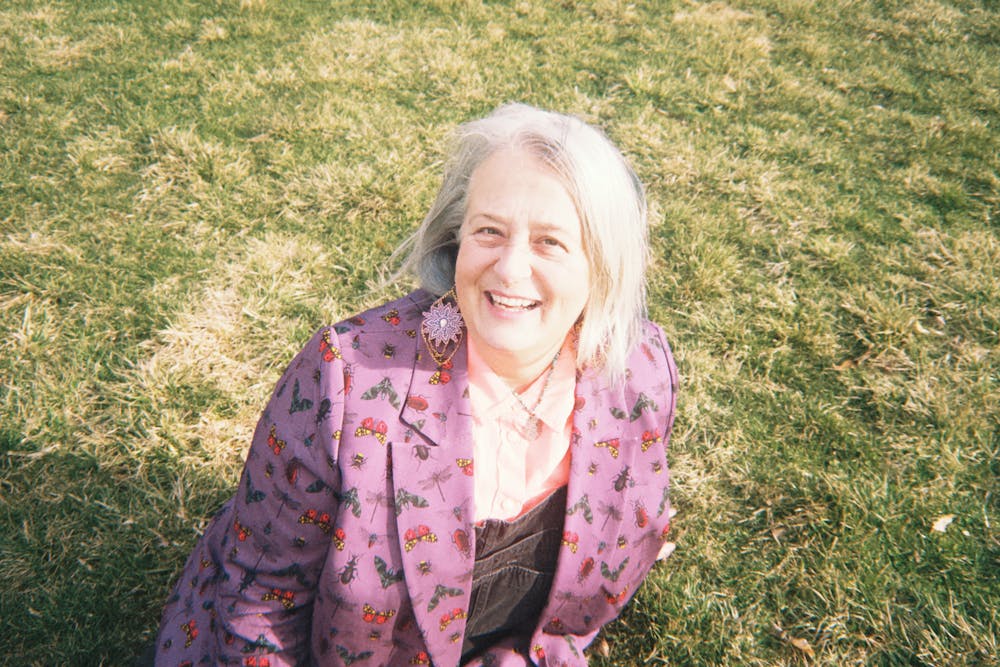
Marin Melchior wears the standard college dining services uniform, but beneath the regulation fabric, the markers of a creator remain: a streak of vibrant blue bleached into her hair, a pair of delicate earrings and a blue bow pinned neatly behind her work hat. As the dining servery supervisor at Middlebury College’s Proctor Dining Hall, she manages the daily ebb and flow of student life; yet, beyond the campus counters, she is the founder of her own knitting company.
If you introduce her that way, she will laugh — not a polite chuckle, but a deep, head-thrown-back laugh, as if she just heard a great joke. When the laughter settles, her eyes remain bright. “I just love people,” Melchior said. It is not a slogan; it is the philosophy she lives by every day at her post.
Melchior’s most striking quality is her observation of others. From her desk, she once noticed a boy with a smile so radiant it could brighten an entire room. One day, she saw that smile fade — the subtle change in the curve of his mouth, the light vanishing from his eyes. She didn’t intervene immediately, but she held that observation until she could ask him about it the following day. She watches a girl who moves like an elf, carrying what Melchior calls a “box of happiness,” weaving between tables to spread joy. Melchior discerns whether a smile is genuine and notes how a person has changed since the day before. Though her own life has not been easy, she remains a steadfast observer of the world.
This sensitivity eventually flows into her art. Melchior is a designer whose knitting patterns are recognized globally. Her most famous work, “Butterfly Shawl,” is vibrant, intricate and widely celebrated. As a pattern designer, she translates inspiration into a seamless language, drafting every stitch into a detailed written pattern. These digital patterns have achieved significant international success, with her original designs selling over 30,000 copies.

Marin’s butterfly shawls and her painting
When she created “Butterfly,” there was no grand plan. “Butterfly is a good name,” she reflected, alluding to the process of metamorphosis. Later, while preparing for an exhibition, she found an old landscape painting she had done years ago, depicting waves crashing against the shore. The patterns and colors of that painting overlapped almost perfectly with the “Butterfly” design. She had been painting waves while knitting butterflies without even knowing it. She does not intend to stop there; she wants to make her work more realistic — closer to the true veins of a wing — while simultaneously making it bolder.
This pursuit of beauty is her way of countering the rough edges of reality. “The texture of the work I create is the exact opposite of my own life,” she explained. Wool is soft, bright and warm; her life has often been difficult.
Now in her 50s, Melchior’s resume is a testament to varied labors. She has been a forklift driver — she gestured, pushing upward into the air — and has worked in the fashion industry and on farms. She spent more than 20 years in California, a massive chapter of her journey, before returning to Middlebury. Here, her less visible tasks — maintaining cleanliness, stocking supplies and monitoring food safety — constitute her daily routine.
She admits her path has been rocky. “But I like smooth and orderly presentations,” she said. Life can be rough, but the work does not have to be. Her aesthetic leans toward things that are “noisy, busy and full of layers” — not chaos, but abundance. She dislikes anything “wobbly” or unstable. “When a thing is fully developed and not interrupted by strange textures — that’s good,” she said.
Much of what Melchior creates are gifts — expressions of love handed directly to friends. She often names her designs after them. “When you get older, you put your love for that person into something,” she said softly. Her portfolio is, essentially, a registry of the people she has loved.
Melchior notes that she found it easier to adapt to others when she was younger. “Now I just get things done.” She no longer performs happiness for others. She says she is quite happy now, a statement delivered with quiet certainty.
She also shares a truth few creators admit: “When I’m happy, I’m more likely to take good photos and see beautiful things.” Sometimes her mind wants to create, but her body refuses. She will pick up her needles, look at the yarn and know it isn’t the right day. “I tell myself: try again tomorrow,” she said.
At this stage of her life, Melchior is still exploring and thinking about how to do better. She returns to the name “Butterfly,” and is reminded of the act of breaking out of a cocoon. The implication is clear: she is still growing, too. She looks at you with bright eyes, and you realize she truly does love the boy with the fading smile, the girl with the box of happiness, the softness of wool and the act of breaking out itself.
She stands up, heading back into the world of steam and noise. She puts on her work clothes, ready to handle the next supply shortage. The wool is waiting at home, and “Butterfly” is waiting at the tips of her needles. But first, Marin Melchior returns to her desk at Proctor. She sits there, watching students swipe their ID cards, looking up and truly seeing everyone.


