
Designers Amanda Ugorji and Sophie Weston Chien like things soft — which is interesting because their work addresses hard issues: immigration, redlining, the climate crisis, flooding and injustice.
Ugorji and Chien addressed this dichotomy during their talk, “just practice; practicing process,” which was delivered in Johnson Memorial Building on April 9. With backgrounds in architectural design, urban planning and community organizing — but not textiles — the two women, who call themselves “designer-organizers,” have been creating collaborative work in the form of textiles since 2020.
Ugorji is originally from Cambridge, Massachusetts, and has a BA in Architecture from Brown University and a Master of Architecture from MIT. She has worked on urban planning, public design, exhibition production, lighting design and resiliency planning in cities including New York, Boston, Seoul, South Korea and Timișoara, Romania. In addition to her work with Chien, she is an urban planner at the WXY studio in New York.
Chien is from Charlotte, NC. She has a BFA and a Bachelor of Architecture from Rhode Island School of Design (RISD) with a minor in politics and policy. In addition, she has a dual master's degree in Landscape Architecture and Urban Planning from Harvard's Graduate School of Design. She is currently a lecturer at the University of Colorado Boulder, serving as a Postdoctoral Associate Lecturer in environmental design. She describes herself as "a designer organizer” — someone who builds community through social and physical infrastructure to ensure people can shape their own spaces.
“Our interest in textiles was really about the capacity to have an interactive medium, something that you can touch that was soft, which is a reaction to the harsh disciplines of architecture, where everything is precise and clear and shiny," Chien said.
Their first work, created in 2020 and titled “Soft City,” consists of three large-scale textiles depicting maps of Black neighborhoods in the Boston area. Using texture and color, the textiles show flood zones, redlined communities and ecological resilience.
But the rugs are also great to look at. Speaking about the flexibility of textiles as a medium, Chien said, "I think there's an interesting negotiation of what's really legible. People won't know the stories behind each of the rugs. They'll just kind of see general patterns of some folks came on a plane, some folks came in a car. And so I think having some of those levels of concealment and privacy was really interesting."
Textiles also invite touch. According to Ugorji, over 5,000 hands have touched "Soft City" — an action that both designers encourage.
"We've seen it take wear and tear; it is such a strange experience to watch something literally degrade from being touched and be kind of happy about it," Ugorji said.
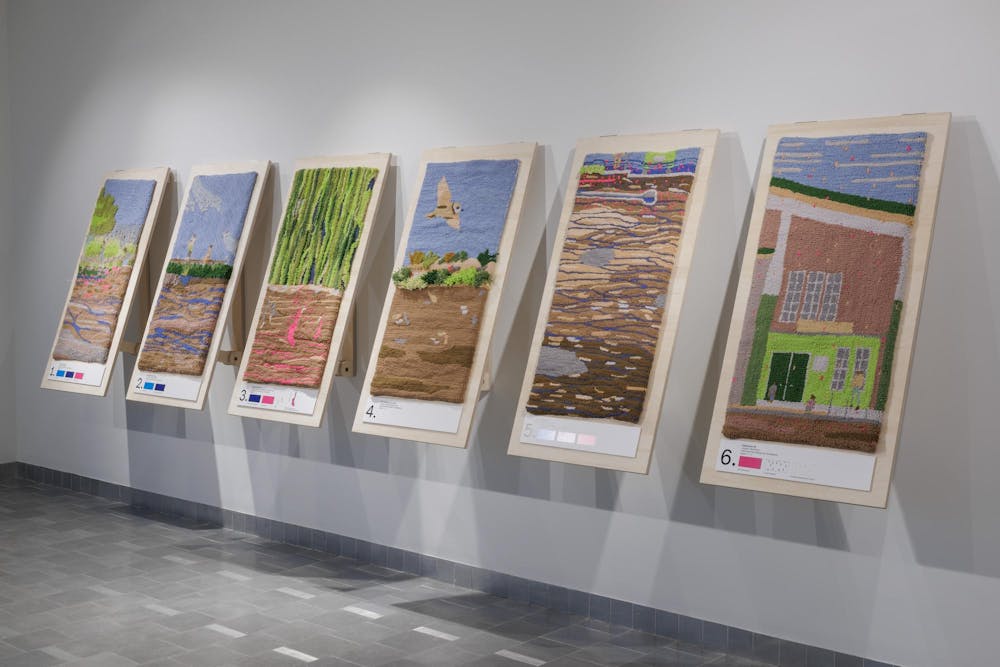
Ugorji and Chien’s most recent work, created in 2025, is “Touching Toxicity,” which consists of six tufted textiles that portray different toxic environments in the Bay Area of California. One depicts toxic air particles that once surrounded a school in Richmond, VA, resulting from the 2012 Chevron Richmond fire. Another focuses on former salt ponds next to Menlo Park, CA, which have become the habitat for the Snowy Plover, a small shorebird found in the Americas.
Ugorji and Chien chose the six locations by speaking with local activists, scientists and community members.
“We wanted to actually start with experts there because we knew that they had relationships with community members,” Chien said.
The textiles were created by “tufting” — a process where yarn is punched into a “substrate,” or backing material, to create a shaggy, textured or soft surface.
"Tufting is different from a lot of textile practices because we're starting with the substrate," Chien explained. "You actually stretch the substrate and then tuft onto it. So it feels a little bit more like painting with yarn than having to do the work of patterning what you're actually doing."
The speed and instant gratification of tufting appeal to Chien. "I found that tufting really matches my attention span," she said.
Ugorji and Chien met more than 10 years ago as students with similar interests.
“When we work together, we do have a united voice. It’s not like two people coming together. It’s a collaboration between two people. That has one kind of voice with what it makes,” Chien said.
Though Chien and Ugorji acknowledged that the current political climate has made creating art harder — funding cuts to environmental organizations have threatened the designers’ access to environmental data, for example — they remain convinced of the importance of art and design to communicate hidden truths. "Let your work enter the world and see what happens," Ugorji said.


