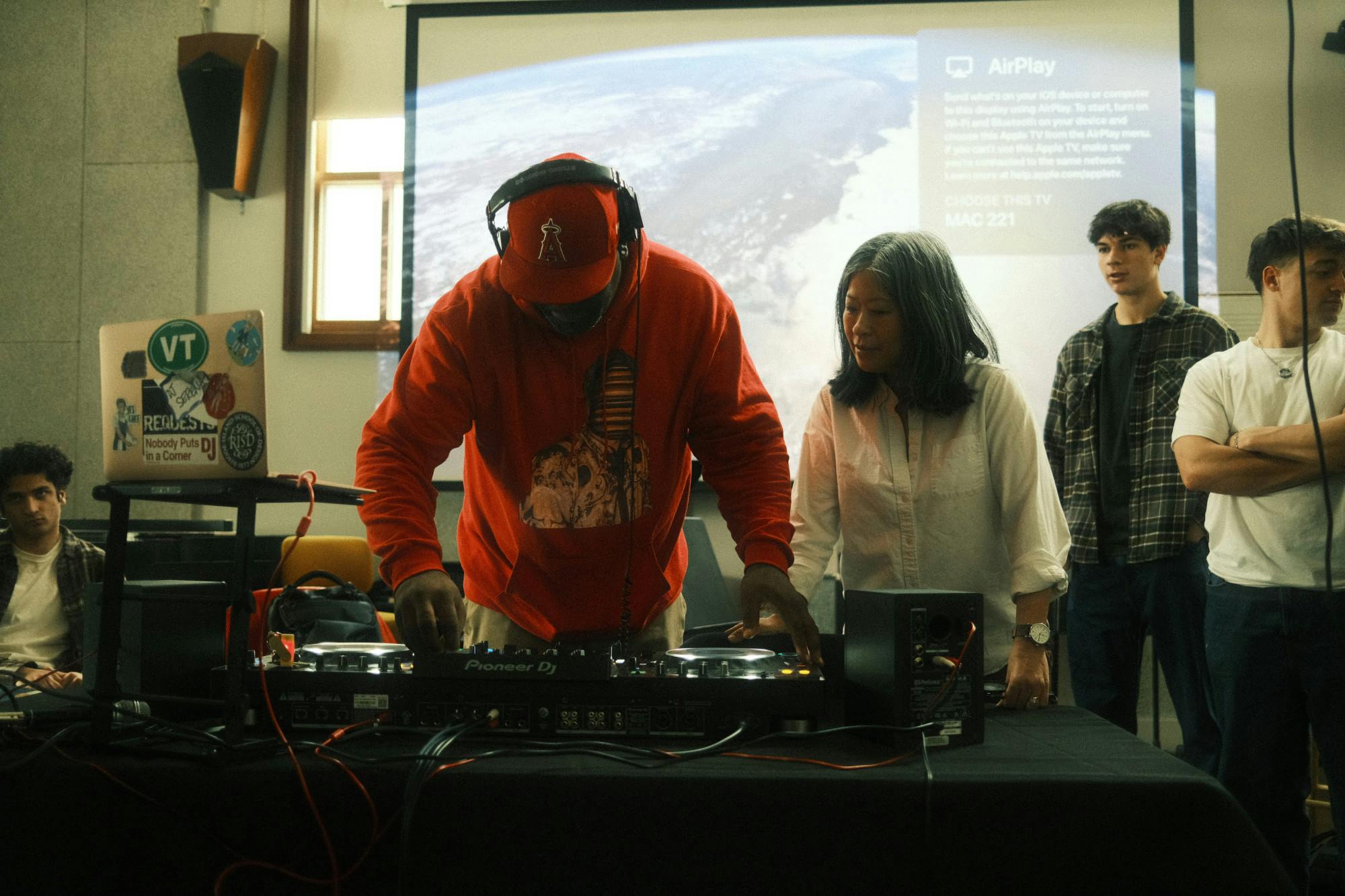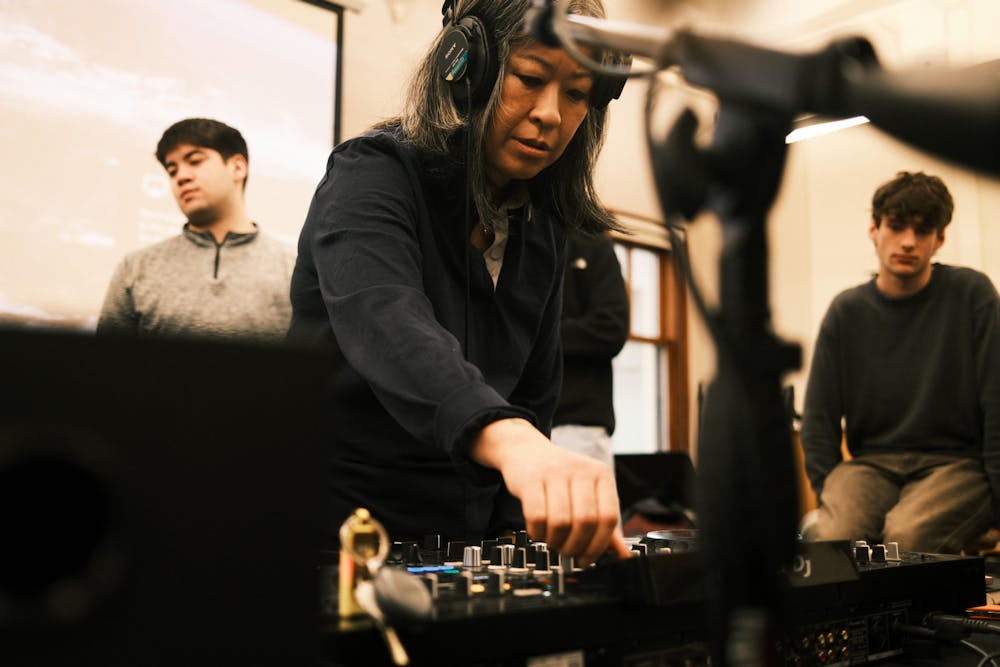
To become a professional DJ requires a comprehensive musical knowledge, mastery of the turntable technology and the ability to read the dancefloor. In the highly sought-after J-Term Class “Craft & Culture of DJing”, my peers and I have spent our month honing our DJ skills.
Under the musical tutelage of resident DJ and co-owner of the Swift House, “DJ Serena Kim,” we have grown a new appreciation for the role that the DJ plays in music and dance culture. The course will soon culminate in a final DJ set hosted in the Freeman International Center Bunker from 7-10 p.m. on Jan. 29. We will be performing the music we have studied on the turntables in 20-minute increments: Arabic Electronic, Reggae, Hip-Hop, Afrobeats, Disco, Techno, EDM, House and a finale of Latin Trap/House.
The vastly different backgrounds within the art form coalesce into one factor that unites all DJs: liberation in the act of mixing and playing new music.
Whilst learning to DJ for our J-Term class, we have been exposed to new songs and genres of music by DJ Serena and our fellow peers alike. Reading “Last Night A DJ Saved My Life” by Bill Brewster helped us to explore the roots of the art. This, alongside listening to the pure, genre-defining, and hidden-gem songs of Reggae, Disco, House, Hip-Hop, Techno, EDM and Afrobeats, uncovered the socio-cultural-political roots of these musical genres.
The class emphasized that the origins of most Modern Dance music were in the Caribbean. Riddims brought to Jamaica by enslaved Africans were transformed throughout the years of their performance. Their repetition, groove and low frequency centered on drum and bass resulted in a music that was both felt and heard. As the sound evolved from Mento to Ska to Rocksteady to Reggae, a new social movement emerged: Rastafarianism. Spearheaded by Pan-African and Jamaican activist Marcus Garvey, preaching a “return to nature and spiritual connection,” the social religion spread like wildfire across the Caribbean and the world through Bob Marley’s Reggae Music. The Culture of Reggae and its performance in dancehalls through soundsystems created by the first DJs and Dub artists inspired the culture of DJing. This musical performance style was brought to the New York Boroughs of Brooklyn and the Bronx by Jamaican immigrants who, in sharing their craft, gave birth to modern music and DJ performances.
One might associate Disco with Flashy Suits, Bell Bottoms, glimmering strings, guitar riffs and a four-on-the-floor beat. However, that white-American mainstream idea of disco eventually led to its demise due to the Rock’N’Roll uprising in Middle America. Now, pure disco music was not a sound; it was a feeling created from Afro-jazz, Caribbean and Latin dance, and Philadelphia Soul, sounding wildly different from what it would eventually evolve into.
Its roots were planted in the movement for black and queer liberation in the late 60s and early 70s. After the Stonewall riots, a family of like-minded black and gay men would reune in the apartment of legendary DJ David Mancuso for after-hours events with liberating music without fear of police retaliation and NYPD raids. They danced together in this space to feel free.
During a guest lecture and workshop from DJ Serena’s colleague, Brooklyn-based DJ Gold Finger, he noted that “Music isn’t a sound, it’s a feeling.” The DJ feels it in their body the same way that the dancers feel it on the floor. Music moves people through the night. It’s the DJ’s duty to feel the energy within the space and the music that he plays in order to convey the story contained in their DJ set throughout the night.
DJ Goldfinger grew up in a musical family, starting as a child prodigy on the turntables at just nine years old. He grew up listening to Soul artists like Stevie Wonder, Aretha, and Al Green, and he believes that there is soul in every music genre and every musician.
“Anybody that feels passionately about what they do has soul,” he said.
Frankie Crocker was another influential artist in DJ Goldfinger's emerging musical palate during the beginnings of Hip-Hop.
“He was one of those guys who played the big song that you had never heard before, cause he had so much cashé he put you on what to play and what felt good,” Goldfinger said.
During his childhood in Downtown Brooklyn, DJ Goldfinger would frequently run into neighborhood celebrity Hip-Hop Artists and DJs while roller skating around listening to music on a boombox.
“The first foundational platinum Hip-Hop Supergroup Houdini was my neighbors," he said, “We used to watch Run DMC leave on the tour bus through the window waving hey’s, and be safe.” He’d play the music that he knew and had available to him, went hunting for new records in his neighborhood, and exchanged music with friends, becoming known not only for the songs that he played at functions, but how he worked them on the turntable.
“Back in those days we would have block parties so you'd have gatherings of people from outside your neighborhood come into your neighborhood, so certain songs you'd be known for is kind of how the neighborhood reflected itself, ” Goldfinger said.
If DJ Goldfinger had to elect one artist to represent Brooklyn, he’d be faced with a tough choice: “Biz Markie was the sound of Brooklyn for a long time, but you know how Brooklyn is, so vast [the city is] always changing.” And so is the rest of the DJing community. From its technology, to genre, to its culture, DJ Goldfinger notes, “everything is always moving, everything is always changing.”
While the class covers many different musical genres, both DJ Goldfinger and DJ Serena note that the concept of “genre” is made up. DJ Goldfinger notes, “Genre is dictated by culture.” In my understanding, it’s an arbitrary box that was designed in the beginnings of recorded music and radio to separate black music from white music, black radio from white radio, and black DJs from white DJs.
“In this class we aim to make DJing an inclusive space for everyone at Middlebury,” DJ Serena said.
Starting out as an unpaid intern at a record Label, DJ Serena eventually worked her way up through networking with other DJs, performing as a backup DJ when the one that was booked for the night was a no-show. She eventually landed solid NYC gigs at Limelight and Tunnel, working in Beat Street Record where she met DJ Goldfinger, and writing music journalism for hip-hop Magazine “Vibe” in the 90s, making her one of the first generation of female hip-hop DJs. Though she may not fit the typical mold of what one might imagine a DJ to be, she continues to guide a cohort of new DJs, passing down her compassionate and inclusive pedagogy of DJing.