
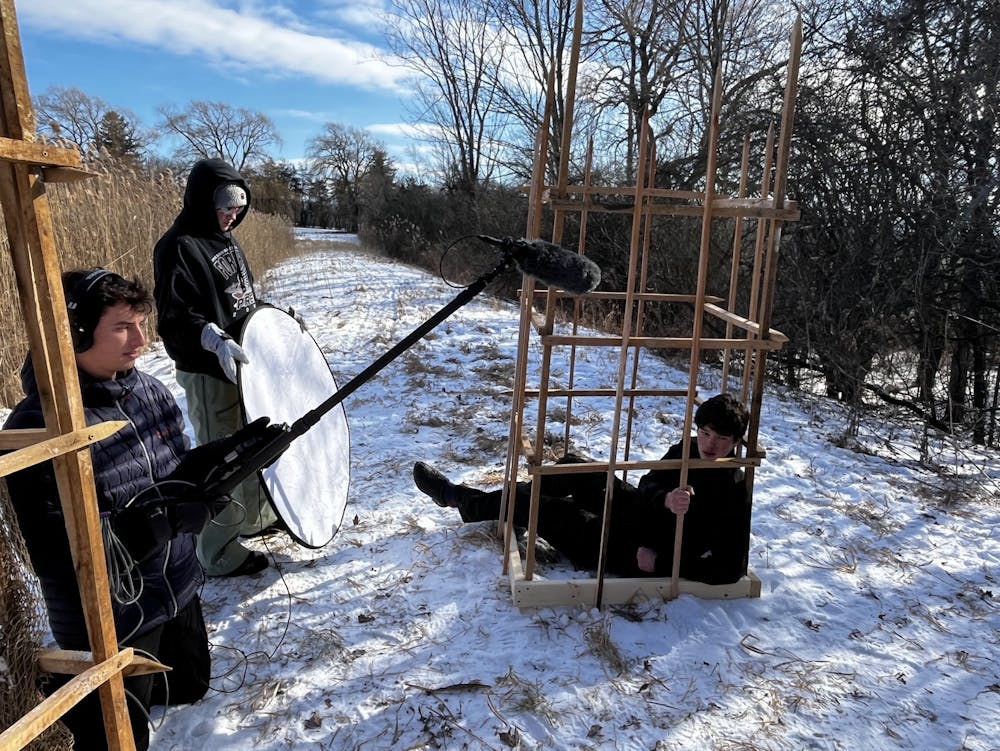
I share a wall with Joey Disorbo ’25.5, so I know first-hand that those inconceivable work hours stats cited on his film’s informational poster board are true: 2000 hours, split across a thin crew. I know it from the many weekends I’ve seen him holed up in his room editing; I know it from the times I’ve been called in to give feedback on music, sound design and visual effects; I know it from the piles of props and costumes that fill our basement storage space; and I know it from that winter semester where he was practically invisible on campus.
Disorbo and I are both Super Senior Febs now, but I can remember a pivotal moment in this long, creative journey years back. In our sophomore year, he showed me his proposal to the Middlebury College Curriculum Committee to create his own major as an Independent Scholar.
He was approved by the committee, and so began a long and grueling process which would come to some kind of conclusion at the end of fall 2025.
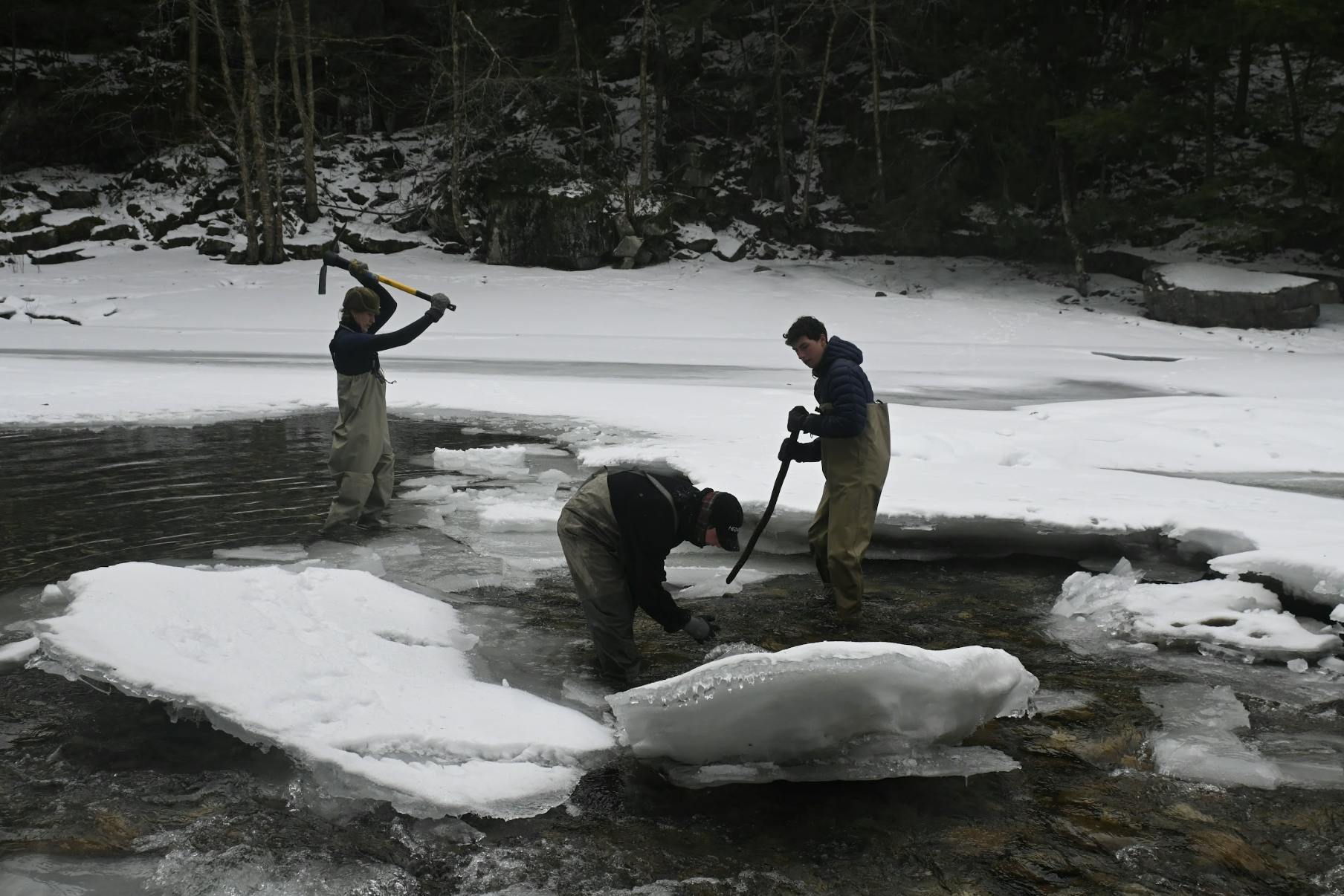
On Dec. 7, the (near) final cut of Disorbo’s feature film, “Envoys”, premiered. A crowd of well-dressed students, parents and faculty shuffled into the Sunderland Language Center and across a long red carpet. A poster greeted the audience at the door of Dana Auditorium, breaking down the early creative process, the filming weeks and presenting a rundown of all the work involved in such a gargantuan project. A team of ushers, ticketing attendants, interviewers, photographers and videographers (all students) guided visitors from door to seat — a seamless and overwhelmingly professional process. If I had slipped on the ice and hit my head before entering, I might’ve believed I was at the opening night in Cannes or Sundance.
“Envoys” is no secret homage to Joseph Conrad’s “Heart of Darkness,” and, by proxy, to Francis Ford Coppola’s “Apocalypse Now”.
“In the collapse of a second American civil war, two coalition envoys journey to a remote rebel encampment to deliver a ceasefire ultimatum to its reclusive, fanatical commander,” reads the logline. “Envoys” is part speculative fiction, part war drama, part action and part comedy. The range of tone works well; there is enough time and space in the film for the mood to shift naturally, from the goofy Canadian sharpshooters to the eerie and ailing General Kurtz.
Lead actors Jin Lee ’25 and Georgia Crosby ’25.5 play the pair of military expendables, and are almost at all times onscreen. They have a large load to carry and, for the most part, they carry it well. Lee channels the narrative’s intensity, and Crosby captures its necessary subtlety and doubt.
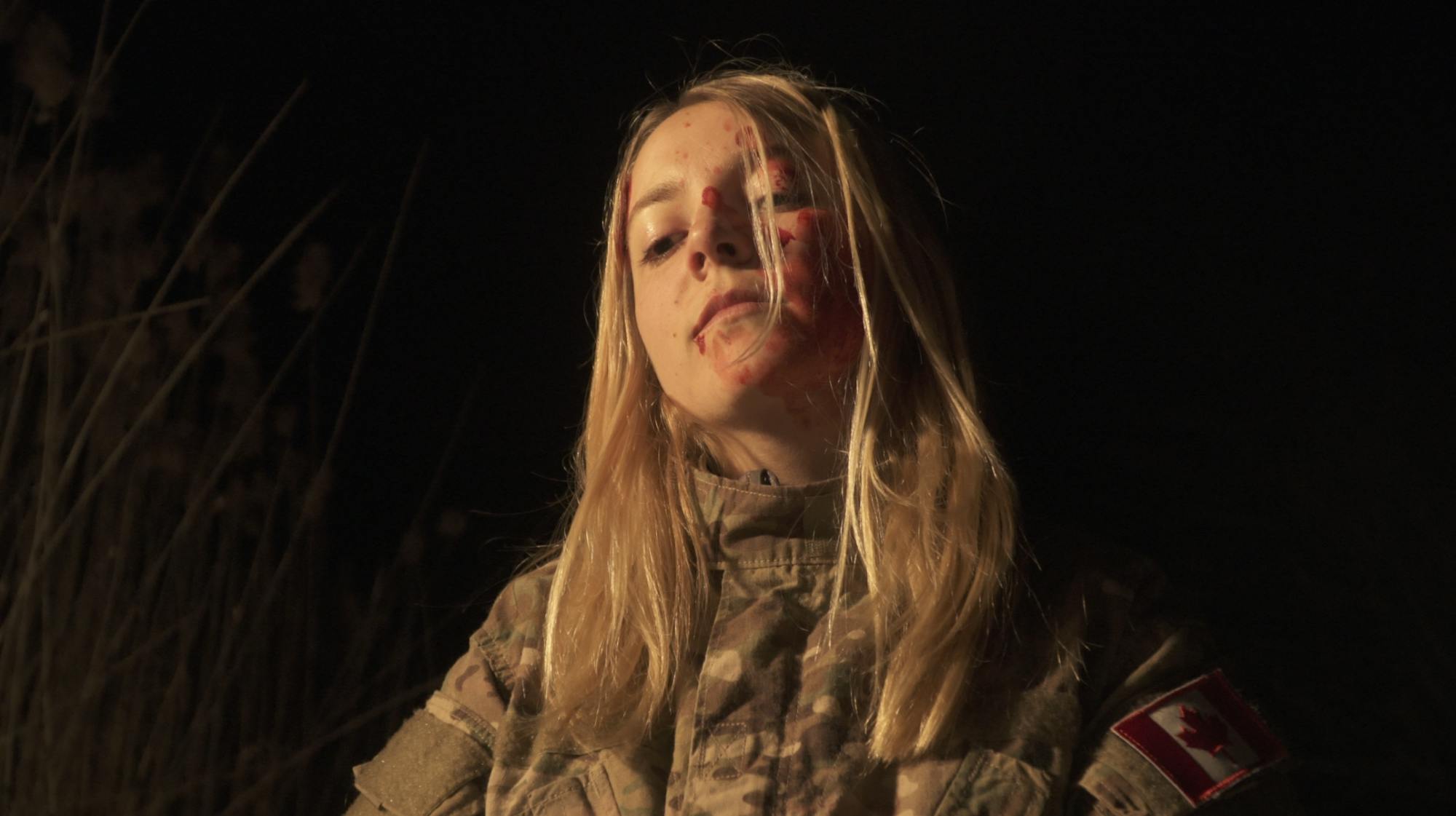
The action sequences feel straight out of a major studio production. The choreography is crisp, the set pieces are menacing and the sound is intense. The costumes and set design are similarly impressive, and certainly punch way above their weight class.
“Envoys” is more of a visceral ride than it is an emotional one. Though you aren’t too attached to the characters even by the end, you are certainly swept up by the pacing and the dramatic intensity, especially during the electric final act.
Even disregarding the creative, financial and logistical difficulties inherent to a student project, “Envoys” is an incredible achievement. The acting, the directing, the creative vision, the sound, editing and the spectacle of the event itself were all incredibly impressive, and to think that Disorbo achieved this while also balancing a normal course load and all the other complexities of college life is astounding.
I sat down with Disorbo to gain more insight into the process and learn why and how he made this massive project happen.
Anthony Cinquina: What is it you really want people to know about the project?
Joey Disorbo: I want other people to know that they could do this. I guess that’s not the entire reason I did this but that’s a pretty large point. I intended to demonstrate that you don’t need a department to perform a project like this, you can do it through sheer force of will. I’ve done this twice now because I’ve done this in the theater realm too; I wrote and put on my own play, Rospo, and that was something I just put on independently.
The same is true with Envoys: I split from the department and did it myself. And I think any student should never feel like they are boxed in by requirements decided for them by a major. That’s what I intended to prove…that you can genuinely just decide what you want to do and do it. You just act.
AC: You’ve done this twice: the play and now the movie. What has been your experience going through channels other than the formal, official ones to do creative projects?
JD: People are very willing to help you. They’re more willing to help you than you might expect. When I did the play, Jim Dougherty in the Theater Department helped us immensely; Similarly for the film, Ethan Murphy in the Film Department helped me on the technical side in the end. He didn’t have to do that, but he just did it. We got the most help from Media Services in Davis, Joe DeFeliece was generous with our filming equipment for months, and Johnny Meli saved my sorry soul during the test screenings in late December.
Generally if you show people you are serious, they want to help you however they can. It’s one thing if you go there and you're not prepared and not serious, but if you do your homework and you show up ready there's very little reason to say ‘no’.
AC: Why a film? Was that the plan from the very beginning?
JD: In my major, I gave myself the option to do a full length theater play or a full length feature film as my thesis... I had done the play, and knew I could do another. But I wanted to push myself and always knew that film is a medium that is more malleable by an independent creative force. So because I wrote [the film], directed it, and importantly did all the post production, I basically got to shape every frame.
Why film? I think I’ve always wanted to do it. When I was a freshman in high school I was already writing scripts for tentative films. Of course they were all terrible. But I made a couple of shorts in high school, and I responded well to the intensity of the filmmaking process.
AC: Did the idea come about only when you started the writing process? Was there some version of the story in your head before that?
JD: Well it starts with music. When I listen to music I’m presented with sequences that are like short videos or scenes. So that comes to me before I write anything; there are no words. So the idea for this really started from music, from the music that is in the film. I wrote the film starting with John Adams, specifically his “Shaker Loops” and “Harmonielehre.” So I listen to those and I see the scenes, before I even know what the movie is about.
AC: So this was even before you had thoughts of basing the movie on “Heart of Darkness?”
JD: Yes, yes. I mean just the sequences themselves are not enough for a movie. I was profoundly affected by “Heart of Darkness.” I wanted to confront it, and so I chose to loosely adapt the novella to these images. Even my play, it was based on a novel: “A Handful of Dust” by Evelyn Waugh. The play continues off right from the end of the Waugh narrative. And I’ve noticed that a trend for me is to be directly and openly in conversation with classic works. I find it necessary, because the classics are classics for a reason. If we’re not in dialogue with them we’re not using them the right way.
Because I’m not just coming up with this [story], this is all derived from other things I’ve encountered in my life. The first maturity for a thinking person is to understand that they don’t have original ideas, they have original syntheses of other people’s ideas.
AC: What state is the film in now? Are you working on it? Where will it go from here?
JD: State of Sisyphus… Right now I’m doing another polish pass as we’re talking. I’m going to attempt to submit it to festivals. I want to see how people receive it out of the Middlebury sphere. It’s bound to leave a specific impression on the Middlebury audience because its Middlebury locations with Middlebury people. But to people who don’t know anything about Middlebury I hope it holds up, and that’s the intention behind that.
AC: Do you have a favorite part of the movie? A favorite scene, character, idea?
JD: My favorite part is the climax with the John Adams’ Shaker Loops, what I call Coraline’s Reversal. In order to complete her journey, Coraline needs to surrender to the violent identity that she has tried for years to suffocate, and this requires a radical self-acceptance. Coraline metabolizes her guilt, and is reborn. She kicks her head back with a deep breath, and for just this moment, she experiences true freedom, which is freedom from morality. To me, this is beautiful. I think that’s the most lucid, existential, important moment.
But honestly the most entertaining moments for me were with the Stingers – Ryan Carron ’27 and Chris Clyne ’27 as comic relief snipers. I had the most fun shooting those scenes, the most fun editing them, and if anything that’s an indicator to me that I should be pursuing something a little more comedic in the future.
AC: So the next project will be a comedy.
JD: Perhaps, if this was a tragedy the next will be a comedy.
AC: I'm looking forward to it.
Editor’s Note: This interview has been lightly edited for clarity.
Anthony Cinquina '25.5 (he/him) is an Arts and Culture Editor.
Anthony has previously worked as a contributing writer to the Campus. He is majoring in English with a minor in Film and Environmental Studies. Beyond The Campus, Anthony works as a writing tutor at the CTLR and plays guitar for a rotating cast of bands.


