
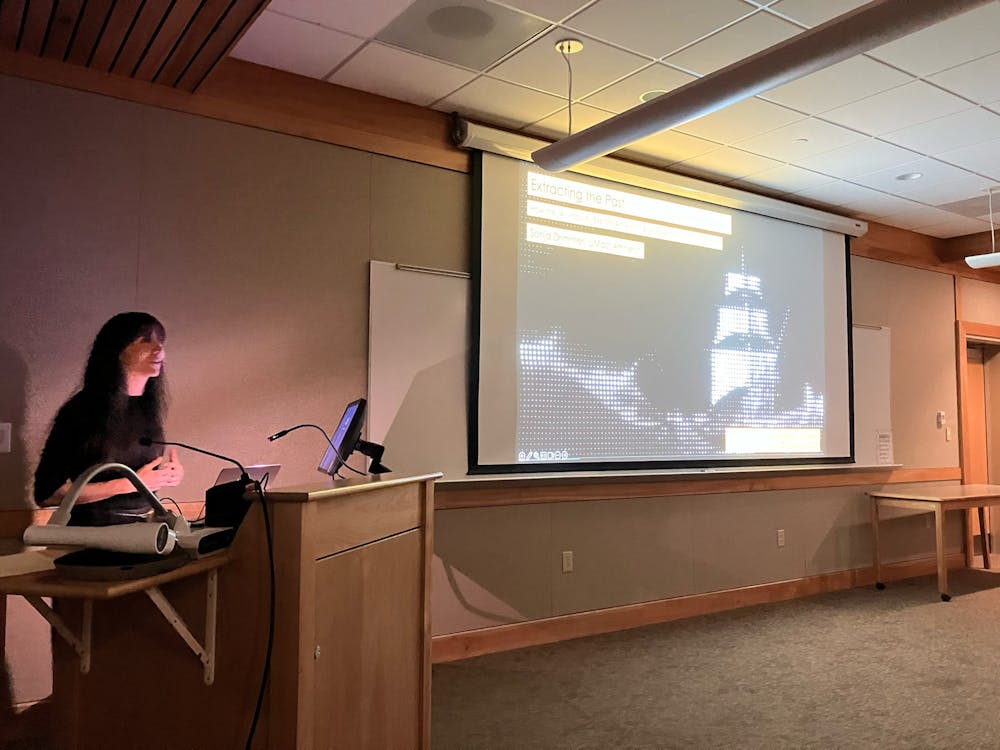
Students and faculty gathered in the Mahaney Arts Center last month to discuss what some describe as the most pressing issue of our time — artificial intelligence (AI) — and how the rise of its industry exploits the arts.
Sonja Drimmer, an associate professor of medieval art at the University of Massachusetts Amherst, led the talk on Oct. 23. As an art historian, Drimmer focuses on the aesthetics and material culture of politics, along with an examination of pre-modern conceptions of power and authority. Over the past few years, she has focused on studying AI as a “cultural buzzword,” with her talk at Middlebury drawing directly on her research for a forthcoming book on the topic.
Drimmer began her talk by drawing attention to an ad that OpenAI premiered at the most recent Super Bowl. Titled “The Intelligence Age,” the ad summarizes the history of humanity in under a minute — beginning as a small dot in a matrix that expanded over centuries before emerging into the current digital age. Aided by detailed visuals, Drimmer passionately emphasized how this formulation of history is an attempt at rewriting the past for corporate gains. She stated that, to the AI Industry, “the past is just a collection of data points on a bar chart of progress, its ultimate destination a utopia of efficiency, optimization and uncertainty.”
The manner in which computer vision has been “extracting the past” even prior to the rise of AI is her pivotal argument. She explains this point by classifying history into categories based on their exploitation by the tech industry. The first of these is “strip mine history”, wherein companies reduce all images of the past as simple data to be rendered. The second, “stagist history,” refers to a reductionist view of the past — exemplified by the OpenAI ad — in order to mold a specific vision of the future. The third stage is labelled “Trojan Horse history,” which refers to institutions today that are constantly trying to one up each other in the AI race; acquiring AI models that are bigger and better than the previous ones.
To elucidate, Drimmer asked the audience whether they’ve ever been subjected to a Captcha test, one that most of us have become familiar with as residents of the digital age.
“When you are credentialing yourself as a human by means of a reCAPTCHA, what you are actually doing is training Google's image recognition algorithms for free,” Drimmer said.
She then highlighted how the process of data visualization — still used by companies such as Google and Apple — is based on age-old practices that had previously been discredited and debunked. Connecting modern technologies with their histories, she stated that facial recognition features employed by these companies today still follow the rudimentary binary model first created in 1958. The modern version of this practice comes from companies training data algorithms to recognize predominantly white facial features, causing Apple photos to correlate images of black men with images of gorillas up until 2015. Now, attempting the exercise again 10 years later, Drimmer illustrated via her own photo gallery. Instead of altering the algorithm to tackle the problem, the ability to search for images of gorillas has entirely vanished. Thus, this is one of many ways such glitches work to increase funding for such technology without actively tackling its flaws.
She explained that this is where the history of art comes in. Google first inaugurated its arts and culture platform in 2011 and quickly began partnering with museums and galleries worldwide to “organize the world’s information and make it universally accessible.”
Partnering with museums for digitization initiatives became a tool for Google to strengthen its image recognition algorithm, once again conscripting the public to do its labour for free,” Drimmer explained.
She provided the example of the “art selfie,” which in January 2018 acted as a popular gimmick to upload selfies in order to match them with a historic doppelganger.
“The problem from my perspective is about the investments and priorities of those who have developed AI as a commercial enterprise whose only hope for profitability is to forcibly integrate it into every sector of life, no matter how inappropriate,” Drimmer said. This, to her, is the underlying issue that art historians face today. It is not necessarily the functionality of AI, but instead how it reduces art to a means of material gain for the corporate world that begs critical attention.
Drimmer then pivoted her focus towards the use of ChatGPT at universities.
“It’s never made clear how research in the historical humanities is aided by this infusion with AI, but universities are going full-steam ahead, enticed by the Trojan Horse of private money to plug the hole left by state and federal divestment,” Drimmer said.
Herein lie the issues with OpenAI’s goals: it's supposed to be accessible to all, a tool that simplifies otherwise complex processes in order to pave a better future for humanity. But, Drimmer’s talk questioned who really benefits from this accessibility, and if there is really a need to simplify something as abstract as art and reduce it to a set of data points.
“We need to thrive in the present in order to have a future worth living in,” Drimmer said towards the end of her talk.
However, instead of blindly embracing the rise of OpenAI, she stated that we must question pre-existing systems of power that currently act as detriments towards the accessibility of higher education.
The question of AI integration is one that has recently sparked discussion amongst the Middlebury community following MiddCore’s partnership with OpenAI during J-term. Thus, Drimmer’s lecture comes at a time of immense debate and uncertainty around the future of higher education, propelling us all — even outside of the History of Art department — to ponder its long-term ramifications.


