
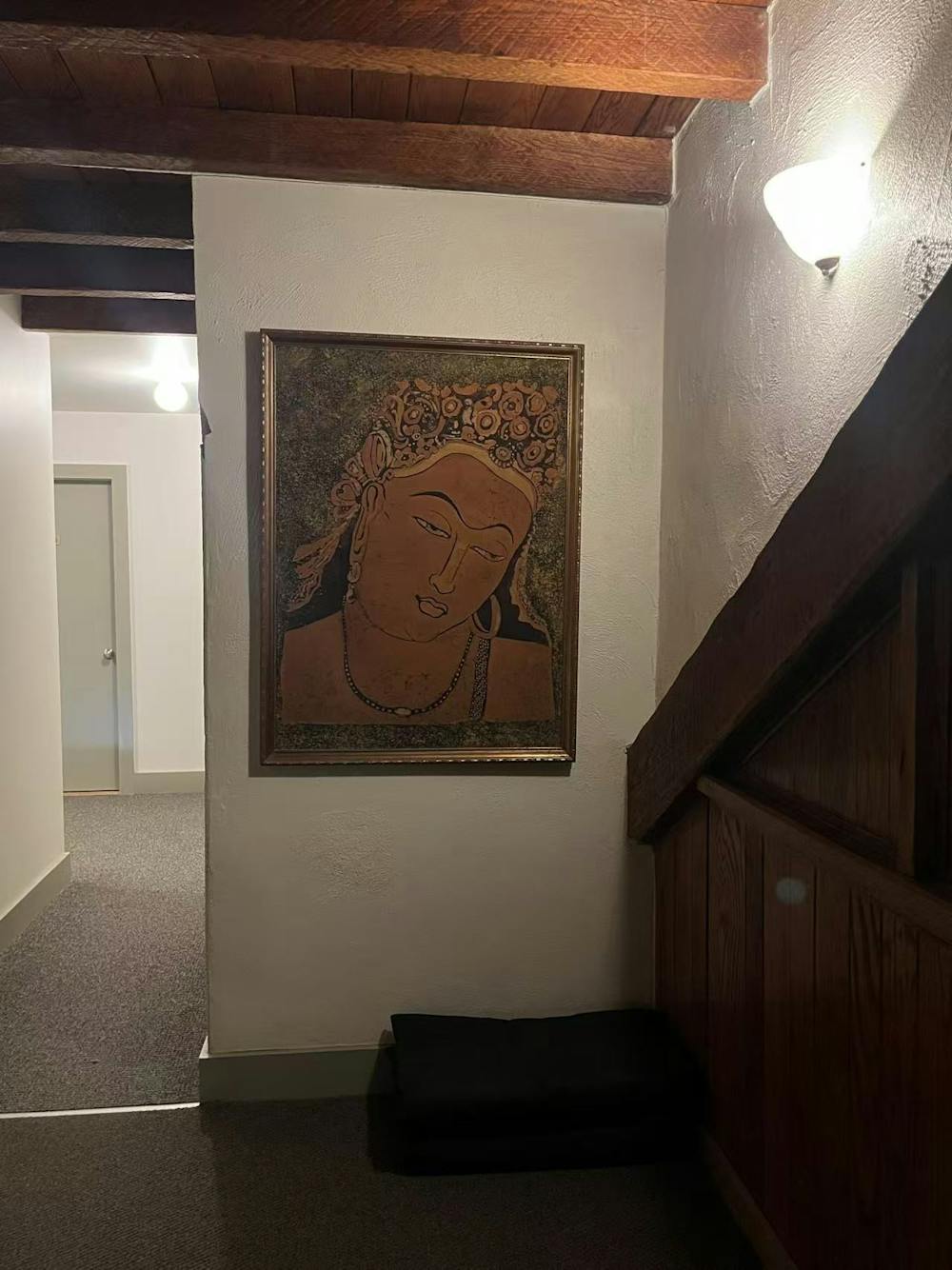
I spent the past weekend at Zen Mountain Monastery in Woodstock, NY, where Professor Waldron from the Religion Department gave a workshop on The Buddhist Unconscious: Yogācāra Buddhism and How It Illuminates Bias.
New to the monastic setting, I felt briefly transported to a sacred and misty world reminiscent of “The Lost Horizon.” The rules and pace of conventional society were temporarily lifted, replaced by a decidedly inward energy. No one was rushing anywhere but looking to arrive within themselves. Before going, I had hoped for the swirling thoughts and feelings inside of me to settle into some kind of discernible pattern. That, however, did not happen. In the company of fellow seekers and sufferers, I seemed to have realized just how much of a writer I am. For one thing, I kept repeating to people who asked: "I want to be a writer;" and "I live my life as a story."
Mischief is, of course, everywhere. My first dinner at the monastery was out in a wooden shed with a couple of guys in their early twenties trying to figure out life. It was their secret smoking spot. We talked about suffering in the rain. At that very moment, I felt simultaneously embedded in life and removed from it, all the while reflecting on how I so often live for the aesthetics of experience — how I feel more drawn to the feeling of being in a monastery than to the actuality of it.
People from drastically different life stages and backgrounds met with immediate sincerity and vulnerability. A simple “Why are you here?” could get a whole world to open up. Instead of gathering catalysts for some spiritual insight, I walked away from the weekend with a rich bundle of revelations, mystical experiences, and tortured inquiries — the raw, intimate “stuff” of other people’s keenly examined lives. This aspect of connection and mutual recognition was, to me, far more affecting than the heavily ritualized and overtly ceremonial monasticism itself.
The daily structure was highly regimented. My day started at 4:55 a.m. and ended at 9:30 p.m., with extensive meditation and chanting sessions, as well as distributed chores in between. Having only a weekend to acclimatize, I found the formalities of sitting and chanting verses in a group for designated periods of time constricting rather than illuminating; I have felt more connected to my interiority and to the elements meditating under a tree somewhere along the TAM.
One thing was for certain: With everyone I talked to, I got to know myself better. Perhaps it was the unwithheld sincerity, the clarifying mountain air or the psychological depth that people are willing to descend to before they even learn your name: in response to questions and comments from other people at the monastery, I said things that were extraordinarily revelatory about myself, as if they were finally prompted to manifest from the substratum of my mind.
On my last morning, I realized while meditating that it’s okay to be confused, that I should approach life in all its raggedness and randomness with a kind of perceptual immediacy (which allows me to be intimate with life) accompanied by infinite empathy (which allows me to behold and accept all phenomena with compassion).
I was reminded of my favorite passage in To the Lighthouse by Virginia Woolf: “What is the meaning of life? That was all a simple question; one that tended to close in on one with years, the great revelation had never come. The great revelation perhaps never did come. Instead, there were little daily miracles, illuminations, matches struck unexpectedly in the dark; here was one.”
I had come to the monastery searching for something akin to “the great revelation.” I left, instead, with a deeper understanding of myself through connecting with others — all of us caught in this beautiful web of knowing and being known.
“What’s your relationship to the part of your story that you can’t write?” A woman who, like me, wanted to make meaning and bridge worlds in her youth, asked me.
“I’m in hopeful anticipation to it.” I said, delightfully surprised by my own words.
Christy Liang '28 (she/her) is an Arts & Culture Editor.
She is an English & Religion major who loves long conversations, live music in underground bars, and films that are a little pensive. She's genuinely curious about what goes on in other people's minds. Her column, "Conversational Art," is a series of interviews with student and faculty artists across all mediums.


