
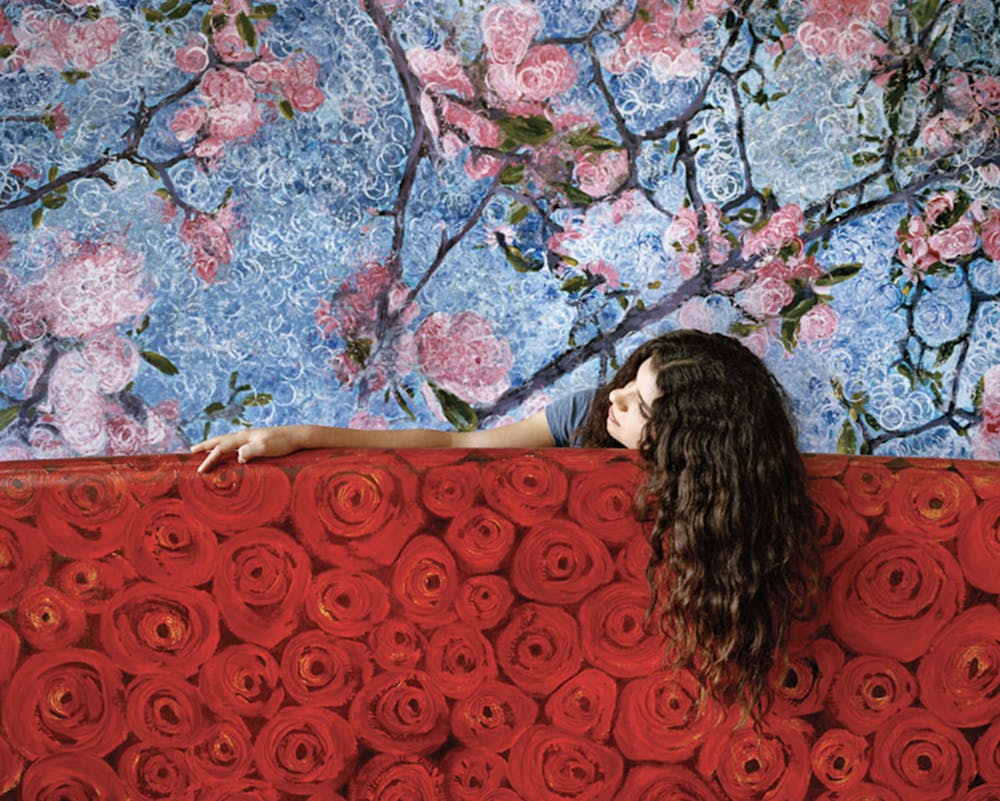
Lebanese Palestinian American artist Rania Matar gave a captivating talk about her photography exhibition “SHE” in the Middlebury College Museum of Art on April 17. The event — initially planned for when her exhibit debuted back in February — was rescheduled due to unforeseen weather circumstances. Titled “From the Personal to the Universal,” the talk chronicled Matar’s photography career, spanning from the U.S. to the Middle East.
Originally coming to the U.S. in the 1980s to study architecture at Cornell University, Matar did not discover her love for photography until she became a mother. Enthralled by the beauty in the mundane and chaotic moments at home, she picked up the camera to document her children.
Beyond domestic life, Matar was drawn to the universal complexity of girlhood and womanhood, which led to her photographic series “A Girl and Her Room.” Capturing teenage girls on the cusp of womanhood in an intimate space of their own creation, Matar discovered the universality of growing up — a counter sentiment to the overarching divisiveness in the U.S. after 9/11. In this collection, Matar experimented with proximity — “how much closer could I get to them [before being chased away].”
Each photograph is a glimpse into teenage angst, performativity and vulnerability. The organic mess of the room externalizes the girls’ emotions. Matar also juxtaposes the passage of time both in the individual sense of growing up and in the intergenerational bond between mothers and daughters.
Especially interesting were the photographs where the mother-daughter pair both occupy a space with an unspoken yet potent intimacy — the genetic bond made apparent by the striking similarity in one or more features. The mirror motif further complicates this dynamic of kinship by introducing notions of assessment, parental control and repetition of inherited patterns.
Matar’s photographs of Lebanese women are gripping and poetic testimonies to the devastating aftermath of the Lebanese Civil War and the timeless grace of human resilience. Against derelict backgrounds, these women turn sites of ruins and rubble into means of empowerment. Matar collaborates closely with her subjects to decide on the spatial and stylistic arrangement of these photo shoots. One of the women chose to be photographed near broken glass because she was once injured by it, making the process of creating art a cathartic one.
According to Matar’s statement on her professional website, her photographic process is “collaborative, and the photo session evolves organically as they become active participants in the image-making process, presiding over the environment, and making it their own.” She finds herself “focusing on their strength and their majestic presence.”
In another image, Matar photographs a woman, Farah, in her burned car. In October 2019, protests broke out across Lebanon against political and economic corruption. Farah was one of the thousands of protestors and returned to find her car burned by those attempting to undermine the protestors’ movement. Matar specifically asked Farah to keep the car in its ruined state for a photo to memorialize the moment.
Most photographs, however, were not as intentional. In another photograph, Alae — a young Lebanese woman Matar collaborates with extensively — is pictured in the aftermath of the August 2020 Beirut port explosion, which led to over 200 deaths, thousands of injuries and widespread displacement in the country. Standing on the top floor of Matar’s father-in-law’s apartment, Alae looks out into the distance, her face reflected in a small circular mirror that she holds up. The viewer becomes a voyeur to Alae’s private introspection, her gaze unfocused on the camera. Her expression is testament to the immeasurability of loss and the incomprehensibility of war.
Anchored firmly by individual expression, Matar’s photographs reflect a timeless and borderless sentiment, underscoring our shared humanity across geographical and cultural connections. Her work testifies to the unfaltering power of art against larger destructive forces.
Christy Liang '28 (she/her) is an Arts & Culture Editor.
She is an English & Religion major who loves long conversations, live music in underground bars, and films that are a little pensive. She's genuinely curious about what goes on in other people's minds. Her column, "Conversational Art," is a series of interviews with student and faculty artists across all mediums.


