
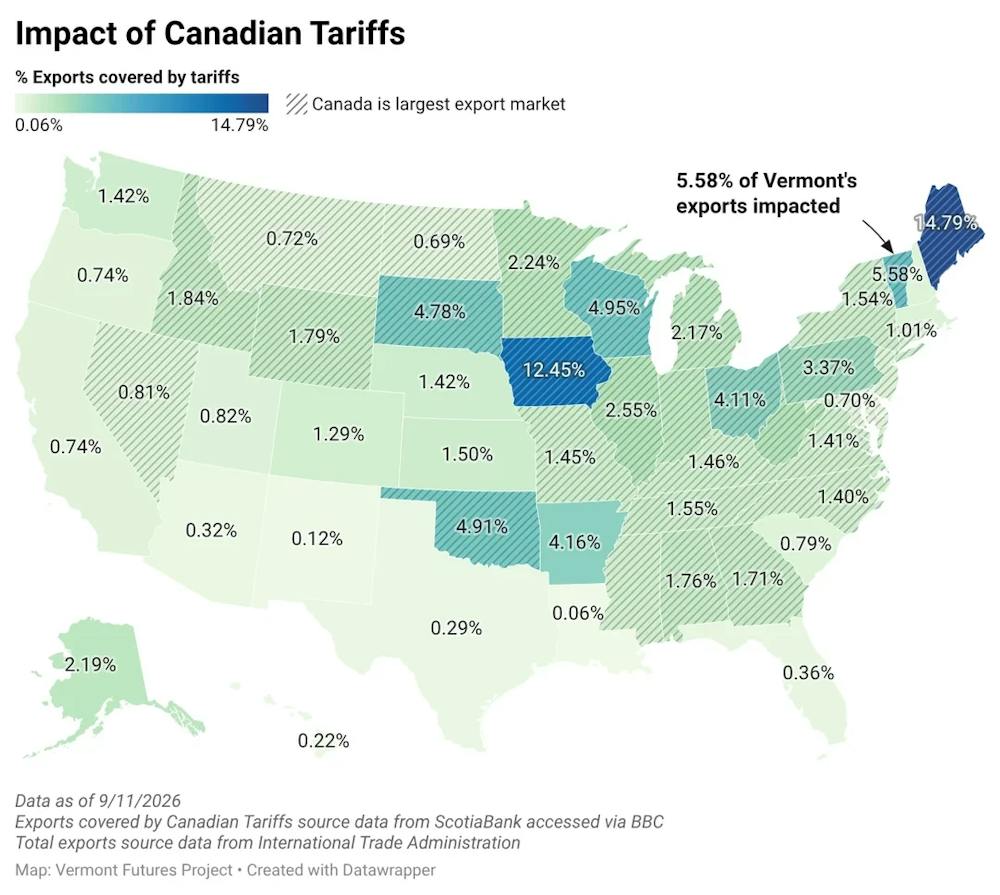
On Aug. 22, the Trump administration imposed a 50% tariff on $20 billion worth of Canadian goods, prompting reciprocal tariffs from the Canadian government and leaving Vermont caught in the crossfire of an unprecedented trade war between the two nations.
Since Vermont borders Canada, the state’s economy has historically been deeply integrated into Canadian supply chains, especially in the wake of the NAFTA and USMCA agreements, which normalized cross-border cooperation. With the sudden interruption of amicable trade relations between the U.S. and Canada, Vermont businesses are struggling to adapt.
On Sept. 1, in the wake of the tariff announcement, Vermont Senator Peter Welch hosted a press conference at Jay Peak where he spoke with local business leaders to explain the expected economic impacts. During the meeting, he warned of dire economic consequences for both Vermonters and Canadians and asked the Trump administration to consider the concerns of border states who are most directly subjected to the consequences of the tariffs.
Thousands of Vermont businesses rely on Canadian partners for their services, from dairy farmers who sell their products into the Canadian market to custom ski companies who use Canadian manufacturing facilities. These longstanding business relationships are now dragged into question. Customs fees are driving operating costs up, dragging partners back to the negotiating table.
“People understand the importance of Canada to our economy,” Tim Tierney, director of business recruitment and international trade at the Vermont department of economic development, said in an interview with The Campus.
Tierney’s office is currently reaching out to businesses to gauge the impact of tariffs so far. They expect the full effect of the tariffs will likely take about two months to register.
Season Wei ’29, an intern at the Vermont Department of Economic Development this summer, helped compile data on historical tariffs to understand the impact of the current customs regulations.
“One of the most interesting parts of my internship was seeing how changes in trade policy translate into very practical questions for Vermont businesses,” Wei said in an interview with The Campus.
“The tariffs were not just something we discussed as a national policy issue. They became part of the office’s day-to-day work as we tried to understand which products and businesses could be affected and organize that information in a useful way, ” Wei continued.
With the new tariffs, many products that cross the border at some point during their manufacturing — or those that rely on certain parts from Canadian manufacturers — will be more expensive.
“A $1 million engine now has a $500,000 tariff on it. That’s a major problem,” Tierney said.
Addison County is also vulnerable to the economic fallout, as its local economy heavily depends on tourism, dairy and cider production. In 2024, $37 million worth of goods was exported from Addison County to Canada, the county’s largest trading partner.
A year later, liquor boards in various Canadian provinces have removed American brands from their shelves. Tourism from Canada — which has made up the bulk of Addison County’s international tourism in previous years — dropped roughly 60%. These changes are difficult on the many small businesses who rely on during the fall foliage season to sustain themselves in the off-peak months.
“Main Street will definitely be feeling it, Vergennes even more, Bristol even more. The college brings in parents and alums to Middlebury to support local businesses, but the latter rely more on tourism,” Phil Summers, the executive director of the Addison County chamber of commerce said.
To prevent a drop in tourism, numerous organizations throughout Vermont are aiming to promote regional tourism, exemplified by the “State of Inspiration” tourism campaign that launched on July 30 across the Northeast.
Austin Davis of the Lake Champlain Chamber has engaged in a series of talks with his counterparts across the border in an attempt to rebuild confidence in economic cooperation.
Trade talks held in the past few weeks to ease the situation have repeatedly failed. One cause, Canadian negotiators claim, was a demand that Canada reconsider their French language protections. With a provincial election coming up in Quebec, the Canadian representatives made it clear they would not back down from their stance, which made negotiations considerably more difficult than usual.
Beyond the economic and political tensions that have arisen between the two countries, matters of national security are also in play. Several defense companies work on both sides of the border, meaning that even products for national defense may face a tariff.
“Canada is one of our oldest defense partners. No one expected to find themselves in this predicament,” Davis explained in an interview with The Campus.
The relationship between Vermont and its northern neighbors is not expected to improve anytime soon. On Sept. 17, Canadian Prime Minister Mark Carney welcomed the European Union’s offer to begin the process of becoming an associate state, which will completely transform Canada’s trade profile. Even with a change in federal policy, the previous business arrangements involving Vermont businesses seem less and less likely to return as Canada continues to diversify its trade.
“Once these supply chains shift, it will be very difficult to rebuild them,” Tierney said.
The uncertainty and volatility of recent federal trade policy have caused much anxiety for businesses on both sides of the border, with customs brokers helping entrepreneurs comply with paperwork. Many businesses are turning to bonded warehouses to maintain cash flow, paying the tariff only after their inventory is removed from the warehouse instead of when it crosses the border.
“It’s important not to make it all doom and gloom,” Summers said. “There’s a lot of smart people who are still running successful businesses here in Addison. They’ll find ways to work around these issues: figure out some different distribution lines, make ends meet. That being said, some small businesses don’t have the resources to wait it out.”


