
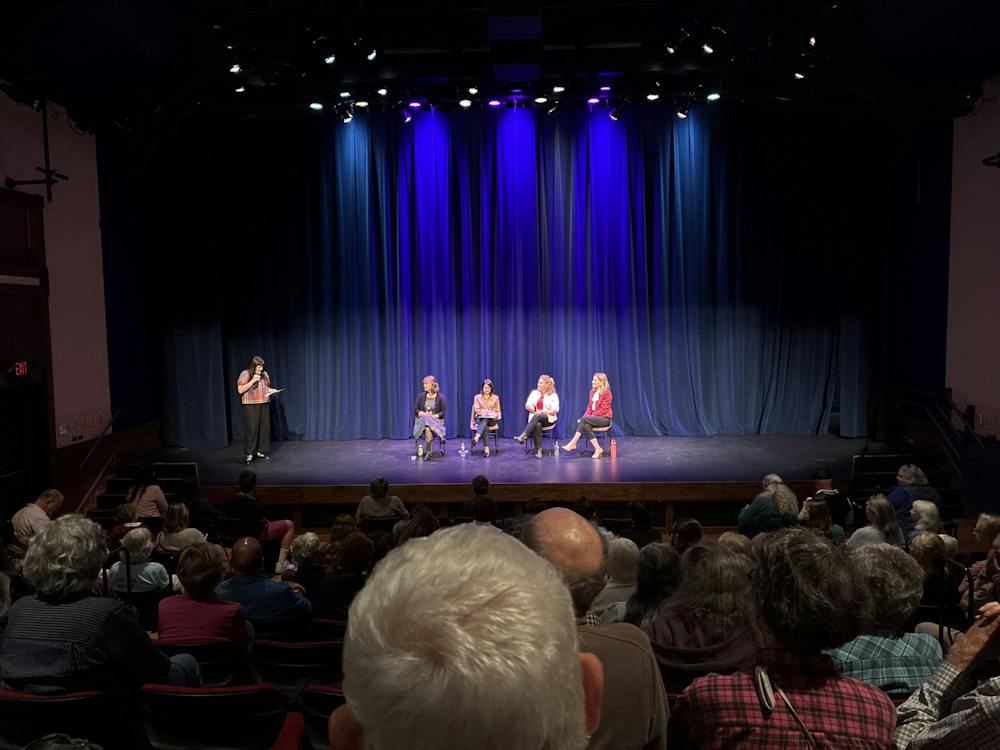
On Sept. 19, Middlebury residents and community leaders gathered at Town Hall Theater for a conversation surrounding the key issues shaping Vermont and the United States prior to the upcoming midterm elections this November.
Over the course of the hour and a half long discussion between State Senator Ruth Hardy, Representative Becca Balint, Vermont Secretary of State Sarah Copeland Hanzas and Vermont Attorney General Charity Clark, the panelists discussed a wide range of topics from affordable housing to mental health. The resounding theme, however? Young people.
Senator Hardy, who moderated the conversation, detailed the importance of this theme initially, noting each panelists’ deeply personal connection to young people.
“All four of us are the moms of young people in Vermont,” Hardy noted. “We all have young adult children or teenage children, and so for us, making sure that young people feel welcome and secure and happy, and that they have a future in Vermont, it's not just our policy for us. It is personal for us.”
Representative Balint, who was the first to speak following Senator Hardy’s introduction, addressed her work in Congress and provided additional details on how young people shape her work.
“I have two teenagers myself: one who just started college, and another who is in high school in Brattleboro,” Balint shared. “And we talk a lot about this time in our country, but also in Vermont, and we talk at the dinner table about whether they're going to be able to buy a house in Vermont, whether they're going to be able to find meaningful work, whether we're going to be able to build a healthcare system that is actually going to work for them. And those fears come up routinely, and I am absolutely shaped by that.”
As Representative Balint detailed the most pertinent issues for Vermonters in conversations around the state, many attendees nodded in agreement and occasionally applauded in support. Unsurprisingly, it seemed the number one issue facing Vermonters was housing, which Balint described as affecting all Vermonters, young and old.
“Young people are very concerned about whether they are going to have a place for [themselves],” Balint reflected. “I get very anxious when people say the youth are our future, young people are our future. They're not the future; they're the now. They're the now, and we need to make sure that we are listening deeply to what they are telling us and having that really direct what the policy is going forward.”
As the conversation continued, each panelist detailed their work in their respective offices, described how they connect with young Vermonters, and most importantly — why that connection remains crucial. Clark, Vermont’s attorney general, who dove into her work as Vermont’s “lawyer to the state,” made a key point about the impact young people can have — notably in collaboration with other young people — by using an age-old example: the Founding Fathers.
“I'm always astonished how young our Founding Fathers were,” Clark remarked. “You know, they did such incredible things, and they were so young, just like some of you here [today]. And I think it's really important to remember that this country was founded by brave people of all ages.”
Copeland Hanzas, Vermont’s secretary of state, encouraged the audience to engage with more young people on the key issues affecting them, and described how it has impacted her career.
“I think that we are missing out on a lot of really important problems that we can fix because we are not activating the youth voices,” Copeland Hanzas said.
Using climate change as an example, Copeland Hanzas mentioned an instance where engaging with young people not only benefited her, but allowed them to explore a key aspect of life in Vermont they were extremely concerned about. Drawing on her time in the Vermont State House, Copeland Hanzas described how becoming the co-chair of the Climate Solutions Caucus led to extensive conversations with groups of young people and how those conversations affected her outlook on climate change as a legislator.
“These are kids who have known since kindergarten that climate change is real. These are kids who were telling us at public forums, ‘I don't know if I even want to have a family when I grow up because I don't know if I want to bring a baby into this world,’” Copeland Hanzas remarked. “And so it was really important to me as we started thinking about climate action, and as we started thinking about what are the solutions that we can find that will really activate those youth voices.”
In fact, young people organized Saturday’s event, specifically Rafaela Botti, a high school senior, Middlebury community organizer, and recipient of the John Lewis Youth Service Award, awarded annually by the state.
In an interview with The Campus following the event, Botti spoke to the importance of both organizing for and involving young people in such events.
“I think that this intergenerational organizing is so important,” Botti mentioned. “Today, all of the people who asked questions were under 20. The conversations that we were having on stage were solely about the work that young people want to see happen. And it was all young voices talking with these state leaders and breaking down those barriers.”
Middlebury student Isaac Simonds ’29 attended the event and remarked on having the privilege to not only see the four panelists in a local setting, but also interact with them following the event.
“I think one thing that's really excellent about Vermont is how personal all of the politicians in the state are,” Simonds reflected. “I mean, you're going to get that of a small state — it's very tight-knit. But especially at the end, when the four excellent politicians were allowing people to come up to the stage and talk to them, they were so friendly to everyone that were talking to them, and they really gave everyone the time of day. And you don't get that in a lot of states, and I think that's something really unique about Vermont. You can develop such a close relationship with your representatives, and I think that's the true spirit of democracy.”
Editor’s Note: Vermont State Senator Ruth Hardy is married to Jason Mittell, the faculty advisor to The Campus. He had no editorial input in this story.


