
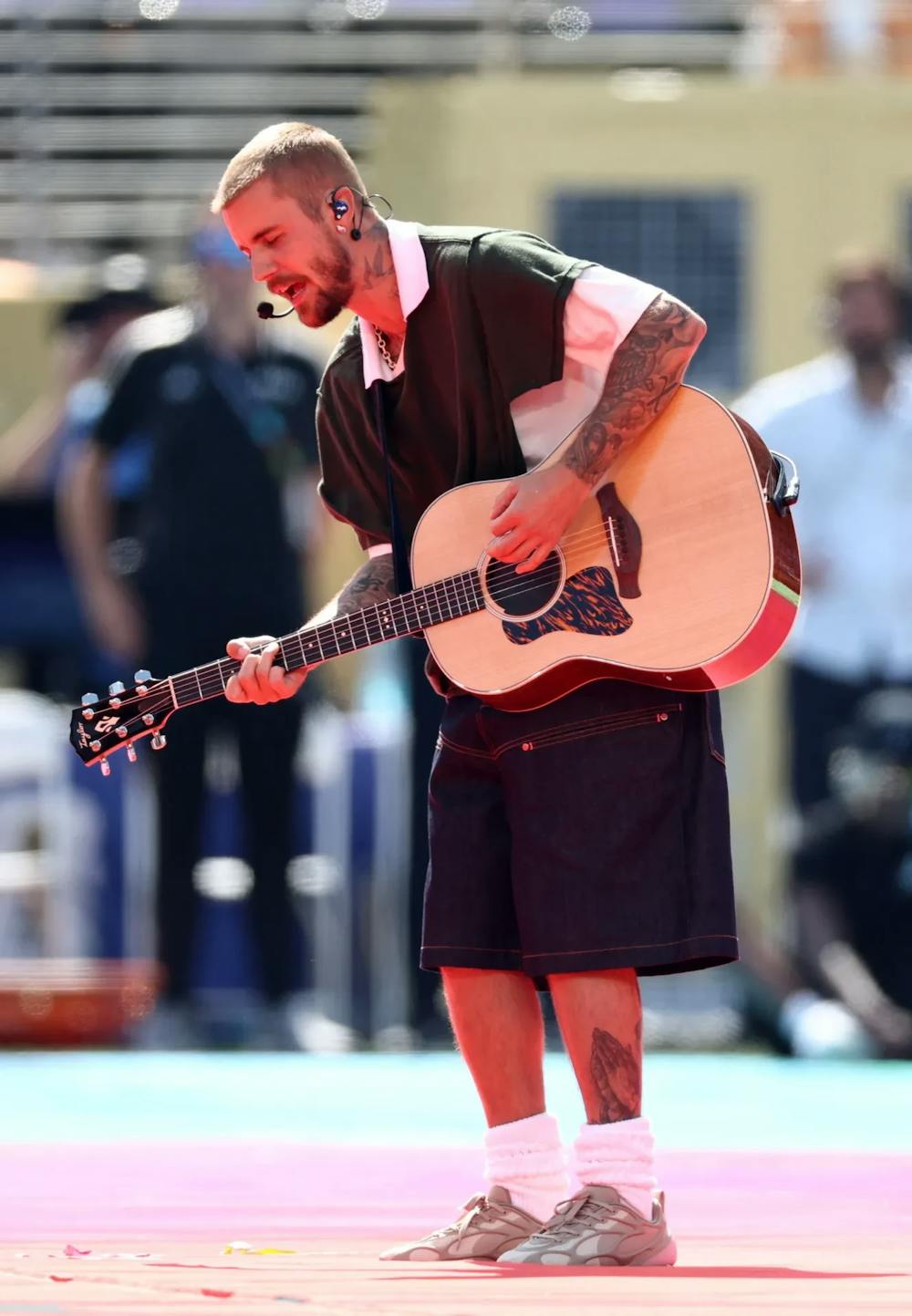
At the end of last month, the Irish artist CMAT (Ciara Mary-Alice Thompson) released an EP of live performances, with a set of accompanying YouTube videos, from a concert at St. Anne’s Park in Dublin. It was one of the best things I saw all summer. The month before, the Canadian artist Justin Bieber played at the first ever FIFA World Cup Final Halftime Show at the MetLife Stadium in New Jersey. It was one of the worst things I saw all summer. So there’s one way to do it, the back-to-school summer culture round-up: not the “highs and lows,” but the highest high versus the lowest low — an artist who represents everything good happening in music versus one who represents the opposite.
Who could be more different than these two, in these two instances? CMAT: imaginative, explosive, funny. Bieber: boring, self-affected, cloying. CMAT: a singular voice, a new sound. Bieber: sounds like A.I. CMAT: the best combination of Patsy Cline, Kate Bush, and Mick Jagger. Bieber: the worst non-parody of “guy-with-an-acoustic-guitar-singing-something-very-serious-with-his-eyes-closed.” CMAT: makes you feel something. Bieber: makes you wish you weren’t feeling whatever he’s making you feel.
Then you get to the quantifiable differences. While the combined view count of the four CMAT performances is 110,000, around three billion saw Bieber’s halftime show. While the number of writers credited on the four CMAT songs is one (CMAT), eight are credited on the Bieber song. It’s always a bit baffling when you hear something great to remember that it is the product of a single human mind. But maybe it’s more baffling to hear something so bad and realize that it is the product of seven top-shelf, LA pop-writer minds.
“EVERYTHING HALLELUJAH” is the name of the Bieber song, which was released last year on his eighth studio album “Swag II.” He comes out onto the field after being introduced by Jason Sudeikis as Ted Lasso. Just him, an acoustic and a wraparound head mic — so this is going to be intimate. “Good morning, curtains dancing in the sunrise,” he sings, already so self-satisfied you have to groan. “Maybe we find love in these moments,” he continues. “We don’t even have to try / I could sing a song, but the words just wouldn’t do / So I said, ‘Hallelujah, hallelujah, baby’.”
Intimate, vulnerable, personal, revealing — this is the currency in which the modern pop star trades. Which is all fine, until “intimacy” means an excuse for terrible songwriting. And terrible songwriting it is: nothing lyrics attached to a nothing melody delivered in a nothing style. In the mode of a Voice contestant, Bieber sings as if vocal runs are the ultimate measure of heartfelt emotion. But it’s a flat emotion, rendered in a tone of pained preciousness so pained and so precious that it approaches, inadvertently, something like petulance. “No autotune, no playback, just him,” says the YouTube video’s top comment. And that’s the problem, is it not? Just him.
In the record version of the song, Bieber includes the lines, towards the end, “Mom and Dad, hallelujah / Hailey, babe, hallelujah / Baby Jack, hallelujah . . . Brush my teeth, hallelujah / Take a swim, hallelujah.” It is unfair to lay songs flat on paper and judge the words without the music; lyrics are never literature. But rarely are they this far from it. The flaccidness of the song is matched only by its solipsism — but then again, this is someone who performed at last year’s Coachella in front of megatons projecting past videos of him, ranging from his 2010s golden boy era to his “I’m the One” DJ Khaled-collab one.
Fitting, then, that the first CMAT song on her EP — which is culled from her dreadnought 2025 album “Euro Country”— begins on the topic of celebrity commodification. “Jamie Oliver Petrol Station,” named after the English celebrity chef, starts out funny, then pulls the rug out from under you and turns out to be even funnier than you thought. So goes the opening line: “I was at the Jamie Oliver Petrol Station / I need a deli but, God, I hate him.” Then you get to the chorus, and she sings: “Ok, don’t be a bitch / The man’s got kids and they wouldn’t like this.” The target of the song has changed. At first, she was after Jamie Oliver. Now, she is after herself, and her impulse to swing from a feeling of mild irritation, or even aesthetic dissatisfaction, to a one of scattershot hatred. She’s after her own song, in a way.
So when she gets about three and a half minutes into it, what does she do? She lights the song on fire. The band has been building to this, so when she goes screaming and wailing into the mic it is in the midst of a whole sonic supernova burning out around her. It is a kind of comic, mock-psychedelic freak out, an expression of both the outward-facing anger of the first lines and the self-directed anger of the chorus’, but really, in the end, of a nameless, almost joyous angst. It’s about the release of that — noise for the sake of noise, being loud for the sake of being loud. It’s — what do you call it? — the thing that died — rock and roll music?
You’d think “Jamie Oliver” would be the biggest barn-burner of the four, but really that’s the third song, “Running/Planning” — a cold slash of an opening verse; a profoundly good bass entrance in the first chorus; and then a steady, simmering build that boils over into a minute of singing well worth whatever the ticket price was. It puts you in mind of Stevie Nicks’ famous 1976 performance of "Rhiannon,” in Burbank, California. Both singers, over a minor-key song comprised of three chords or less, whip up an on-stage tornado in the final minute of the song as they reduce it into a few repeated, half-sung-half-shouted phrases. They do, in other words, what Bieber cannot: tear the roof off.
When you watch CMAT sing “Nothing Compares 2 U” later in the show (a performance only on YouTube, not the EP), you get the complete idea. There’s something of the barmaid burlesque in many of these performances, her act as a whole like some kind of advanced, country-inflected pop/rock cabaret. But all that that means is that she’s using every technique at her disposal to inhabit the music, to take the audience inside the song with her. Bieber — walled-off and sealed-up, alone inside his songs — knows little of that. But who knows: Maybe he’ll enlist her for a duet re-release one day, and at last we’ll get something real out of all those hallelujahs.


