
As an international student and a passionate traveler, I have moved a lot— packing up, settling somewhere new, then doing it all over again after a few months. But after a while, I noticed my mental picture of any city usually boils down to the same few things: a couple of go-to restaurants, traffic I have learned to avoid and the little apartment where I am holed up somewhere in the middle of it all. Unless the city has an obvious historical claim to fame, I rarely stop to ask what is actually behind all that hustle and bustle.
This summer, during a temporary stay in Montréal, I stopped by the MEM — Centre des mémoires montréalaises. It sits right at the crossroads of Saint-Laurent and Sainte-Catherine Street, two of the busiest streets in the city. The museum’s glass walls quietly reflect the street lights and the crowd passing by — it blends in so well that it took me a solid 15 minutes to even find the entrance, which turned out to be on the other side of the building.
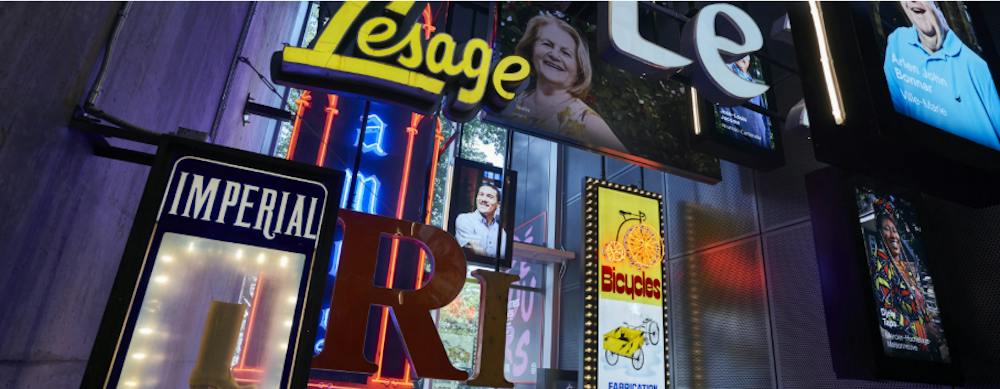
I walked in expecting old artifacts — maybe retired road signs or last-century telephones — but there was none of that. Following the guide, I stepped into the first room of a featured exhibition, "Détours — Urban Experiences." It is a huge, dark cinema-style room with multiple screens flickering at once. I walked up to the first one and found a pair of headphones sitting beside a stool, a clear invitation to dive into an immersive experience.
This gallery space contains 25 screen-seat-headphone sets, each tailored uniquely to the story it tells — some projected onto a wall, some displayed on a mini television, others installed on the ground like a well. Once you sit down and hit play, the screen runs a three- to four-minute documentary during which a city resident tells you their story. The people on screen are not celebrities; they look like the person sitting next to you on the metro. The first documentary I watched told the story of a neighborhood I lived in a year ago, where a man named Maxime Saint-Denis sells his Christmas trees every winter. I recognized that courtyard full of Christmas trees instantly — I remembered walking past it a couple of times in the snow. Seeing it always made me happy, because it meant home was only two blocks away.
Each documentary allowed me to peek into an aspect of the city – some narrators speak French, others speak English with a strong accent from their home country. There is a student who started a dance club in university despite his own disability, an Italian grandmother who found friendship through her cherry tree and a Jewish priest who established a supportive religious community after being judged for her sexuality. Through these stories, the history of this city isn't just marked by significant figures and events — it is told by ordinary people living their everyday lives, people who came from different cultures and backgrounds, showing exactly why we call Montréal a melting pot. As the teaser of the exhibition says (translated from French): “These fragments of life and the city unveil Montréal with a fresh perspective.”
In another section of the permanent exhibition "MONTRÉAL," an interactive piece caught my attention. It displays a map of the city and lists multiple residents, each with a different background. If you choose a resident, the map shows their commute route, along with a marker for their favorite place in the city. I picked a deaf actor whose favorite place is a jewelry shop. Seeing her walking pass the familiar streets made me wonder what my own map would look like, and how many small, ordinary places in this city mean something to someone else that I will never know about.
The exhibition tells the story of Montreal by chronicling the lives of ordinary people. Through digital technology and audience interaction, the museum reminds us that a city is made by its people — and so the stories of its people become the story of the city itself. By showing us fragments of stranger’s lives, it shows us a microcosm of Montreal: its pride, its struggle and what it means to belong here.
Yoyo Zhang '28 (she/her) is an arts & culture editor.
Yoyo is an Applied Math and History double major. She enjoys watching live theater and is also an actor herself. She has a wide interest including calligraphy, snowboarding, and painting.


