
On Sept. 8, Vermont Air National Guard members returned from deployment, supporting the U.S. military intervention in Venezuela and war with Israel against Iran. The Vermont People’s Arm Embargo, an anonymous independent project, recently published their website which details how more than 30 companies in Vermont held more than $3.6 billion in active contracts with the Department of Defense between Jan. 2025 and March 2026.
As students return to the buzz of the semester, it may feel like rural Vermont is an island geographically and conceptually removed from “what really happens” in the world. However, local organizers would tell you that we are located within a devastating and complex web of international politics, and that we have the tools, right here, to resist.
Prominent organizers from across Vermont spoke with The Campus on how they’re using grassroots strategies in the current political juncture: a moment in which young Americans, for the first time ever, overwhelmingly support Palestine as the genocide soon enters its fourth year, and in which brutal immigration crackdowns are drawing record attention to U.S. immigration policy.
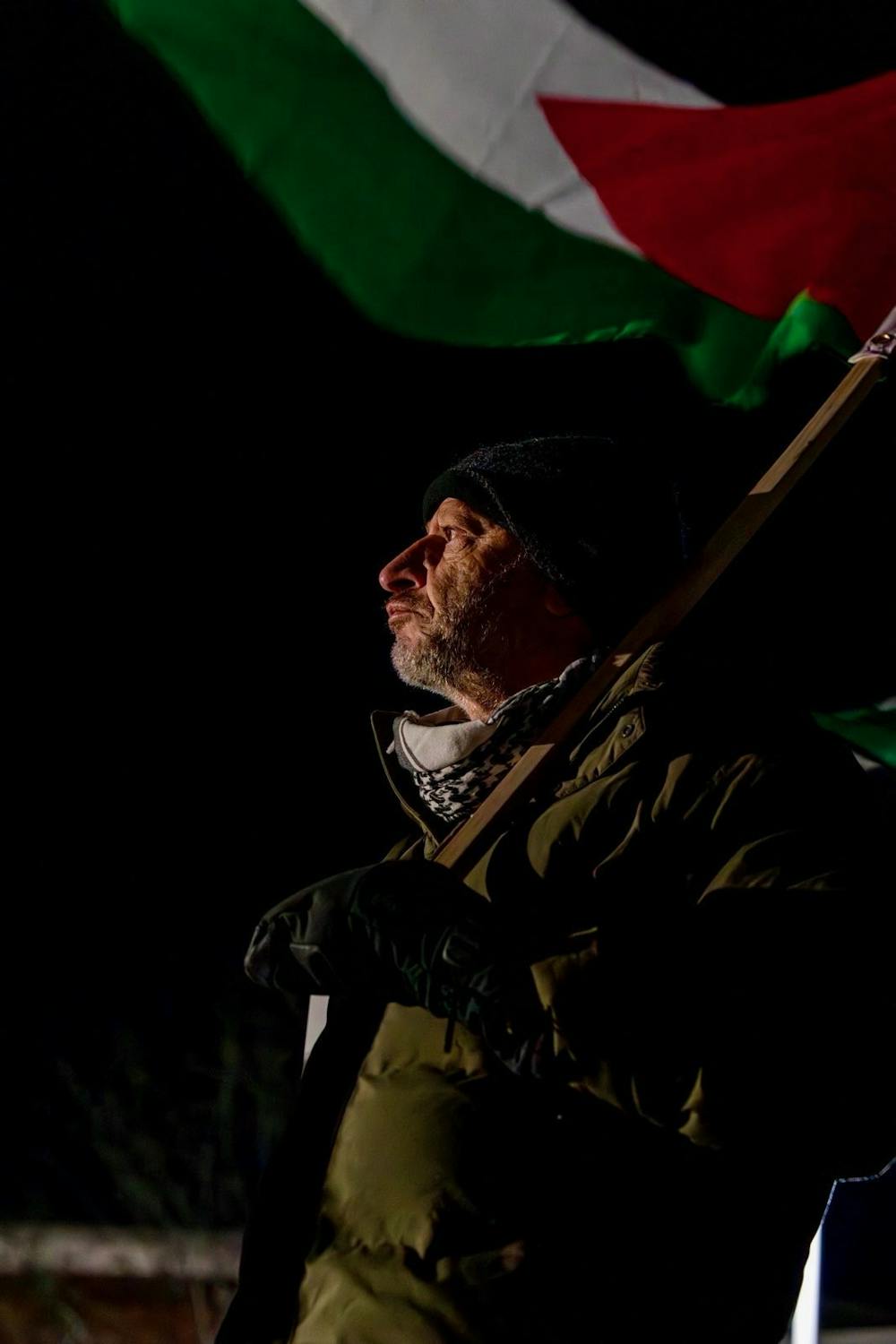
Wafic Faour, a long-time organizer with Vermonters for Justice in Palestine (VTJP), told The Campus that he has witnessed public opinion change drastically: “[The public] has changed one hundred and eighty degrees.”
Since 2001, VTJP has advocated for self-determination and liberation for the Palestinian people in Vermont, through issues that affect Vermonters. They have ushered a successful campaign that removed Ben and Jerry’s sales from the occupied West Bank in 2021, and are a part of Apartheid Free Communities (AFC), a global grassroots initiative that pushes organizations and municipalities to sever ties with Israel.
“We went to the street again here and collected votes [for AFC] by hand… And this is how we succeeded in eleven municipalities” Faour said.
He further explained the utility of AFC in a local context, and responds to critiques that accuse the program of causing fractures in the local Vermont community:
“It's not only a genocide as some say. Between the river and the sea, there are two people living under two different legal systems… Of course our opponents will say, ‘You’re dividing the neighborhood.’ But we’re asking for equality. ‘Dividing’ the public is dividing them between racist and non-racist.”
Faour emphasized that coalition is extremely important to the grassroots work that VTJP does. In particular, Faour highlights Migrant Justice of Vermont. VTJP’s campaign to end Ben and Jerry’s sales in the occupied West Bank mirrors that of the Milk with Dignity (MD) program. In 2017, Ben and Jerry’s also became the first major dairy corporation to join MD, requiring its supplier farms to come into compliance with a code of conduct. This requires extensive conditions ensuring economic justice and human rights for migrant workers who often face abusive working and living conditions.
Alongside migrant workers, VTJP is part of a sprawling network of movements including Black Lives Matter and the Vermont Racial Justice Alliance. Since 2024, the group has been a part of an active coalition of 27 member organizations in the Vermont Coalition for Palestinian Liberation (VCPL).
“There is no movement happening in this country without the Black struggle. And we agree that us, the Palestinians, are moving on their shoulders. But you have to show [other movements] step by step where we relate and we have a common enemy… Nothing can come easy. They don't come with you because you tell them, let's say ‘Black Lives Matters,’” Faour said.
Faour told The Campus that while some allies in Vermont, including Abenaki and LGBTQ+ groups, have never been afraid to associate with VTJP, some have only more recently come around — namely, 350 Vermont, which first dismissed VTJP shortly after the peak in 2020 BLM protest but now stands firmly in solidarity. 350 Vermont writes in “Our Impact in 2025” that they are mobilizing in tandem with local action on Palestine and migrant working conditions.
Faour cites the victory of Amanda Janoo in the Vermont democratic gubernatorial primary as recent proof of the sweeping changes happening with public opinion. Janoo, deemed a “political outsider,” compared to her better-funded opponent Aly Richards, answered affirmatively to all five of VCPL’s State Candidate Survey: a series of questions asking about adopting the AFC framework, rejecting funding from Israeli organizations, support for Boycott, Divest, Sanctions among others.
“Janoo’s opponents dismissed us completely. [Richards] didn't answer because she's living in yesterday's atmosphere that Palestine-Israel is an untouchable or radioactive subject,” Faour said.
Meanwhile, Janoo has elected to stay close to the local manifestations of pro-Palestinian politics. She contributed to fundraising for the legal defense of Mohsen Mahdawi, Vermont resident and activist at Columbia University facing deportation.
“And she did it in front of three hundred and fifty people. That is smart, that is brains. She cannot buy that kind of advertisement,” Faour said.
Faour pointed out that Mahdawi’s case isn’t the only Palestine-centered immigration proceeding catching the attention of international media in the specter of the Trump administration’s DHS. After writing an op-ed criticizing her school’s response the genocide, Tufts University doctorate student Rümeysa Öztürk was detained in St. Albans, and legally processed in the U.S. District Court in Vermont.
Sept. 14 was the first day of the trial of Jason Eaton at the Costello Courthouse in Burlington. Eaton is charged with three counts of second-degree murder of three Palestinian-Vermonters, university students: Hisham Awartani, Tahseen Aliahmad and Kinnan Abdalhamid. More than two years after the shooting, Awartani remains paralyzed from the waist down as a result of bullet injuries.
Faour told The Campus that his presence at the courthouse is important to the family of the victims arriving for Palestine for the trial. As a Palestinian refugee and Arabic speaker, he has long bridged communities and been an integral part of the movement propelling solidarity action to be possible in Vermont. As this article is published, the trial of Eaton continues and Vermonters receiving notifications from VCPL’s social media and newsletter have been providing court support.
Reflecting on recent successes, Faour shared why VTJP and VCPL’s organizing strategy has made an impact.
“We brought Palestine to be a local issue to succeed. You cannot just talk from above. It's an international question but you have to bring it and relate it to the issues here locally in Vermont, to keep the movement going, to make a regular Vermonter or American understand why the question of Palestine-Israel is important to them.”
June Su '27 (he/him) is the Senior Multimedia Editor.
June is a political science major and studio art minor, also studying history and Spanish. He spent the summer of 2025 working as a political science research assistant examining investments in the Congo River Basin to achieve international biodiversity and carbon goals.


