
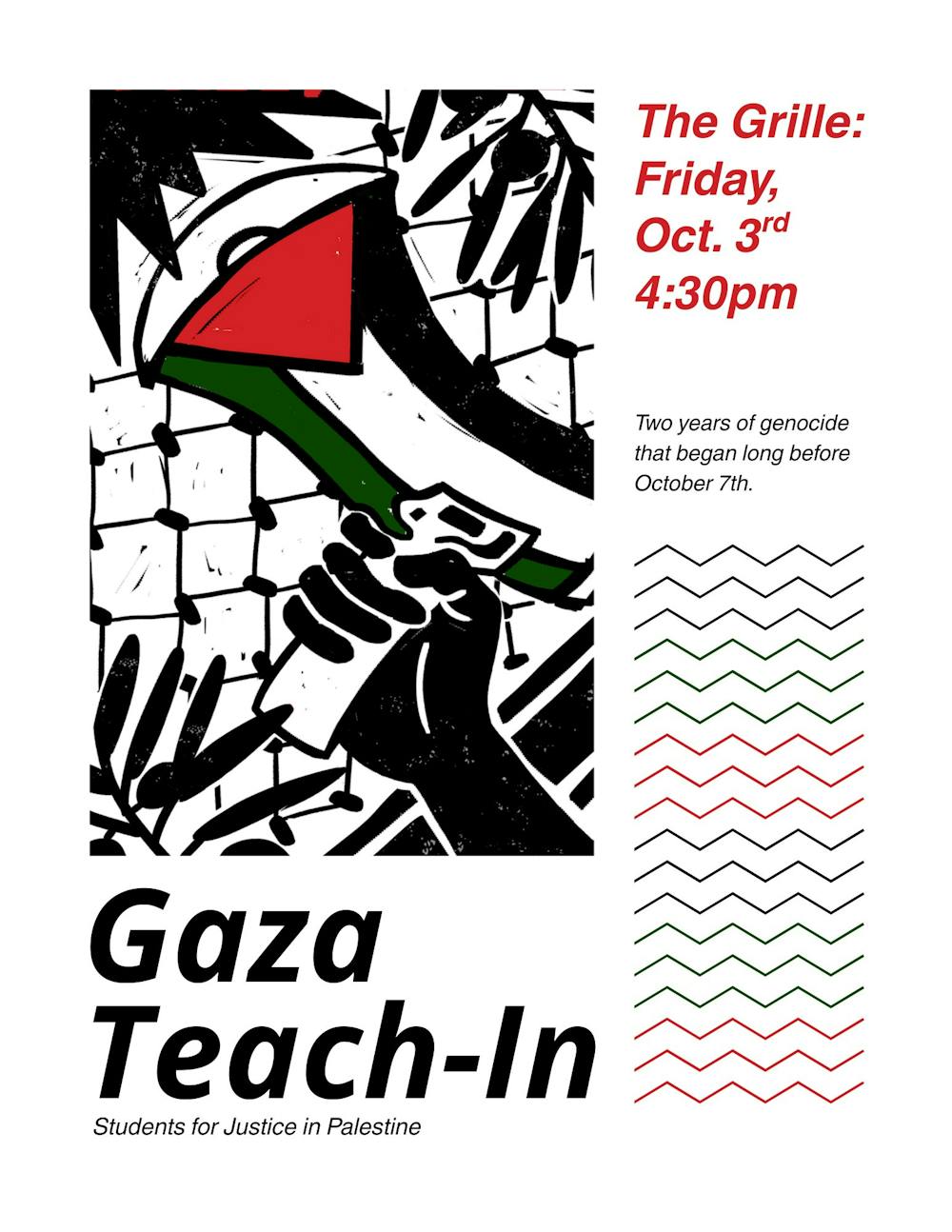
On Oct. 3 in the Grille, Students for Justice in Palestine (SJP) hosted a Gaza Teach-In. Speakers emphasized Middlebury’s connection to the Israeli Genocide of Gaza personally, intellectually and as fellow human beings. Two years into the genocide and with a new U.S. president in office, this event followed the precedent of the first Gaza Teach-In hosted on November 1, 2023.
“We see that the easy way out is to keep our heads down and stay silent, hoping that it will save us and keep us safe, but the only way out is to know that our struggles are the same. That is why we have organized today’s teach-in, to highlight the connections and intersections of our struggles as a diverse community here on campus,” an international student SJP member said to introduce the event.
With 21 different speakers, the Teach-In lasted from 4:30–7 p.m., turning out voices from all corners of the campus and the community. Two alumni who graduated in 2008 and 2009.5 joined virtually to share about their ongoing campaigns for family members dealing with repeated internal displacement in Gaza.
Wafic Faour, prominent Palestinian activist based in Burlington, spoke to the Apartheid Free Communities campaign. Faculty in departments from creative writing to political science, and religion to gender, sexuality, and feminist studies joined in, contributing their personal experiences and academic expertise.
Students gave speeches on personal perspectives and on behalf of affinity groups, political organizations, and academic departments. Represented organizations included Black Students Union, Voices for Indigenous People, Migrant Justice at Middlebury, Weybridge House and West Asian and North African Students (WANAS).
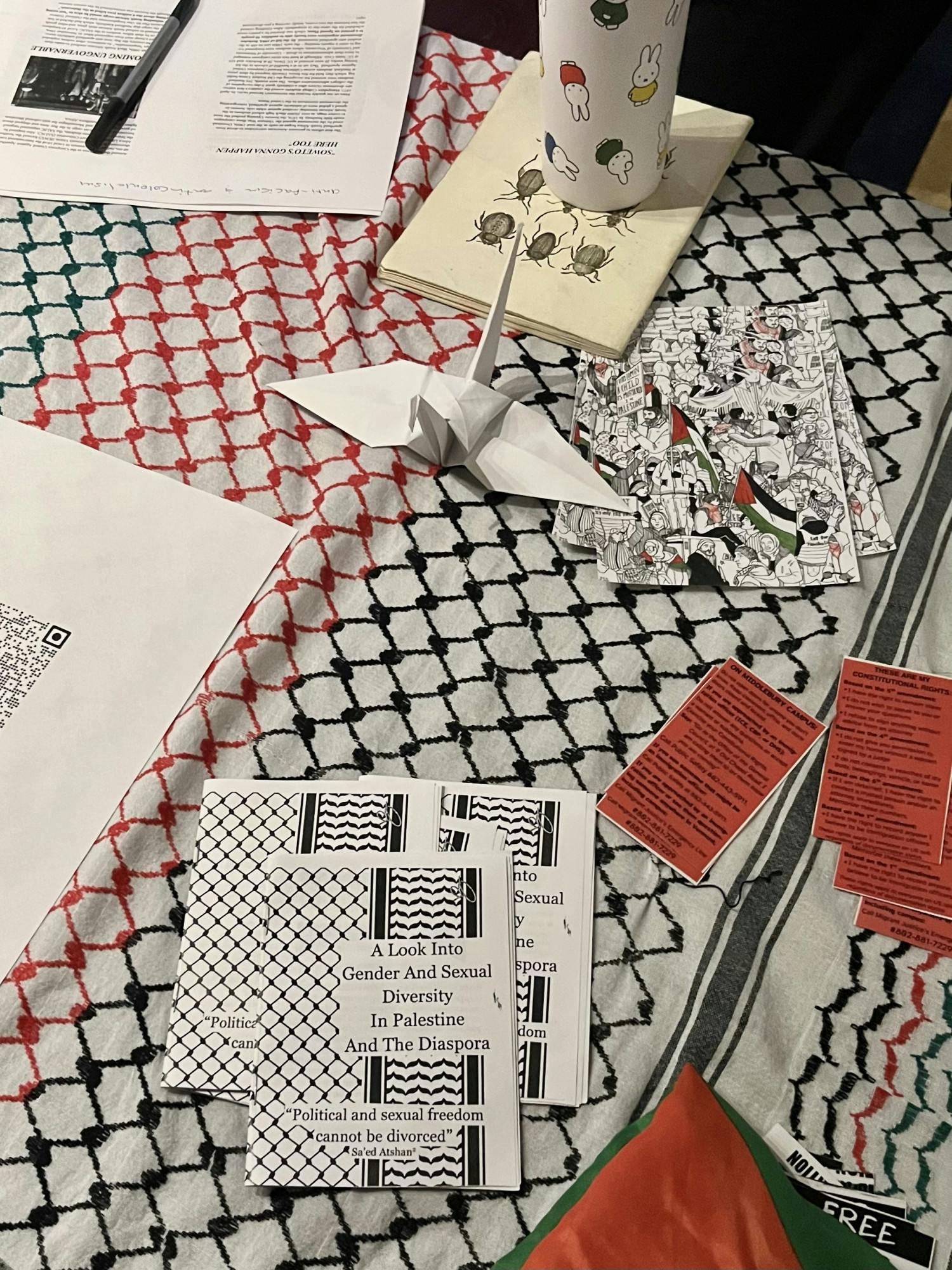
Participant Nicea Armstrong ’27 told The Campus about her thoughts on the structure of the event.
“I thought it was really meaningful that students were running the whole thing and introducing everyone, and that there was a mixed order of speakers, showing that there are a ton of different angles to approach this. I thought it was a good mix of different ages, citizens and internationals, organizations and personal stories like with the Vietnam War story specifically,” Armstrong said.
“On March 16, 1968, American soldiers entered the Sơn Mỹ village and executed over 500 unarmed, unresisting Vietnamese civilians. Raping and mutilating women and children, burning homes, and executing men, the Mỹ Lai Massacre remains the largest massacre of civilians by U.S. forces in the 20th century…
American-made bombs are no longer stifling the dreams of Vietnamese students but continue to effectively halt the ability for any Palestinian child in Gaza to learn. Instead of my Vietnamese mother behind the barrel of a gun, it is a Palestinian mother. Our media is no longer flooded with images of Vietnamese fathers, but with Palestinian fathers weeping over plastic bags that contain the remains of their children. Unlike the nameless children slaughtered in the Sơn Mỹ village, we know the names of the Palestinian children of over 66,000 Palestinian lives stolen in Gaza,” Phoebe An ’27 said to the crowd at the event.
Discussing food justice as yet another intersectional issue connecting to the Palestinian genocide, Maia McNeill ’25.5, student representative of Weybridge House and organizer with ACORN Food Hub, described her approach in speech writing in an interview with The Campus.
“I wanted to be hyper specific and accurate about one kind of food and one kind of history. When we get into the abstract, like in vague ideas of what ‘food sovereignty' means or vague ideas of Palestinian food, it's kind of detached from reality… I wanted to be able to say: Here was this boy, he was looking for this plant, and here's what this plant means. Here's why you might feel connected to this boy, and emotionally invested in his safety and security,” McNeill said.
“I will never forget the video I watched over a year ago. A young boy in Gaza, maybe four years old, eats leaves off the ground. The man behind the camera asks him, "what are you eating?" The boy tells him that he's eating khabayza. The man from the camera says "no darling, that's not khabayza, I promise you it's really not.”
“What is Khabayza? Khabayza is a sweet round leafy green that grows wild in Palestine… It grows like weeds on the land and conflict after conflict, it's helped people in the region avoid starvation. As Gazan resident Amin abed described in a 2024 NYT interview, "It’s supported us more than everyone else in the world. People survived the darkest chapters of the war on khobeza alone.
How are we supposed to react to this video of the boy? What do we do with this information? Here's a kid who's familiar enough with the land around him to look for khabayza, but too young to identify it properly, and hungry enough to eat it raw off the ground. How can I express all the love in the world for this man who is doing his best to pass down knowledge to this kid, even though it happens in conditions of starvation?” McNeil said in her speech.
Representatives from the Black Students Union, Bianca Belk ’28 and Michael Sanjurjo ’28 spoke about global systems of racism that enable the Western world to turn the other cheek in times of genocide in the Congo and in Palestine.
“Why is it that while our screens are filled with endless news… the exploitation and genocide in the Congo rarely make it into the conversation? The answer is brutal and uncomfortable: because the people being exploited are Black, and in a world built on racial capitalism, Black lives are treated as expendable, their suffering invisible, their labor a source of profit for others…
These struggles — Congo, Gaza, Sudan — are not separate. They are threads of the same cloth. The same companies that profit from cobalt in Congo profit from the weapons dropped on Gaza. The same powers that ignore Sudan’s displaced millions are the ones that turn their backs on Congo’s children. Oppression is global. Extraction is global. But so is our solidarity, if we choose it to be,” Belk said in an excerpt from their speech.
Natti Martínez ’28, a representative of Migrant Justice at Middlebury and a Latinx student, told The Campus why she spoke, explaining the dynamics of solidarity and political action in the midst of great fear and mass deportations.
“I feel like there's a lot of fear keeping many students of my community specifically silent - and not just silent, but unwilling to associate in any way with any sort of political activism. Although I do think the fear is real and it's so valid, I think there's also so much fear-mongering saying, ‘well, just don't get involved and you'll be fine; you're protected as long as you don't speak out.’ We’ve seen that this is very much not the case. I really wanted my speaking to show that there are times where this silence isn't gonna help us,” she said.
“Palestinians have been making online videos in English for the purpose of catching your attention, to humanize themselves, and beg that you listen to them for 30 seconds because their lives are at stake. If that creates fear in you the same way it does when you’re translating for family or community members because you realize how much you have to humanize them for them to be granted a sliver of visibility…then good,” Martinez said to the group.
In their speech, a Palestinian international student who wished to remain anonymous spoke as a representative for West Asian and North African Students (WANAS) and summed up the meaning of the teach-in: cross-group solidarity.
“To be Arab, to be Palestinian, to be an immigrant, to be undocumented, to be a person of colour in this country, to be part of a community whose brethren face U.S imperialism and colonization in our homeland, is to live in fear of colonial repercussions on your family, on yourself. You are assigned guilt at birth and spend every moment trying to prove otherwise. And yet, I cannot find this excuse enough for me to stay silent. I have been increasingly disillusioned by a myth of self-preservation at the cost of everyone else,” they said.
June Su '27 (he/him) is the Senior Multimedia Editor.
June is a political science major and studio art minor, also studying history and Spanish. He spent the summer of 2025 working as a political science research assistant examining investments in the Congo River Basin to achieve international biodiversity and carbon goals.


