Every fall, first years arrive a little earlier than everyone else for orientation week. They wander around campus in their oversized orientation groups and complain there’s too much programming — like many students before them. Even though it’s an annual tradition, some aspects of the experience were different this September.
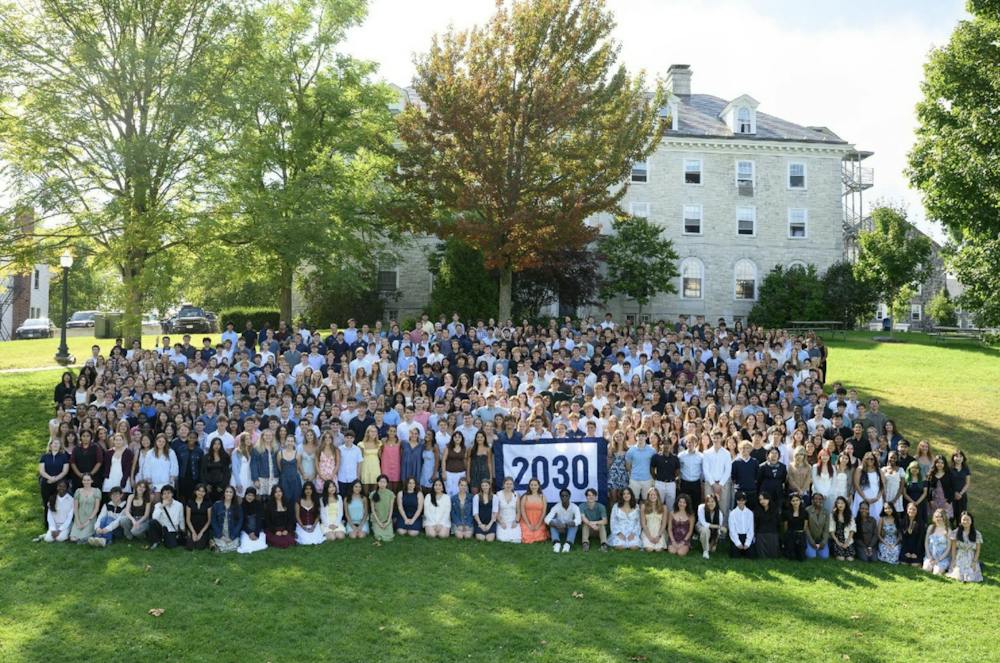
For one, there were more of them. According to the college’s admissions and financial aid website, 640 students comprise the first-year class (115 more will join as Febs), inching Middlebury’s acceptance rate up to 18%. You might notice the longer lines in the dining halls or have a harder time parking on College Street. It might feel unfair that — thanks to the renovations in Stewart and New Battell’s recent construction last semester — the first years have the nicest dorms on campus.
Some things haven’t changed, like the shock of rural Vermont for city kids who grew up minutes from a bodega. “It’s different to hear about how isolated it is and then be here,” Gus Zolov ’30 of New York explained in an interview with The Campus. The other day we were like, ‘let’s go to Stewart’s’ – and it turned out to be a 45 minute walk.”
Instead of bustling city blocks, students are surrounded by the college’s expansive rolling hills. “My first impression of Middlebury was how beautiful the campus was,” William Keegan ’30 of Munster, IN said in an interview with The Campus.
In previous years, outdoors trips and activities — from hikes in mountains to apple picking excursions — were baked into the orientation schedule. Those trips were replaced this year with a day at Branbury State Park at Lake Dunmore. Middlebury Outdoor Programs — which oversees the Middlebury Mountain Club (MMC) — stepped in to organize excursions: 15 MMC guides, fresh off their first annual Guide Fest, led over 200 first-years on 25 trips throughout the day, ranging from hiking to Falls of Lana and Silver Lake, to paddling in canoes and kayaks on the lake, to climbing at the Falls.
“I thought it was fun to have students [lead] it,” Chloe McClung ’30, who went on a canoeing trip led by an MMC guide, said. “It lowkey made me want to [be part of the club]. I saw a mountain club poster in Battell and I was like ‘wait, I’m actually kind of interested in this now.’”
Students burnt out from a packed orientation schedule expressed appreciation for the Dunmore outing: “I love Dunmore Day because what I wanted to do was swim and just relax because the last couple days had been so much,” said Mia Tao ’30.
However, the new program was met with logistical issues – buses ran late and spots were overbooked. “I know a lot of people who wanted to go hiking or on different trips, but they couldn’t because it was too booked and they were running behind schedule, so they just weren’t able to go at all,” Tao mentioned.
Annaliese Dorchinecz ’28, president of the MMC, acknowledged the room for growth of the pilot program: “We were limited by the number of MMC Guides we had, so unfortunately not everyone could get out on a trip. In the future, we would love to have a larger capacity of guides and at MMC, we are especially interested in the possibility of leading longer, more significant pre-orientation outdoor trips.”
Another pilot program was the Zero Dollar Store hosted by the Anderson Freeman Center (AFC). It’s an initiative where students may come and get free dorm supplies — from decorative materials like posters and maps to hangers and hygiene materials.
When devising the program, Assistant Director of Intercultural Life & First-Generation Experience Steve Zatarain ’15 asked himself: “What are the major challenges of joining our campus community?” — especially for underrepresented identities like first generation and low-income students. “Many Middlebury students will quickly say isolation, [which] is associated with the lack of connection to immediate supplies you need.”
The program, inspired by similar initiatives at peer institutions like Swarthmore and a broader “mutual aid” movement, collects materials through donation drives during move-out periods.
62 students across class years and identities came by to collect two to three items each. As of the time of the interview, the initiative has redistributed 152 items or bundles of items — accounting for up to 90% of items donated earlier in the year. The most popular item was lamps, according to Zaratain, who joked that everyone is afraid of “the big giant lamp a.k.a. the ceiling lights.” All 38 donated lamps found new homes.
The program received positive feedback from a diverse spectrum of people, from international students who arrived with only two suitcases, to students who weren’t able to afford specific materials, to folks simply interested in sustainability and recycling.
“The ultimate goal is to create an ecosystem where people can be assured that there are things that are at no cost that they can take for themselves, no questions asked,” Zaratain said. “And understand that they could contribute to this ecosystem of re-donating things.” At the sale, the AFC received a couple donations by students, signaling a promising start to the initiative.
This year also saw major changes to orientation week for the college’s international students. In previous years, the college hosted pre-orientation programs for first-generation and international first years, who arrived a couple days before the rest of the cohort. This year they grouped international students — who make up 11% of the 2030 and 2030.5 class — into regular orientation programming, cutting back on events and programs previously catered to them specifically.
Whatever interactions between international students that remained were minimal. “We were only able to have ‘connection points’ during breakfast and lunch and walking them from point A to B,”explained student coordinator Munira Nurbhai ’28. Beyond a Saturday night talent show and one PAL group meet up, both of which were optional, there was little room for international upperclassmen to spend meaningful time with their assigned first years. Many see this hindering cross-class year bonds that are particularly prevalent in the international community.
“It’s important for internationals to have their own thing because we have a lot of shared experiences and could connect better than with regular American students… I see the benefits of integrating us but also we are adjusting to a very new environment with specific needs that Americans may not relate to,” Yara Uthman ’29 said in an interview with The Campus. “There are a lot of [first year] international students who are talking about how they only really know internationals they’ve talked to before coming here because they haven’t been integrated well with other international students. They’re finding it to be very difficult to adapt here.”
International upperclassmen were able to host the International Talent Show in McCullough Student Center this past Saturday — a tradition through the years. But without enough international student programming, Nurbhai lamented that there were “a lot of impromptu performances since we didn’t have a rehearsal, or time to advertise it or talk about it properly with our PALees. For those who showed up, however, Nurbhai described it as a “blast.” Performances ranged from Japanese traditional dances to group karaoke sing-a-longs to international icon, Shakira.
For all the tweaks to the week, the first year’s have pulled through to the first week of classes. And some are starting to feel at home. Everyone here is very friendly and open to talking,” Amelie De Jean ’30 said. “I feel like in high school it can be a little like ‘I don't want to talk to anyone else who is not in my crew.’ Here it feels like we’re building a community.
Met Ly '28 (he/him) is a News Editor.
Met is a UWC Davis Scholar majoring in International Politics and Economics with a Creative Writing minor. He is also a fellow at the Rohatyn Center for Global Affairs. He hails from Siem Reap, Cambodia and spent his gap year there as a digital marketing manager and events coordinator. Outside the newsroom, he line dances in his cowboy boots and jams out to the Arctic Monkeys.