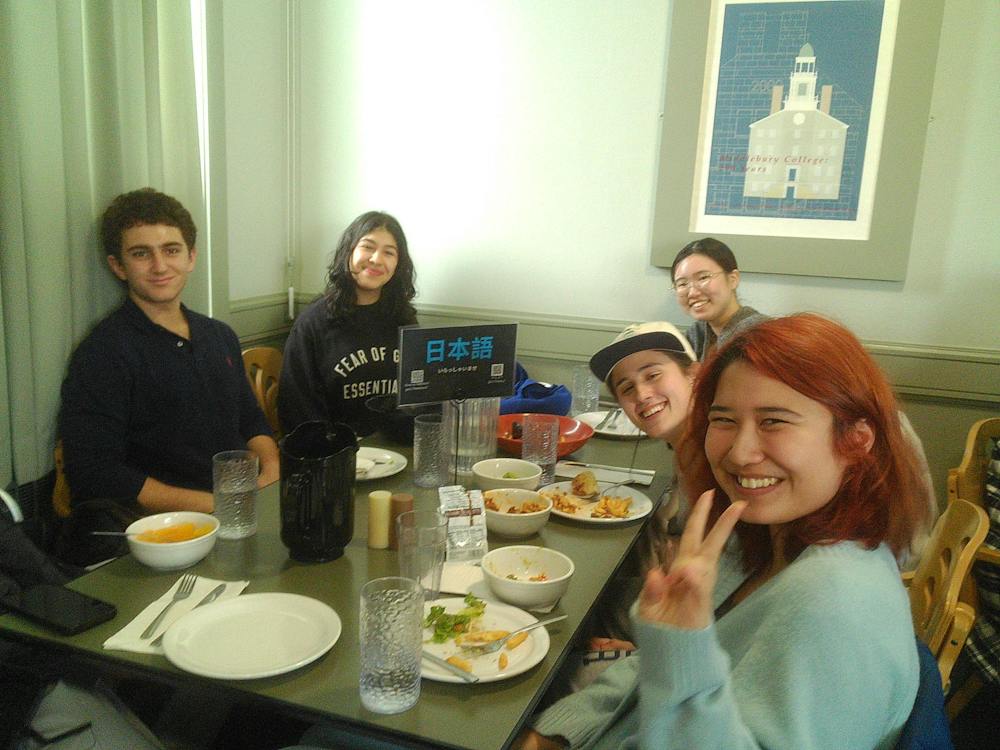
Following a faculty decision, Language Tables will shift its structure for this fall semester. In an Aug. 13 statement online, the program announced that student waiters will no longer be a part of the program. Instead, there will be a “buffet style” meal set up for students, much like how the dining halls function.
Middlebury College is arguably most known for its robust and extensive language education programs which include 30 plus locations to study abroad, rigorous summer language schools, specialized classes during the semester and daily Language Tables.
Students will remain part of the learning aspect of the program, through a new position of “ student interlocutor.” This position, as described in the statement, will “facilitate discussion at the tables alongside language TAs and professors.”
The statement also mentions that the program will still hire a small number of dining assistants to work in the kitchen upstairs, similar to before.
Many view the student waiter role as a fundamental part of the Language Tables experience. Removing waiters means that students employed in that position no longer have that job opportunity.
Anna Armstrong ’28 first got involved with Language Tables during J-Term of her first year.
“I started as a substitute waiter, so if anybody called out sick, I went in and subbed. Then afterwards, I've been a Japanese waiter and I've also been attending the Chinese language tables,” she said in an interview with The Campus.
“I think from the get go, language tables have been a really significant part in my Middlebury language learning experience,” Armstrong said.
Beyond employment, Language Tables provided international students with a large sense of community on campus.
“[Language tables] provided a lot of international students with a sense of community, I think. I made a lot of friends there that are older than me that I might not really have classes with, so I think that the community of people that want to share their language apply for this job, because they want to speak their language with people, and help language learners practice,” Armstrong said.
For former Language Tables manager Sylvi Teich ’25.5, hearing the news was a shock and a disappointment. Teich studied German and Linguistics as a student, which is how she got involved with Language Tables as a manager –– yet she knew about the program before she even enrolled at Middlebury.
“One of the biggest things that drew me to Middlebury in the first place was the language programs, like from the beginning, I've seen Middlebury as a school for languages. I mean, we even have the summer language programs and there were just, I remember, when I was applying it was still COVID, so it was all virtual tours, but they were all talking about all these opportunities and language tables came up, every single time,” she said in an interview with The Campus.
For Teich, Language Tables always came up as a central part of the language learning space at Middlebury, and throughout her time she also realized how important the space was to international students.
“There were a lot of international students who worked at language tables, and I think it was really cool for them to help teach their language and their culture to students who are just starting out with it. It was also a way for them to meet other native speakers,” she said.
“This feels like a really major, like not really subtle at all, cut to [the program]. Just from a standpoint of student employment opportunities, I mean, there's still plenty of opportunities on campus, but, you know, they keep increasing the enrollment, but with more and more students, it seems kind of crazy that they would just cut a bunch of jobs,” Teich said.
When Teich was manager in spring of 2025, the program had around 70 student workers. She feels that Language Tables was a unique space for employment on campus where students authentically enjoyed their work.
“Anyone who I talk to –– and I could be a little bit biased because I had such a good time –– everybody usually seemed really happy to be there. It's upsetting, both because it takes away this kind of natural language learning space, because it's not in a class, and the professors aren't there, and it's not going towards your grade. Language learning can be really intimidating, especially in a super academically competitive place like Middlebury,” she expressed.
Despite the structural change of the program, current Language Table leadership hopes to have a successful semester. Marcus Helm ’27.5 is one of three managers this year, alongside Amador Abiuso ’29 and Annie Boyse ’29.
“I do think this decision changes the program,” Helm said in an interview with The Campus. While some things are internally changing, the program is still 100% student led. Many of the new hires for the student interlocutor positions are those who were previously employed as waiters.”
This fall, Helm and his co-managers are focused on adapting to the changes and thinking about how they can facilitate things to the best of their ability.
“We are looking to maintain the same energy and atmosphere moving forward, despite the changes to the program.”
Norah Khan '27 (she/her) is an News Editor.
Norah has previously served as a Arts & Culture Editor. She is majoring in Political Science and English, with minor in Spanish. Outside of The Campus, she is involved with Matriculate as an Advising Fellow and the Conflict Transformation Collaborative as a Conflict Coaching Peer Facilitator.