
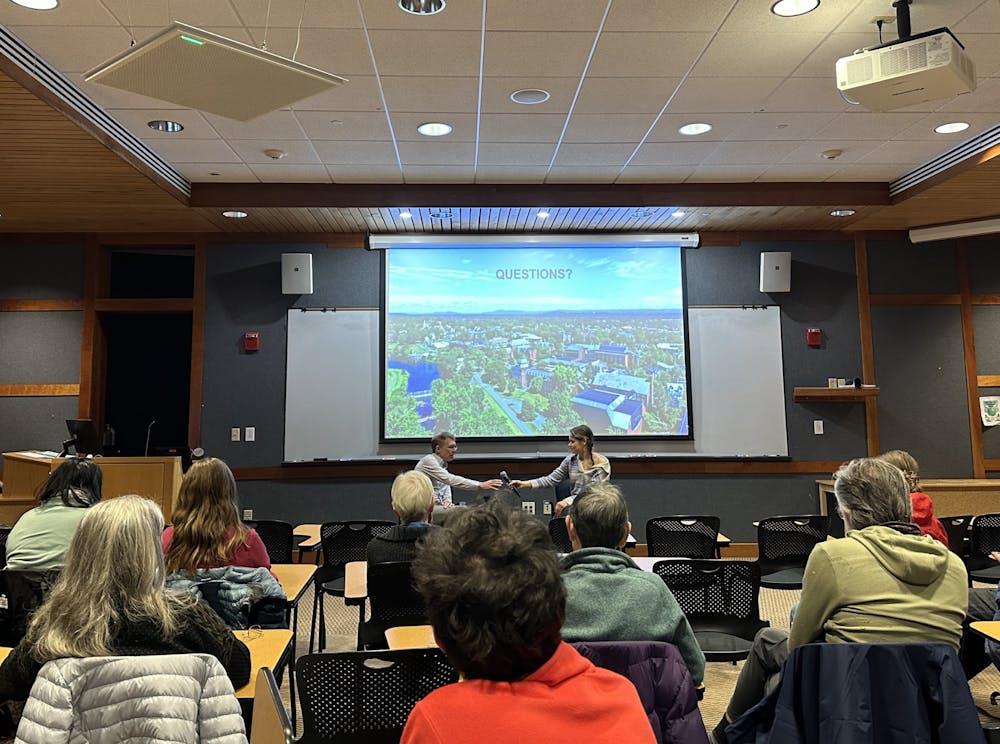
On March 17, the student-led Sunday Night Environmental Group (SNEG), partnering with the Climate Action Program (CAP), hosted a talk by Associate Professor of Environmental Science and Policy Alex Barron of Smith College, who discussed climate action in higher education institutions (HEIs).
“There’s not a lot of scholarship on higher education and climate action and decarbonization, and Alex Barron is the leading scholar in the field,” SNEG’s team manager Lily Jensen ’28 said in an interview with The Campus. “We thought it would be good to bring him in to see what [other institutions] are up to.”
Barron’s talk drew on his working paper, which argues for decarbonization over carbon neutrality as a framework for addressing climate change. While carbon neutrality — the model most HEIs, including Middlebury, subscribe to — allows institutions to offset emissions through mechanisms such as carbon credits, it does not necessarily require changes to the infrastructure producing those emissions. Decarbonization, by contrast, requires replacing combustion-based systems entirely.
His research found that some carbon-neutral institutions have increased their emissions since first reporting, relying on offsets to close the gap.
"I will take a good decarbonization plan over a rapid carbon neutrality commitment," Barron said. "You can't do this kind of infrastructure change overnight. You really have to be thinking about it."
On a slide highlighting colleges at the forefront of climate action, including peer institutions like Amherst and Swarthmore and larger universities like Michigan and UC Berkeley, Middlebury was notably absent.
“I came [to Middlebury] because of its environmental programs and its reputation, but to be candid, I do feel a little bit let down,” Jensen said, reflecting on the college’s commitments to climate action. “Middlebury has genuinely done a lot of great things to pioneer [climate action in HEIs], but my view is that we got a little bit complacent.”
Environmentalist, author, and Schumann Distinguished Scholar at Middlebury, Bill McKibben hailed the college as being “in the vanguard of American colleges on global warming issues” back in 2006 when the college announced the construction of the biomass plant. It was one of the first institutions to declare carbon neutrality in 2016, and in 2019, Middlebury launched Energy2028, committing to a full transition to renewable energy, reduced energy consumption, and divestment from fossil fuels.
"Middlebury has taken early swings, and that's something to be proud of," CAP Director Minna Brown ’07 said in an interview with The Campus. “Is that the decision we would make today? Probably not."
“You can’t just assume that bioenergy is carbon neutral,” Barron said. He explained that the model isn’t scalable as “you can’t have every school burning bioenergy and still maintain land and forest,” and “it is a much more uncertain climate benefit than fully decarbonizing campus infrastructure and running it on clean electricity.” Biomass relies on combustion, and still produces emissions.
“Everyone will tell you it was awesome in 2009, but it’s also been 15 years, and we haven’t seen much movement to plan for that next phase,” Jensen said.
The college’s carbon-neutral status hinges significantly on its biomass plant. According to the Middway Report, the plan supplies two-thirds of the campus’s thermal energy, which in turn accounts for 80% of the college’s energy consumption.
The plant is approaching the end of its life in the mid-2030s, and no concrete replacement plan has been announced. This decision will determine the college’s emissions profile for at least the next two decades. Barron noted that Middlebury is at an inflection point where the college “has enough space to plan for what to do before having to take the action.”
“We are at another decision moment that is enabled by the urgency [of climate action] and the opportunity of a strategic planning process of a new president who wants to build on momentum,” Brown said.
Brown and Jensen both participated in the working group on climate as part of that process. In its final report, the group called for a comprehensive plan to decarbonize campus infrastructure, though the recommendations remain under review as President Baucom’s strategic plan is finalized.
“It’s going to be exciting to see what comes out in early May when President Baucom releases the strategic plan with more details and priorities,” Brown said. “It’s going to be up to all of us [since] I don’t think that there are decisions that are set.”
Gaps in the college’s emissions tracking further complicate its climate record. Barron’s paper notes that Middlebury has not reported to the Sustainability Indicator Management and Analysis Platform (SIMAP) since 2017. As of this reporting, the college also does not hold an active Sustainability, Tracking, Assessment and Rating System (STARS) rank, a benchmark for sustainability performance used by at least 685 HEIs.
Answering concerns of the higher upfront cost of decarbonization infrastructure, Barron said, “the whole idea of college is a long-term investment. It’s expensive to go upfront, and it’s disruptive, but we do that because we know it’s the right thing to do in the long run. Higher education is one of the few institutions that thinks in these long-term scales — Middlebury has been around for a very long time — so [they] can appreciate these kinds of long-term investments.”
Another stakeholder in the college’s approach to climate is the broader community.
“I’d like to challenge the college to adopt a more visionary approach to climate action than what seems to be happening currently,” Alice White ’76, an appointed member of the Town of Middlebury Energy Committee, wrote in a message to The Campus. “The town looks to the college for leadership in climate matters. When the college is dragging its heels, the town feels supported in their own lack of attention to their greenhouse gas emission reduction goals.”
“We see a lot of behavior at other institutions that I would characterize as suboptimal that would not happen if there were more scrutiny coming from students and other members of the campus community,” Barron said. “Students have a real power to demand accountability and ambition in these transitions – especially in moments when we know something has to happen.”
Editor's Note: Lily Jensen ’28 is a staff writer for The Campus.
Met Ly '28 (he/him) is a News Editor.
Met is a UWC Davis Scholar majoring in International Politics and Economics with a Creative Writing minor. He is also a fellow at the Rohatyn Center for Global Affairs. He hails from Siem Reap, Cambodia and spent his gap year there as a digital marketing manager and events coordinator. Outside the newsroom, he line dances in his cowboy boots and jams out to the Arctic Monkeys.


