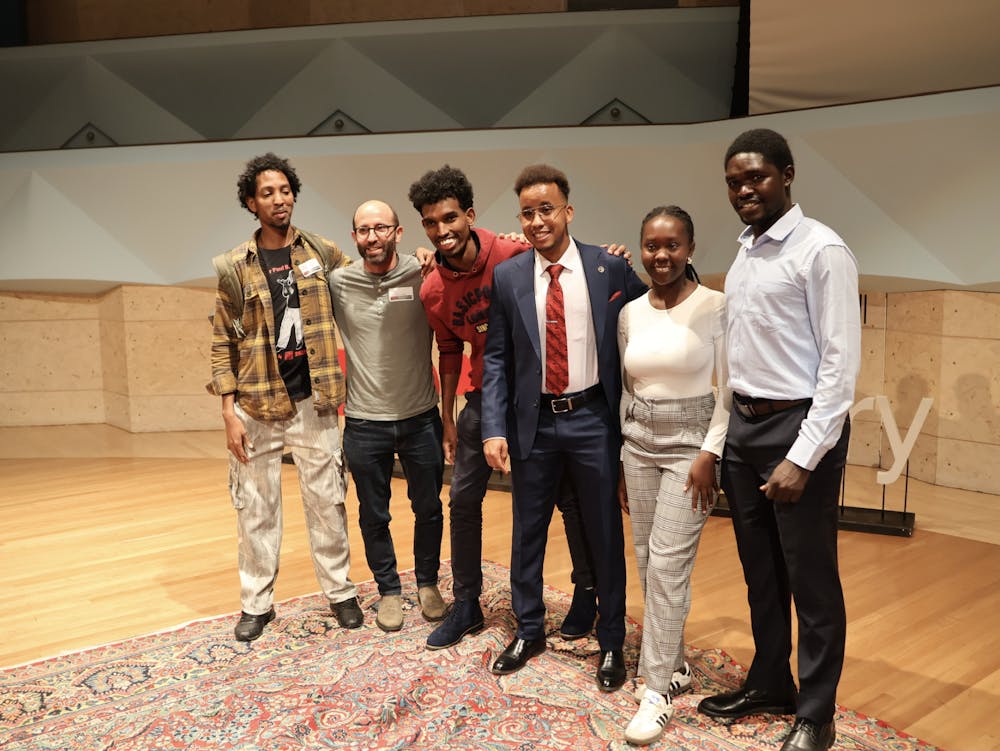
For more than a decade, Middlebury College has hosted students from the Kenya Scholars Access Program (KenSAP), which brings high-achieving and high-need students from Kenya to colleges primarily in the United States.
With six students from the program currently enrolled at the college, the program is part of a variety of external organizations that the college works with to enroll international students who otherwise would not have the opportunity to apply to Middlebury.
KenSAP was founded in 2004 by Mike Boit and John Manners. Boit, who studied at East New Mexico University after representing Kenya in the Olympics, and Manners, who was a Peace Corps volunteer in Kenya in the 1960s, wanted to send students with high financial need to colleges in the United States.
In the first decade of its existence, the organization sent around 140 students to the United States, building long-term relationships with colleges across the country.
Executive Director Alan Davidson, who joined the organization in 2016, expanded its role from solely guiding students to universities to also include college preparation and long-term student support. Currently, KenSAP requires students to participate in a college-readiness program by taking a gap year before starting college.
"In addition to our college access work, we also provide college readiness support, which offers college-style coursework to prepare students academically as well as career and professional development programming," Davidson said in an interview with The Campus.
Part of this gap year is a six-month residential camp held between June and November. The camp is run by KenSAP alumni and American teachers, who prepare students for the college admissions process and provide them with classes most American students take.
"Each summer, our interns come to KenSAP to teach college-style classes, easing students into what university life will feel like. This preparation is critical, as the Kenyan high school curriculum leaves many students underprepared for the interactive classroom style of a U.S. university experience," Davidson said.
“They taught us literature, helped us prepare for the SATs, both math and English,” said Mohamed Noor ’27, who enrolled at Middlebury through KenSAP.
Noor’s residential program occurred partially online, following sporadic election violence in Kenya in 2022.
“There was an election, so everyone had to go back to their homes and participate virtually,” said Noor.
The residential program is fully funded for students. KenSAP primarily relies on the colleges it works with to cover the costs of attendance for its students. It also raises funds in the United States, Canada and Kenya to cover the costs of its recruitment, residential program, and visa and travel fees.
"The most exciting thing is that our alumni are supporting us. Last year, they raised $112,000 through their own contributions, donations from friends and family and corporate matching gifts,” Davidson added.
The residential program covers boarding, food, entertainment and supplementary costs.
“They give you pocket money [for the residential program] if you have necessities and you don't have money, so they're very, very accommodating,” Emmy Napao ’26 said.
Following the residential program, KenSAP students are placed in internships in Nairobi, while asynchronously preparing to move to the United States.
A central focus of KenSAP’s work is supporting high-need students in Kenya who would not otherwise have access to higher education, both locally and abroad. Usually, the organization receives upwards of 2,000 applications per year and eventually selects around 20 students for its residential program.
Napao, who achieved the highest KCSE (Kenya Certificate of Secondary Education) score in the Kenyan county of Turkana, did not know about KenSAP until she was spotted by a KenSAP student in a magazine featuring her results.
“I got a call from someone who went to school in Turkana, where I am from, who had applied to KenSAP and was going to Davidson College. He told me, I've seen your results, and I think you should also look into this program, it's called KenSAP,” Napao said in an interview with The Campus. “I started applying with his help; I didn’t even have a phone at the time. I used to go to the nearest cyber cafe and do my application.”
Noor, who also achieved the highest result in the northwestern province of Mandera, learned about KenSAP after participating in a different post-high-school program.
“I sent KenSAP my KCSE results slip via WhatsApp. The first thing I received was, ‘Which school do you go to?’ I replied, Mandera Secondary School, and then the next thing was they just sent me the form, and they were like, fill in this form, and then send it by tomorrow. They gave me 12 hours,” Noor added.
For Middlebury College, KenSAP is a trusted long-term partner that helps connect the college with students who would not otherwise hear of it.
“[KenSAP] allows us to find students in areas around the world we wouldn't be able to travel to, especially rural areas. We tend to travel to more urban areas and go to schools where we'll see dozens of students. KenSAP … spread[s] the Middlebury name in ways that we would not be able to accomplish otherwise,” said Karen Bartlett, associate director of international admissions, in an interview with The Campus.
While the college has worked with KenSAP for over a decade, its relationship with the organization is not a fixed partnership and depends on the availability of annual funding for high-need international students.
“We never guarantee that we can admit a student who is nominated by KenSAP. Each year, we evaluate international students based on the financial aid that we have available and how well we think a student is prepared for Middlebury,” added Bartlett.
KenSAP provides its students with the opportunity to select a college that aligns with their personal, professional and academic interests.
“They give you some college names, and ask you to look at all these different schools, what they offer, their locations, and you know, you can get to decide whether that's a good fit for you,” Napao said. “I had two options, either Smith or Middlebury. I am from Turkana, which is very hot, and I wanted somewhere cold. I also went to a girls' high school and primary school, so I didn't want to go to an all-women school.”
In addition to university application support, KenSAP also helps its students apply for valid Kenyan passports and US visas.
“I did not have a passport, like many students, so we applied for passports all together; they booked our appointment together,” Napao said. “Getting a US visa appointment was hard. We used to be online checking whether there's an open spot, so you could grab an early appointment. I think I got my visa the day before I was supposed to travel.”
The organization maintains a connection with its students even after they enroll in a US college and provides them with support after graduation.
"Our career development program offers support for as long as alumni need it. Even a decade after beginning their college access journey, many return home to Kenya, uncertain of where to start, and we're there to guide them." Davidson said.
“It’s not just our CCI [Center for Careers and Internships] and our ISSS [International Students and Scholars Services] keeping an eye out for these students, but KenSAP also offers ongoing support, helping students network to find summer internships and jobs after graduation, so they are a helpful part of the student support network,” Bartlett added.
In light of changing immigration requirements for international students, KenSAP is preparing for potential restrictions by diversifying its partnership with non-US colleges and increasing opportunities for its graduates to return to Kenya in the long term.
"Our primary focus has always been US university placement, and that remains true today. However, recent visa restrictions on some African countries have prompted us to think more expansively, and we are now actively exploring opportunities at universities in Canada, Hong Kong, Japan and Europe," Davidson noted.
KenSAP is one of the many organizations Middlebury works with to identify high-achieving international students. Some organizations the college has worked with on the African continent include the USAP Community School in Zimbabwe, Bridge to Rwanda, Gashora Girls School in Rwanda and Elimisha Kakuma in Kenya.
For the KenSAP students at Middlebury, the current six-student cohort provides a built-in support system as they navigate an unfamiliar environment.
“When one of us comes to Middlebury, we help them figure out things, like, if they want things as small as, like, getting, like, a phone through the SAS grant, academics, internships or even just finding a job on campus,” Noor said. “I just try to pay back the support I received, and I will do that for any incoming KenSAP student.”
Yuvraj Shah '26 (he/him) is a Managing Editor.
He has previously served as the Senior Opinions Editor. He is a joint major in History and English Literature. He was awarded a $5000 Mellon Humanities For All Times Grant through the Axinn Center for the Humanities and is conducting research about the citizenship rights of the British Kenyan Asian diaspora. He studied abroad at Keble College, University of Oxford. He is a Senior Fellow at Middlebury College Admissions, a Residential Advisor, and Arts Events House Manager. He is a member of Middlebury College’s new 10-year plan development committee. He has previously interned with the New England Review and the Middlebury Magazine. He is an international student from Nairobi, Kenya, and London, UK. He is a UWC Davis Scholar.