
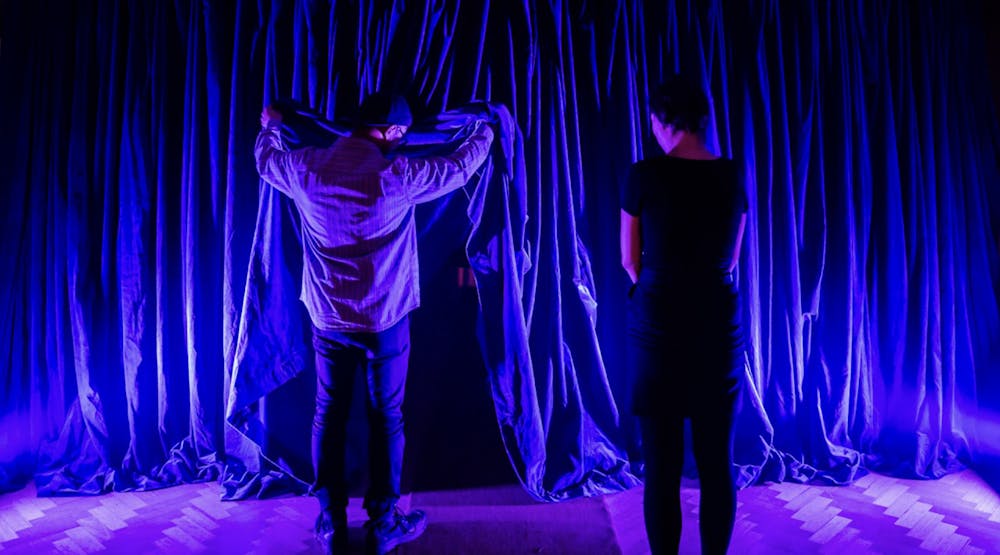
Standing in front of the heavy door of the Wright theater, darkness heightened my senses. I could only hear the woman’s instructions coming from my headset, accompanied by subtle music: Open the door. Find a bench. Sit down. I stared at the orange door, hesitated, and slowly followed the instructions. The dim light, the tenderness of every step and the tick-tock of the walking clock forced me to meditate on the intersection of time and space: Where am I? Where am I going next? This is a typical experience of a ‘one step at a time like this’ theatrical production, where audiences are guided through the space, becoming the actor of their own piece.
‘one step at a time like this’ is an Australian theater company that resided in Middlebury from Jan. 15—29. They facilitated multiple student workshops, worked closely with Middlebury faculty and student partners, and continued to develop their piece-in-progress “ALL THE WAYS WITHOUT YOU”, which had showings on Jan. 28 and 29. They aim to break the boundaries of conventional theatre and create audience-centric experiences, prompting them to explore different venues and spaces that they could transform into playgrounds for audiences to navigate.
The production partners, Suzanne Kersten, Clair Korobacz and Julian Rickert, met and soon launched the program. They decided to create a 21-year program that ensures long-term collaboration, allowing them to build an intimate space where they can experiment, fail, and continually reinvent their work. Originally, they made shows with audiences sitting down in a theater, but in 2009, Kersten and her partners decided to expand their stage into a city where their audiences could live and act in this theatrical experience.
“We want to see the audience walking out in a city, where they could see the world as a heightened experience if given time, a headset and not knowing their destination. You know, when you move through the city, you have a purpose, where you often stop to check where you are. But when you are in a city, in a show, and you have no purpose except to follow the instructions, then your senses can open up. We didn’t know this when we first did this, but it was just the audience walking with no straight performance — except for the world,” Kersten said.
This initial experiment tested whether the simple act of walking could prompt audiences to perceive the world itself as a form of theater. It’s accompanied by audio — local music, poetry and philosophical reflections — designed to heighten visual awareness and anchor participants in the immediacy of the present moment.
Their theatrical production is also unique in its high degree of personalization. They host audiences in very small groups; when the company first developed the walking work, they would take only one audience member at a time. Kersten noted that the showings in Middlebury are the largest groups they have hosted, with only 12 audience members, split into three groups taking three different routes.
This production also marks the company’s first time staging a mobile work focusing on a fully functioning theater. As theater people, they came back to their birthplace with a baby work that re-incorporated the space in an utterly unconventional way. The performers open up the space that was reserved for the acting crew, offering the audience a guided tour of the Wright Theater — from entrances and emergency exits to the conference room, backstage dressing rooms and the stage itself. The theater’s lighting and sound systems further enable the creation of visual illusions and metatheatrical moments. Even the curtains are woven into the performance, adding spatial layers and enclosing the audience onstage, evoking a palpable sense of entrapment.
“ALL THE WAYS WITHOUT YOU” focuses on closely examining specific sites to commemorate the nature that once existed there — the landscapes, habitats and topography. In one scene set along Otter Creek, audience members are instructed to lie amid marsh grasses and cattails, projected by artificial light, meditating to a soundtrack of growing plants and glaciers. Just as the audience settles into a mood of meditation and tranquility, the atmosphere is sharply interrupted by Rickert, who declares that he has had enough of what he calls a pretentious meditation — one staged in a “natural” setting that is, in reality, constructed through artificial and digital means.
“The truth of the matter is: you’re late. You are all late — five or six hundred years late,” Rickert explained. He pointed out the paradox that to create this meditative experience, the marshland needs to be drained, the cattails need to be cut, and a theater needs to be built — and all of this is to replace a real experience with a fake one.
“This theater is built upon the destruction of nature. I really liked this design. While asking you to immerse into this scene, they interrupted themselves, and later asked you to lie down again. This creates a sense of absurdity and encourages reflections,” Jane Zhang ’28 said, the student partner of the production.
During their time in Middlebury, the theater company led two student engagement workshops, working closely with students to discuss and reflect on their practice. The sessions centered on debates about the nature of theater, as the artists themselves wrestled with how to define their work. By the end of the discussions, they arrived at the idea of the production as a “heightened experience”: once audience members put on the headset, they become both spectators and participants in relation to the world around them.
By transforming everyday spaces into a stage, ‘one step at a time like this’ suggests that life itself is theatrical, awakening our consciousness as actors in our own lives.
Yoyo Zhang '28 (she/her) is an arts & culture editor.
Yoyo is an Applied Math and History double major. She enjoys watching live theater and is also an actor herself. She has a wide interest including calligraphy, snowboarding, and painting.


