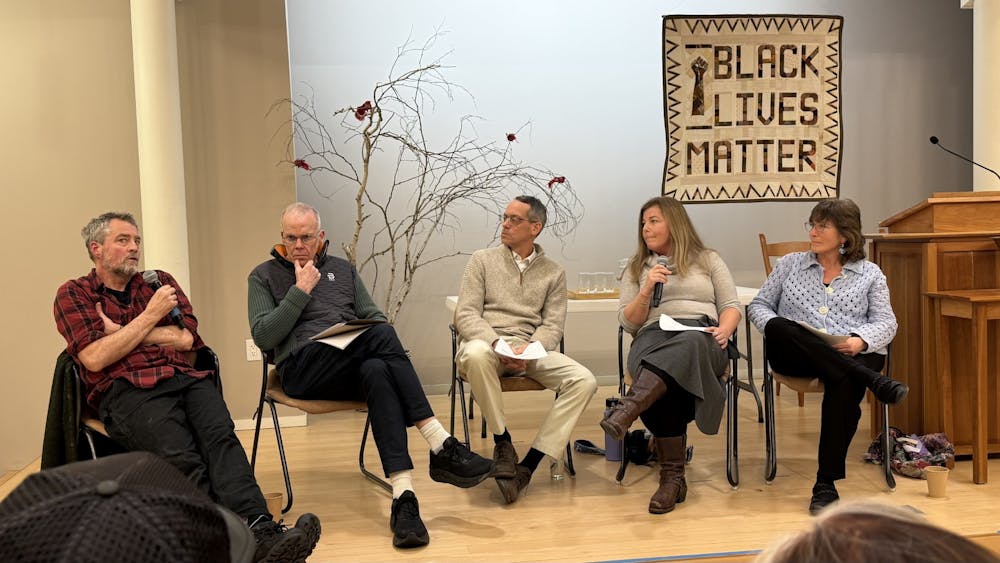
On Wednesday, Feb. 11, a crowd gathered at Champlain Valley Unitarian Universalist Society to listen to a panel of experts on the subject of middle schoolers’ mental health during an event titled “Fostering Resilience and Hope in Our Children Today.”
The panel consisted of local experts on children and psychology: Matthew Kimble, a former Chair and current professor in psychology at Middlebury College; Laura Basili, Ph.D., a clinical psychologist in town who teaches part time at the college; Wylie Cate, a licensed clinical social worker who runs a private practice; and author Tal Birdsey, a teacher and the head of School at the North Branch School, the small, private Ripton middle school that assembled the panel. The discussion was moderated by Bill McKibben.
In attendance were students from the college, local middle schoolers and Addison County educators and parents.
Rose McVay, a teacher and associate head of North Branch, helped coordinate the event and watched from the audience. She explained the importance of organizing this event.
“In our school, we have more kids feeling more anxious or stressed and getting overwhelmed more easily. We do attribute a lot of this to the new digital world, which can divide our lives into the real world and that world with all of its accountability issues and algorithms,” McVay said
Addressing the specific needs of their students has been an ongoing initiative within the close-knit North Branch community. A few months ago, the school invited Kimble to speak to the middle schoolers about resilience.
“I think they recognize that kids at that age always have particular needs. I think they’re also recognizing that middle schoolers these days have particular challenges and are seeing this manifest in their students in ways they haven’t before,” Kimble said.
Kimble came to North Branch to explain how to navigate those challenges with resilience.
“Resilience is technically, and it started fundamentally as an engineering term to reflect structures that bounce back after stress,” he said.
At North Branch, resilience is incorporated into the curriculum.
“[Students] trust themselves to use their experience to figure things out, to make the best decisions they can, and importantly, they also trust that they have support –– people they are connected to that they can go to if they are in trouble. They are connected to themselves that way, and they are connected to their peers, to trusted adults and to a community that way,” McVay said.
Wednesday night’s conversation echoed that theme. To start, the panelists shared what they considered key differences between how they grew up and today’s generation. Themes of childhood risk-taking and social connection without technology were prominent. The conversation then moved to the challenge of technology, prompting Kimble to reference psychologist Jonathan Haidt’s thought that “smartphones are an experience blocker.”
The panelists discussed how often children resort to their phones when faced with an uncomfortable situation, rather than processing their emotions or pausing before reacting. Basili and Cate both described the need for alternative response methods. They suggested listening to a podcast or music, doing something creative, or simply going on a walk.
The panel also addressed anxiety within parents. Kimble stated that a child’s anxiety could be, in part, a result of the anxiety manifested in their parents.
“[Parents] have to support them more in their becoming. They have to show them what we want them to do. That means not being on our devices as well,” Basili said.
Cate suggested “Ask Lisa,” a podcast she and Basili follow, as a resource for the event’s audience. The podcast focuses on “future-proofing” children. Future-proofing refers to helping children prepare not for individual stressors, but for managing their emotions when something does not go as planned or a significant disappointment arises. Above all, Cate emphasized, “Don’t escape. Don’t check out. Don’t leave the hard class. Teach your children to sit with the hard things.”
Following the panel and a Q&A session, the audience had an opportunity to mingle and reflect on the key takeaways.
For instance, Malia Rutherford ’26, who is also in Kimble’s senior seminar, “Resilience” hopes to spend more time having face-to-face interactions.
“I’ve definitely become much more of a texting freak in the last few years,” Rutherford said.
Madeline Murphy, a fourteen-year-old who attends North Branch School, reflected on the local community's support. “I think that really what I’ve taken away is that there’s such a community behind helping kids,” Murphy said.
With the conclusion of the event, McVay hopes parents and students will walk away with new tools to help them navigate today’s world.
“One [is] the importance of encouraging healthy connections with self, peer groups, trusted adults, wider family, and communities to foster resilience. Helping them to recognize the power of their own stories in their own unique words, both spoken and written. Getting kids involved,” said McVay. “I feel like the conversation has just started and the world will keep changing, and we will need new tools to best support our kids,” she added.