
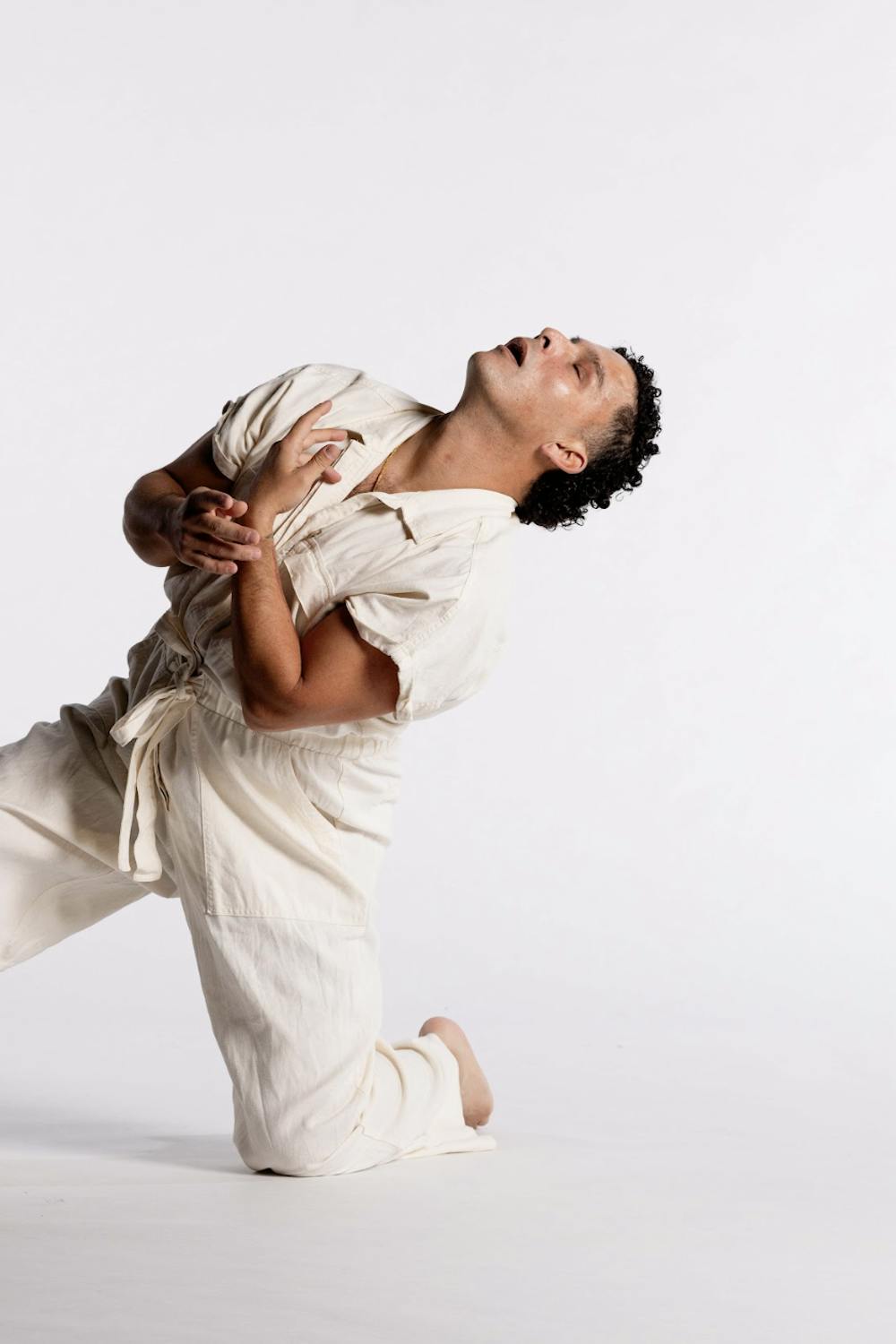
Conversational Art is a column of artist interviews (faculty & students alike) that foregrounds the personal voice, the creative process and bouts of insight springing from the resonant space in between.
I discovered Butoh dance this January, and it was sensational. I kept saying to friends how it was a “spiritual practice in motion,” an improvised phrase which continues to ring true as the practice deepens.
Professor Chavez carries a captivating presence that resonates with care. I knew it was the right place to be the moment he asked us to walk, but not as us. Walk defiantly — backwards, tiptoeing, hopping like a rabbit, slower and then faster. Discover ways to be outside of our domesticated bodies. Discover opportunities for unison, resonance and reconciliation through movement arising entirely from impulse.
I sat down with Professor Chavez to discuss his decades-long pursuit of Butoh, his inspiring relationships with world-class Butoh dancers and his profound insights into art, life and finding our place in the universe.
Chavez first found Butoh in a photo book underneath a massive sound system in a house he shared with fellow artists in Portland, Oregon. He was transfixed by the strangeness of the figures; something about the theatricality of the contorted bodies spoke to him.
Around the time of his chance encounter with Butoh in pictorial form, a festival called TBA (Time Based Art) happened in Portland, which had a Butoh workshop. Chavez immediately knew he had to go, despite knowing nothing about it.
At the festival, Chavez first met and was immediately entranced by Akira Kasai, a world-renowned pioneer of Butoh: “The workshop itself blew my mind. It opened me up, and then I saw Akira Kasai’s piece, which was called Pollen Revolution. I went three nights in a row. I could not understand what I was seeing. It was all goosebumps. And at the end of that last night, I thought, I still don't know what's going on, but I know I have to learn how to do that. I saw how Akira Kasai was commanding space by moving beyond himself enough that it was moving the people who were watching him. It was like we were all ensnared in a field. And so I started chasing him first.”
Later on, Chavez met Denise Fujiwara — another leading figure in the art form — at the Exit Festival, part of a Butoh consortium held at an old farmhouse turned compound outside of Berlin, where eight Butoh choreographers and about a hundred dancers worldwide were brought together.
“The very first night they had all of the teachers perform. When Denise performed, I was on the edge of my seat. That thing, again, was appearing where I was like, ‘How are you doing that?’ I’m seeing something that is unnameable. Right there and then, I knew she was the one. I knew I was going to work with her. I just knew it. We were having lunch one day and she was talking about working with Natsu Nakajiima, and how she wanted to have Natsu create a solo for her, and Natsu said no. Ten years later, she went back and was like, ‘I need you to create a performance for me.’ In our conversation, she said to me, ‘I knew that if Natsu said no again, I was gonna give up dancing forever.’ And I was like, ‘Whoa, Denise, that's a big statement.’ But she was deadpan. She said: ‘If I knew I couldn't get what Natsu had, then I didn't want to dance anymore, because there's enough mediocre dance in the world.’ I almost started crying. It still makes me cry. That's the moment I knew she was my teacher.”
I asked Professor Chavez about the tension between being an artist and a scholar, between living the truths and imparting them.
“If I'm being perfectly honest, I'm always struggling with this institution. Not this one, per se. I'm not entirely convinced. I try not to compare myself to other professors. But sometimes I look around and think, I'm not bought into this the way I see other people. I didn't see being a professor on my bingo card. I didn't go to college. I'm a high school dropout. I chased a dream around the world for this thing that is so small and so unknown and somehow it's opened these amazing doors for me. When I got hired as the artist-in-residence during the pandemic, I didn't think I would ever create work ever again. All of my energy just went into surviving. For my first piece, I had to force myself. It was in J-erm, and I told everyone that I was having an open rehearsal at 7 in the morning, and anyone could come. I knew no one would come because who was going to show up at 7 in the morning. I would go into the dance studio, put my hoodie over my head, roll around the ground, and I would cry. Then halfway through that J-erm, I was like, ‘Oh, I think there's a piece here.’ And so I made a piece from my tears. The truth is, everything that I'm teaching you in class, I have to live. Deeply. Or my life doesn't work.”
Towards the end of our conversation, I shared with Professor Chavez how learning Butoh led me to appreciate the inherent intelligence to the ways in which circumstances emerge outside of our control. The natural, unperturbed rhythm of things.
He responded by sharing his decades-long connection with a theologian.
“We met through Native ceremonies. One of his inspirations in his life is Meister Eckhart, who lived from 1260 to 1338. He ended up being shut down by the church because his teachings were so radical. Eckhart would say that everything has its own isness, and that it's in the recognition of isness that relation is built. And that everything has its own resonance. That just blew people's minds at that time. It still blows people's minds. Because if we really believed that, then it would have to change how we interact with everything.
“All of a sudden, we're not the ones enacting the thing; all of the things are enacting the thing, and we're in some sort of communication with them. I think that points back to indigeneity. I always tell people that if I was in a tribe 150 years ago, everything I needed would be right around me. And if it wasn't, it would be 50 miles that way. It's all in our sphere already. But we're not taught that. We're taught that the other thing is way over there, and that it's going to have to be always just beyond your reach. What if it's within our reach? Maybe things are beyond. But maybe they're right there. I don't know. I think about these things a lot.”
Christy Liang '28 (she/her) is an Arts & Culture Editor.
She is an English & Religion major who loves long conversations, live music in underground bars, and films that are a little pensive. She's genuinely curious about what goes on in other people's minds. Her column, "Conversational Art," is a series of interviews with student and faculty artists across all mediums.


