
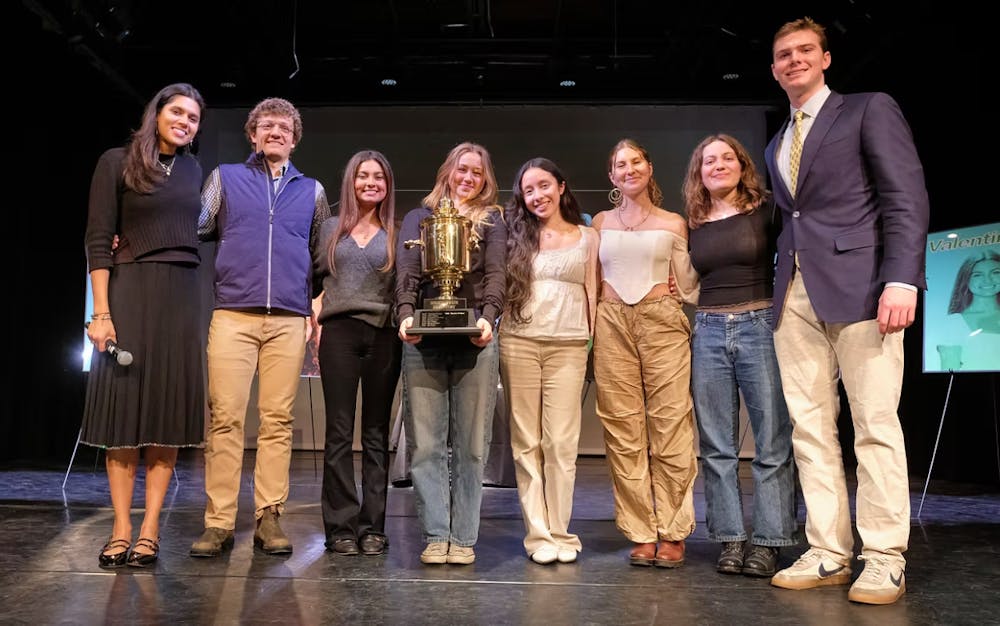
The Spencer Prize Speech Competition is an annual event hosted by Oratory Now that showcases the public speaking abilities of the First Year class. Participants progress through a nomination process in their First Year seminar, followed by two rounds of speech competitions, culminating in a final showcase on Jan. 27th.
This year, the finalists were Andrew Baay ’29, Talia Shilling Rabin ’29, Brianna Acosta-Garcia ’29, Lillian Tracy ’29, Mary Bosco ’28.5 and Valentina Askar ’29. The winner was Tracy, who discussed her sociology class and the Quantified Self.
Students share something they learned or realized through a Middlebury class, how it connects to something in their own life, and to convince the audience why they should care, too. The final round — held in McCullough this year — features five finalists and includes a $500 cash prize for the winner. The competition aims to teach students important lessons about themselves, the things they care about, and how they connect to their academic journey at Middlebury.
Zane Malarkey ’28, one of the executive producers, participated in the Spencer Prize competition last year and joined Oratory Now soon afterwards, before serving on the organizing committee for this year’s competition. He started working with Ben Powers, associate director of Oratory Now, and Yasmina Errahioui ’28 this past October. Malarkey explained how the process and competition have changed slightly over the past year and outlined the new features added. They included adding speech coaches and students from previous years’ competitions to mentor the new participants.
“The coaches complete a 10-hour course over three weekends of the fundamentals, philosophy, and sort of how to coach. The mentor system…was something that we piloted this year,” Malarkey said.
Malarkey emphasized the importance of supporting each speaker and helping them lengthen their speeches. Baay, one of the finalists, emphasized his appreciation for the mentorship program, how it helped him to develop his thoughts and organize his speech ideas. He reflected on how his mentor, Lily Jensen ’28, provided consistent feedback and supported him throughout the process.
“Lily taught me that speech writing is completely different than normal writing…When she made me have that realization, I was able to jot down my thoughts and actually chop down my sentences, because that sounded better than speaking,” Baay said. “It actually became more clear to me when I just started brainstorming my ideas out loud of what I wanted to talk about more…They asked me to go deeper and to die in the stories and to provide imagery.”
Shilling Rabin, another finalist, highlighted the collaborative nature of the speech performance process and how she learned from her peers as they delivered their speeches. She incorporated some of these nuances and personal touches into her own speech.
“[It was] interesting, just to see how many little elements play into making an interesting speech, like the way that people gesture or the certain tone that they use [and] pauses. It was really just so interesting to see all these little elements and how much of an effect they can have,” Shilling Rabin said.
Oratory Now also serves as a student job for many. Xander Bowles ’26, finalist for the winter 2023 Spencer Prize, noted how the program provides employment and community. “Oratory Now has been my on-campus job since freshman year, given me a community of people I wouldn't have otherwise connected with, and made me a much better speaker than I would have been,” Bowles wrote in a message to The Campus. Bowles was a light and sound technician for this year's competition.
There was variety in the topics: Baay discussed mindfulness; Shilling Rabin discussed gender and the body. Bosco discussed cannibalism and elements of her cultural anthropology class, Askar spoke about lying and storytelling; Acosta-Garcia discussed her global health class and social stratification.
Spencer Prize winner, Tracy, discussed the confidence she had going into the competition: “The confidence [came from] the fact that I was genuinely stimulated by the things that I had learned last semester,” Tracy said. “It was kind of incredible to see how an idea that started off really small from a class could really take form into something that everybody can relate to and appreciate, because I didn’t think my little thought that I had loved presenting on in my sociology class could become what it was.”
Acosta-Garcia spoke about her prior public speaking engagements and experience, which she found enlightening, and noted that the opportunity to educate others about a subject she is passionate about is unique.
“I really love theater, I love acting…I loved speaking in public and screaming and being dramatic, and that really helped the presentations…[my mentor] Mac told me to come to [Oratory Now] with an open mind…It’s okay that this is my story and I know it better than anybody else,” Acosta-Garcia said.
Bosco expressed similar sentiments and observations and expressed her gratitude for the moment and the opportunity.
“I think the bottom line for any good story is to just show people that you care, and what you care about…I think that’s what lends to the most moving stories that people can hear…I think seeing other people be passionate about it and care a lot about the process really encouraged and inspired me to be brave and get up the courage to go on stage,” Bosco said.
Editor's Note: Managing Editor Yuvraj Shah ’26 and Design Director Joanne Zhang ’29 contributed reporting to this article.


