
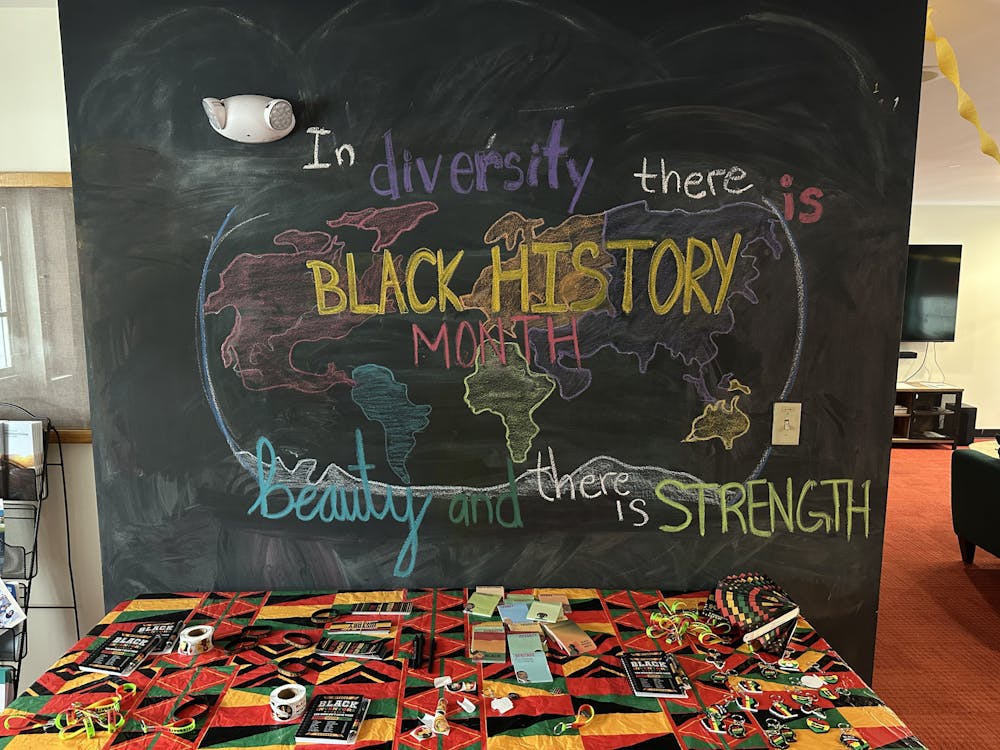
On Monday, Feb. 16, students gathered in Coltrane Lounge for a Double Dutch workshop organized by the Black Students’ Union (BSU) in conjunction with Evolution Dance Troupe, part of a host of events planned for Black History Month.
“Black History Month is a great opportunity to showcase Black culture in a positive light,” BSU Co-President Michael Sanjurjo Jr. ’28 said in an interview with the Campus.
Programming lined up for the month on top of the Double Dutch Workshop includes a Blaxploitation film series, multiple Welcome Back events, Spirit Week Celebration with various events and themes through the week, a student and faculty mixer, dining hall takeovers, a “Shades of Nudes” brunch and a collaboration with the student-run M Gallery.
“[What] we try to focus on is having something fun, something educational, and something that brings people together and promotes discourse,” BSU Co-President Nawale Nachula ’28 said.
Another common motivation from organizers behind the programming is building a sense of community, especially for Black students and faculty members. According to the 2024-2025 Common Data Set, African Americans make up only 5% of Middlebury’s student cohort.
“I like to say [the Black community at Middlebury] is small but mighty,” Nachula commented. “Creating a community between Black students and Black faculty and staff members […] gives you a nice home away from home feeling.”
Both BSU and the Black Studies Program have looked to collaborate with other clubs and departments on and off campus for events.
“At a small liberal arts college, there shouldn’t be a reason why departments can’t work together,” Black Studies Program director Jerry Philogene explained. The program’s Blaxploitation film series is in collaboration with faculty from both the Film and Media Culture and the Luso-Hispanic Studies departments.
“It's a good way for us to have interdisciplinary dialogue and cross-cultural conversations,” she said.
“With all the things these other clubs do, they tie very well into our philosophy as BSU, which is to promote Black culture throughout different experiences at Middlebury,” Nachula said. “A lot of our members are in these clubs, and we want to support them as BSU in whatever avenues they decide to pursue.”
Sanjurjo is currently working with the Anderson Freeman Center (AFC) to organize shuttles to Burlington on Feb. 28th for an event called The Black Experience. The event is described as “a holistic celebration of Vermont’s Black lived experience,” hosted by Flynn Theatre, featuring author and activist Ibram X. Kendi.
Nachula also emphasized the diversity in programming is to showcase the breadth and diversity in Black culture: “[The various collaborations and events] is to show that the Black experience and being Black is not a monolith.”
“People have a lot of preconceived notions about what the Black experience is,” Nachula said. “Being able to flip those and showing people that it can be multiple different things is something that’s very important to us.”
Organizers are also thinking beyond February.
“I’m always really suspicious of Black History Month because it seems like it’s the only time we celebrate Black culture,” Philogene said. “I think these conversations should be happening all the time.”
The film series starts in February and runs through the whole spring semester as part of a continuous effort.
Sanjurjo emphasized a programming philosophy BSU has implemented, which is to hold consistent weekly but low-stakes meetings throughout the year — the only culturally-based organization to do so on campus.
“We have learned that minority students are probably the majority of student workers on campus as well as in town,” he explained. Given their demanding schedules, weekly open-door drop-in sessions are more effective than mandatory attendance meetings.
After February’s celebrations, these meetings will build toward the Night of Black Culture featuring planned performances and celebrations, a tradition that has its roots in the 1980s, according to Sanjurjo.
Organizers generally expressed appreciation for institutional support for the programming.
“What I am very happy about is that Middlebury has been very committed to us doing the work that we do,” Philogene said. “I have not gotten any ‘don’t teach that class’ or ‘don’t have this film.’”
Nachula expressed appreciation for the AFC, the college’s center for underrepresented students, for their support in both advice and resources.
“I don’t think we’d be able to do half the things we do if it weren’t for Derisa and Steve,” Nachula said. “A lot of cultural organizations can say the same.” Derisa Collymore is the executive director of the AFC, and Steve Zatarain ’15 is the assistant director.
This programming comes at a time when Black Student Unions and other cultural organizations are being shuddered nationwide due to anti-diversity, equity and inclusion (DEI) bills. Since 2023, 141 of these bills have been introduced, and 29 have become law across a majority of states.
“We’ll continue to do this work [...] because [it’s] so important,” Philogene said, framing it as part of a broader “liberatory process.”
“One of Michael and I’s main aims for this semester is to make BSU an environment where everybody is welcomed and comfortable,” Nachula said. “Regardless of your background or identity within the Black community and even if you’re an ally, we want to foster a space where everyone can congregate, celebrate and cultivate a sense of shared understanding around Black Culture.”
Met Ly '28 (he/him) is a News Editor.
Met is a UWC Davis Scholar majoring in International Politics and Economics with a Creative Writing minor. He is also a fellow at the Rohatyn Center for Global Affairs. He hails from Siem Reap, Cambodia and spent his gap year there as a digital marketing manager and events coordinator. Outside the newsroom, he line dances in his cowboy boots and jams out to the Arctic Monkeys.


