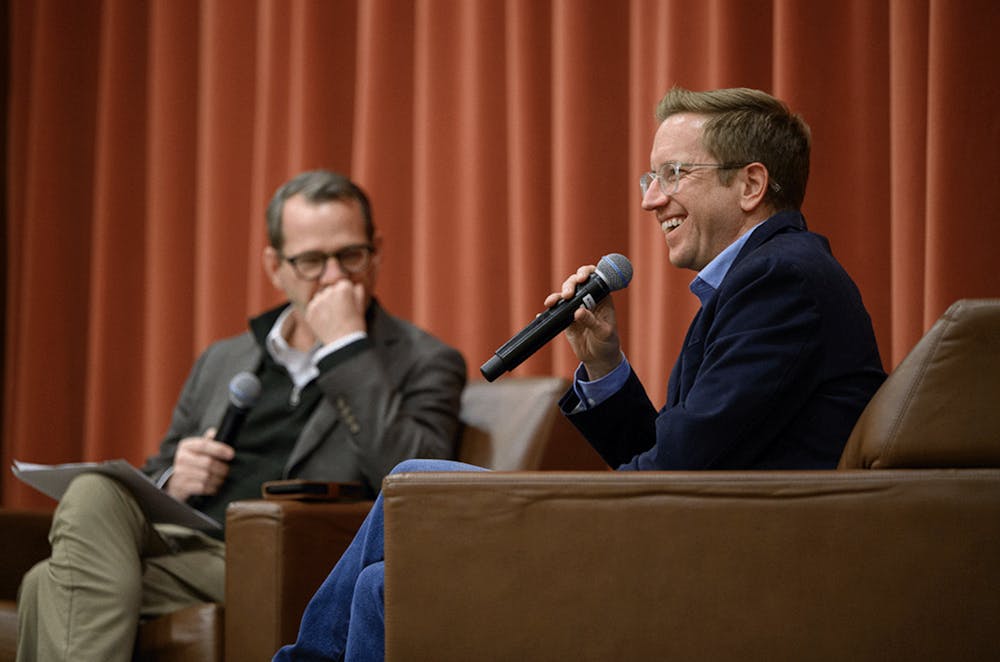
On Nov. 14, college President Ian Baucom sat down with Jamie Henn ’07, a climate advocate and founding member of the Sunday Night Environmental Group (SNEG). The discussion, held in Wilson Hall as part of the “What Works Now” conference, marked the 20th anniversary of SNEG and echoed the college’s 2005 “What Works” climate summit. The event offered Middlebury the opportunity to publicly discuss its environmental future.
Henn — a co-founder of 350. org, one of the world’s largest grassroots climate organizations, and the founder of Fossil Free Media — has spent two decades in frontline climate activism. In 2022, he was named a “Grist Fixer,” a title Grist, a nonprofit media organization, gives to emerging leaders developing innovative climate solutions.
Baucom opened by asking Henn about the beginnings of his climate activism, an origin story rooted squarely at Middlebury. Henn first became interested in climate advocacy while taking the J-Term class “What Works Now: Building a New Climate Movement,” which he said altered the trajectory of his life.
“I very quickly fell into a class, and a conversation, and a community, which has gone on to define my life and career for the next 20 years,” Henn said.
Baucom and Henn went on to discuss the importance of community in fostering activism, which Henn coined the “myth of the solitary genius.” Henn worked together with other Middlebury students when founding 350.org, struggling through winter nights in a Burlington apartment with only a space heater for warmth. Henn emphasized the importance of collaboration in struggle, that effective organization came not from an individual but from a space that fostered valuable communication.
“SNEG was a group of people who had so many different interests and projects, but a shared commitment to each other,” Henn said. “I think there was some sort of electric magic in the room.”
Henn described what began as students organizing in Vermont eventually grew into a movement responsible for global days of action, including the People’s Climate March and the Global Climate Strike. Baucom then asked how Henn maintains energy and optimism in a field often defined by existential urgency. Henn encouraged aspiring activists to live in more than one emotional register, to enjoy hope and small wins while simultaneously understanding the magnitude of the issue.
“Multiple things can be true at once. We could be living through an incredibly dark time and we don’t have to sugarcoat that,” Henn said. “At the same time, something else can be true, which is that we’re seeing just incredible momentum in the clean energy space.”
Throughout the conversation, Baucom drew frequently on prominent academics and historians, which struck a chord with Henn, who majored in history. Their dialogue intertwined ideas about social change with reflections on organizing campaigns and Henn’s more recent communications work through Fossil Free Media.
The final portion of the event was reserved for a Q&A with the audience, which ranged from how to find yourself as a student activist to a direct question about how to encourage Middlebury to divest from arms. Henn was eloquent in his replies, encouraging students to “take it slow” and “find momentum” in their climate advocacy.
One audience member asked how to push for the college to divest from arms-related companies — a topic that has remained contentious since the Board of Trustees voted against arms divestment in Oct. 2024. Baucom chose not to respond directly, instead inviting Henn to answer. Henn encouraged the audience member to find new avenues of activism if they found themselves stuck on the issue of divestment. Since 2012, 350.org has driven 1,300 institutions to divest from fossil fuels.
The talk fit well into the inspiring collection of panels and lectures put on in the rest of the conference, offering both students and alumni a new way of thinking about the climate movement.
Kai Arrowood '29 (he/him) is a News Editor.
Kai previously served as a staff writer. He is a prospective English and Sociology joint major. Aside from The Campus, Kai is a copy editor for Middlebury Geographic and an avid participant in National Novel Writing Month.