
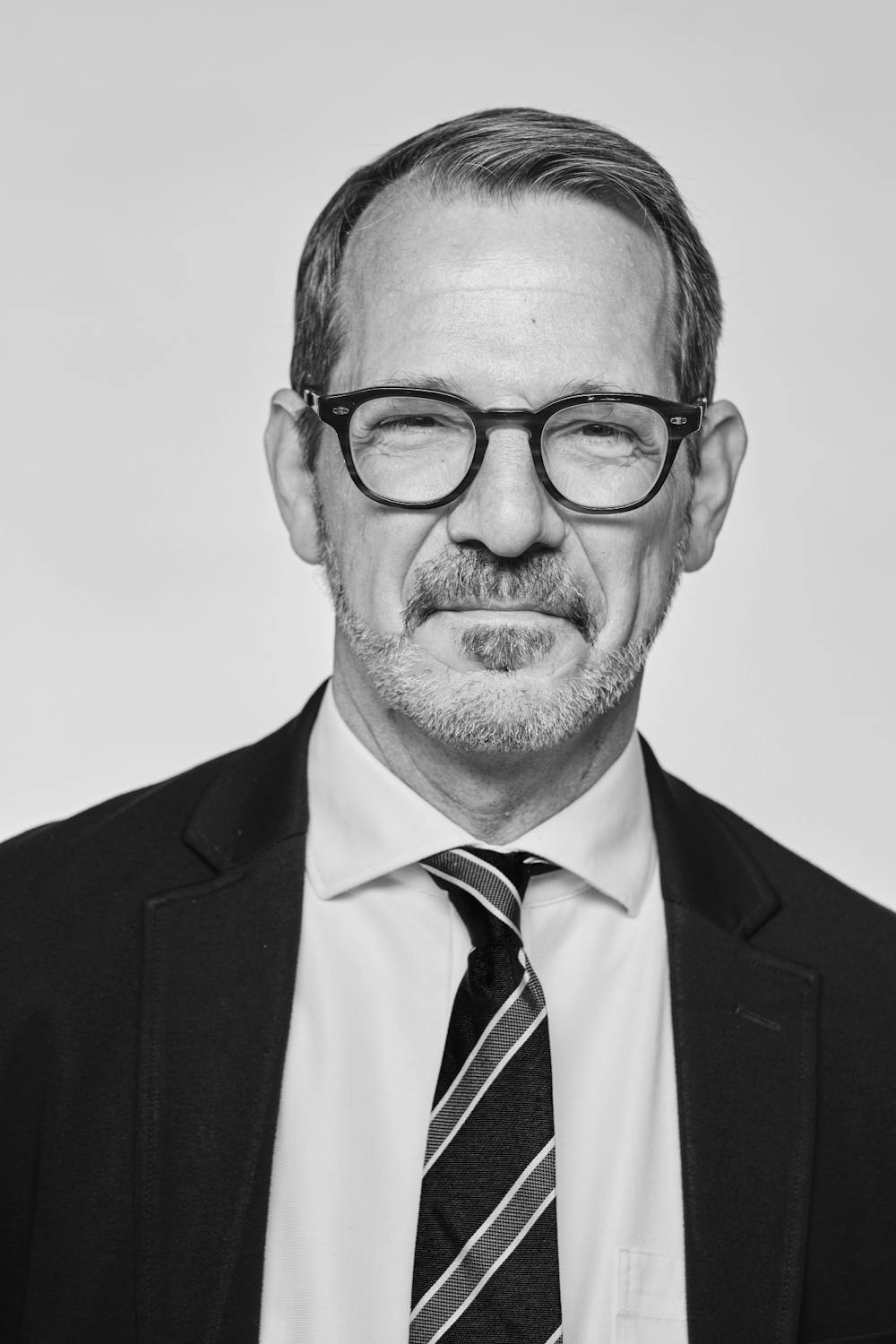
Since Ian Baucom began his role as Middlebury College’s 18th president in July, he’s mapped out a regular walking route. Starting at his office in Old Chapel, he winds past Old and New Battell, through BiHall, out to the Knoll, back up College Street, around Proctor and down to Axinn. Sometimes he walks with a faculty or staff member, engaged in conversation. Other times he’s alone, thinking. He is still searching for a favorite campus tree, he said. Like any other first year, Baucom has time.
For the postcolonial and climate change studies scholar and former provost at the University of Virginia (UVA), his first semester at the college’s helm has come with a whirlwind of new experiences and challenges to confront.
In August, he decided to close the Middlebury Institute of International Studies at Monterey (MIIS), a major step towards balancing the college’s large budget deficit. His inauguration on Nov. 2 came the same week he was tasked with leading a community mourning the suicide of Lia Smith ’26. Baucom was selected for the presidency in January, just days after Donald Trump returned to the White House. Trump has since sought to dismantle critical aspects of higher education nationwide.
While Baucom could not have predicted the full magnitude of this shift while he was interviewing for the job, a crystal ball would have only affirmed his decision.
“I wouldn't want to be a college president any other time, because it's so clear that what we do matters,” Baucom said in an interview with The Campus.
In October, Baucom signed a statement along with several other college presidents rejecting the Trump administration’s “Compact for Excellence in Higher Education."
For him, the greatest challenge facing Middlebury, and higher education more broadly, is defending academic freedom and, with it, democracy. Over recent decades, public trust in higher education has fractured.
“[Higher education was] that place where I and everyone had the possibility to participate in the fullness of democratic life,” Baucom said. “There was a consensus, and it was not politically divided. We've lost that consensus…We need to return, or find a new path so that people really believe that college represents the possibility that our democracy can realize itself more fully.”
Earlier this fall, Baucom launched a Strategic Planning Initiative, Middlebury’s first of its kind in more than a decade. According to an Oct. 29 news announcement from the college, the plan will clarify the school’s mission, sharpen its priorities and identify concrete goals for the next several years.
“A strategic planning process, which is primarily and generally for the college itself, is also a way of making a case for college, making a case for higher education, making a case for the liberal arts, and it's urgent,” Baucom said.
This isn’t his first go at strategic planning. He worked on the 2030 plan at UVA and on a “Strategic Vision” at Duke University as chair of the English department. But he explained that those schools are markedly different from Middlebury; they run major hospital systems and sports franchises, prioritize research and run multiple schools under their institution. Middlebury’s project is focused solely on the liberal arts.
“We know our core and so there's a clarity of purpose here,” Baucom said. “We know everything emanates from residential undergraduate education.”
The strategic plan is being led by a 13 person steering committee, co-chaired by Professor of Global Health Jessica Holmes and Associate Professor of Chemistry AJ Vasiliou. The committee includes faculty, staff, students and trustees charged with gathering community input and articulating long term goals for the college.
It also consists of 11 working groups answering specific questions about strengthening the college's core, how the college should connect more intentionally with Vermont and its global programs and how to address issues in higher education. The plan held its first open meeting on Dec. 2 in Wilson Hall, and another is scheduled for Jan. 15.
“My aspiration is for us to be the best liberal arts college in the country, in the world,” Baucom said. “I want to be the best. I want your education to be the best. I want your experiences to be the best. I want our faculty and staff's experience to be the best.”
That aspiration is rooted not only on Middlebury’s campus but in the local community that surrounds it. Since moving here, Baucom has been struck by Vermont’s commitment to preserving its natural landscape and the strength of small-scale civic life. On Fourth of July Weekend, he and his wife Wendy attended the Great Bristol Outhouse Race to watch heats of outhouses being pushed in a fierce competition on West Street. The moment stuck out to him as a marker of what small town Vermont life and community can be like.
Baucom believes the college must understand itself as part of the solution to Vermont’s numerous problems, including housing scarcity, population decline and a child care crisis. He recently joined more than 150 community members at the ribbon-cutting ceremony for Otter Creek Child Center on Weybridge Street, a project the college subsidized.
“Thinking about how we can participate in economic vitalization is a really crucial thing and I want [the college] to be really good partners for the state of Vermont,” Baucom said.
The mentality of looking beyond campus shapes his view of Middlebury’s global programs. Baucom visited several Schools Abroad sites in May, including Madrid, Paris, Florence, Rabat and Oxford.
“I can't understand Middlebury if I don't know what our [other] schools are like,” Baucom said.
The contrast between sites — “the urban intensity of Rabat” versus “the dreamy spires of Oxford,” as he called them — prompted him to think about how to better integrate the Vermont campus with its global network.
Middlebury’s foregrounding of global communities and global impact has also directed Baucom’s direction as a scholar. His recent academic research has targeted various intersections and overlaps between the humanities and climate change. Part of his interest in coming to Middlebury was its commitment to environmental studies and the climate crisis. This new orientation for his scholarly work has recapitulated his love of teaching.
“I haven't taught in 10 years, and I want to teach again, and I want to start teaching courses at that point of intersection between the climate future, climate humanities and literary studies,” he said.
Baucom is currently working on a monograph project.
“The central question is: Does the climate future have what, in legal terms, is called standing? Standing in that legal matter means that you have the right or the ability to bring a claim, and you're recognized as a party with rights. So does the future have standing?”
When he’s not walking, thinking about how to solve the crisis in American higher education or pondering the future’s standing, Baucom has been spending his time around campus, getting to know the school. He strolled through the fall Student Activities Fair, stopping by clubs’ tables to talk. He has attended rehearsals for student productions like “These Shining Lives” and “A Gentleman’s Guide to Love and Murder.” He hosted the board of Dolci, Middlebury’s student run restaurant, to cook a meal in his house. Though he said not every community interaction is posted on his Instagram account, several have been.
An Instagram account is not only new for a Middlebury president, it’s new for Baucom as well. He never used social media before coming to campus.
“It's just turned really fun because it feels like a reminder every day not to let myself get trapped in my office. So the fact of having an Instagram account helps me think, oh, like, where can I be? Like, who can I get to meet?” Baucom said.
His next step is an abbreviated version of the “Ross Challenge,” a mythical endeavor in which students attempt to spend all of J-Term shuttered inside the Ross Commons complex. Baucom clarified that he does not condone this idea. But to him, just 24 hours in a building doesn’t seem too bad.
“I just want to experience what it’s like to actually be a student, living in a dorm, eating in a dorm, studying in a dorm in the middle of winter,” Baucom said.
With a growing list of aspirations and expanding sets of problems for the college to address in the years ahead, Baucom’s tenure as Middlebury’s president won’t be easy. But he is up for challenges — all kinds.
Cole Chaudhari '26 (he/him) is the Senior News Editor.
Cole is a senior at Middlebury, where he serves as The Campus's Senior News Editor and studies English literature and history. This past summer, Cole taught high schoolers in New Hampshire, which he is seeking to do after graduation.

Mandy Berghela '26 (she/her) is Editor-in-Chief
Mandy has previously served as the Managing Editor, Senior Local Editor, a Local Section Editor and Staff Writer. She is majoring in Political Science with a minor in History. She currently is Co-President for the Southeast Asian Society and an intern with the Conflict Transformation Collaborative. Last summer, Mandy interned with U.S. Senator Kirsten Gillibrand and participated in the Bloomberg Journalism Diversity Program.
Madeleine Kaptein '25.5 (she/her) is the Editor in Chief.
Madeleine previously served as a managing editor, local editor, staff writer and copy editor. She is a Comparative Literature major with a focus on German and English literatures and was a culture journalism intern at Seven Days for the summer of 2025.


