
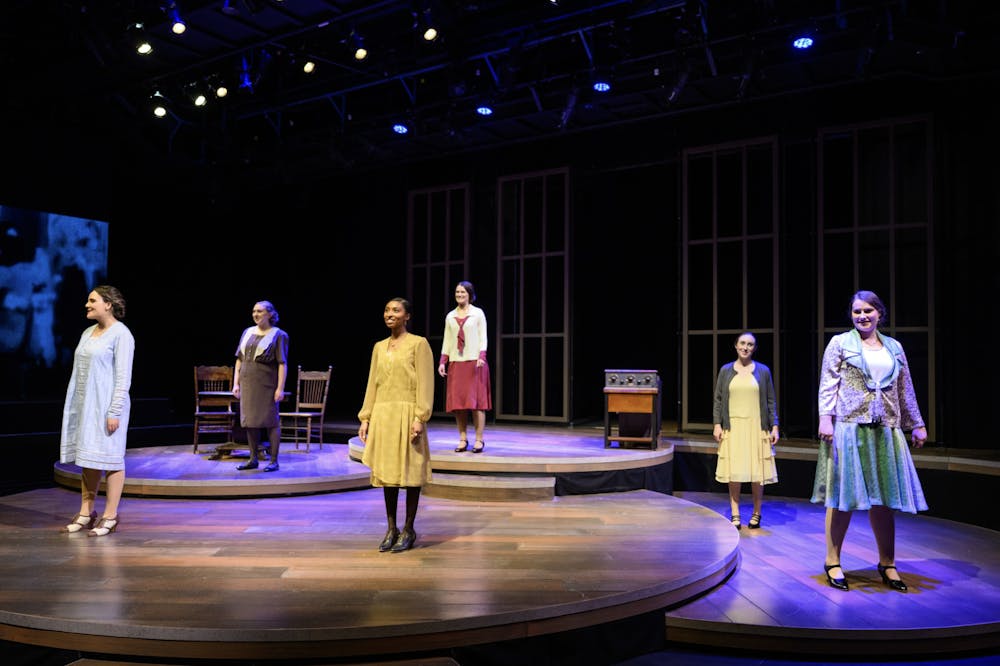
Powerful depictions of female friendship, American history and grief lit up the Seeler Studio Theatre this past weekend as the cast of “These Shining Lives” took to the stage. The faculty-led production ran from Oct. 30–Nov. 1, with a total of four performances.
The play, written by Melanie Marnich and directed by Associate Professor of Theater Michole Biancosino, is about the lives of the “Radium Girls.” Based on the true story of women in 1920s—1930s Ottawa, Illinois, the story follows the life of Catherine Donohue (Molly Snow ’26) as she starts working at the Radium Dial company.
This company was one of the few employers of women in Illinois at the time, where hundreds took jobs painting watch dials with radium-based paint. At first, the job seemed like a dream. Women were paid relatively high wages and weren’t required to do laborious work. Considering how recently women had been granted the right to vote (1919), they were eager to secure employment and exercise their rights. Little did they know their employers were terminally poisoning them. What seemed like an uplifting opportunity would lead to exploitation, disease and death.
The opening scene depicts a morning where Catherine prepares for her first day at the Radium Dial company, her first job ever. Excited and nervous, she asks her husband Tom (Owen Foberg ’27.5), to reassure her that she can succeed at the job. He affirms that her goal will come true.
As Catherine arrives, she is welcomed by the supervisor of the company Mr. Reed (Max Blumenthal ’27) and is placed in a room with three other women, Charlotte (Hannah Alberti ’26), Pearl (Jordan Henry ’26), and Frances (Norah Santoni de Castro ’26). The women teach Catherine how to paint the dials with a simple “lip, dip, paint” sequence.
As Catherine remarks that the brush paint tastes funny, they reassure her she’ll get used to the flavor in no time. Charlotte, who can “read bones,” anticipates that Catherine will be a good painter, and Catherine returns home that day with a sum of money and high hopes for the job.
Slowly, the four women become close friends and the dial company becomes a consistent part of Catherine’s life. Time in the play flies by quickly. In one scene, six years after Catherine started working at the dial company, the four women take a day off from work, “borrow” one of their husband’s cars and drive to the beach. They picnic together, eating sandwiches and drinking gin.
The set included projected video footage of Lake Michigan with wave sounds in the background. The girls marvel at how they landed a job that affords them to enjoy such a perfect day; toasting to one another and to the Radium Dial company, hoping to keep working there for years to come.
However, things soon start going downhill when Catherine notices that her hands glow in the dark. The radium-infused paint is in her skin, and no matter how many times she washes her hands, she can’t get it off. She starts to notice pain too: in her leg, her jaw, her bones, her whole body.
A visit to the company doctor only reveals his reluctance to treat her. Without much investigation, the doctor prescribes Catherine aspirin. In fact, he prescribes aspirin to all of the women in the company who have started to feel pain. But no matter how many times the doctor turns them away, the women suspect there is something far more sinister at play.
Soon enough, Catherine is fired from her job. As Mr. Reed puts it, she’s taken too many sick days, has gotten sloppy with her painting and has been “talking” a lot — the company can’t afford the spreading of harmful rumors. Eventually, Catherine's friends are also released from the Radium Dial company. Now unemployed, their pain worsens. As the women seek treatment, the doctors in town refuse to see them. They are forced to go to Chicago, where they finally find Dr. Dalitsch (Claire Hatch ’26), who agrees to see and honestly diagnose them.
The women then find out they have radium poisoning, which is incurable and fatal. The play involves a second, contrasting scene at the shore of Lake Michigan, right where they picnicked and cheered to the Radium Dial company years ago. Now, however, they find themselves out of work and terminally ill.
Catherine finds solace in her friends, talking and playing poker with the other women. In one such game, the four decide that the winner will choose whether or not to put up a fight and hold the Radium Dial company legally accountable for knowingly poisoning the women. Catherine wins the game and decides to sue. Her biggest fear is being forgotten; she can’t just quietly die and do nothing about the company that has sent her to an early grave.
The final scenes of the play involve a series of court hearings, lawsuits and ultimately Catherine’s death. Director and Associate Professor of Theatre Michole Biancosino deliberately included projections of real newspaper headlines about the court proceedings to emphasize to the audience that this was based on real life. She also refrained from showing pictures of the actual women until the very end, so the audience’s perception of the characters wouldn’t be affected by the projected images.
“These Shining Lives” was unique in its preparation, a process that demanded a lot of research. The actors had to delve into the history of the play: who these women were, what Illinois was like in the ’20s and ’30s, what popular culture consisted of at the time, how radium affects the body, how prohibition worked and how the crime world of Chicago operated during that era.
The actors got the chance to talk with the playwright, Melanie Marnich, over Zoom. They learned about her inspiration for writing this play and Marnich’s creation of the characters.
Biancosino explained that the play represents the metaphor of time on both small and large scales. The audience contemplates time in a broad context and also in the context of these women. Namely, how their time was cut short by painting clocks. Mark Evancho, the scene designer, made up the stage in the shape of a split-up clock. Like parts of a whole that have been separated out, the intricate design featured multiple circles that created an entire clock when put together.
Biancosino emphasized that this play shines light on a tiny piece of history that informs us about ourselves today. There is still a lot of injustice surrounding the working class and workers’ rights. Women's health and bodily rights are also issues constantly in the news and still something many don’t take seriously. The play not only asks us to think of time in the context of these women’s lives, but also within our own. Time is what we choose to make of it, and something we must let shine.


