
My introduction to the horse world began with teeth marks on my hand.
When I walked into the barn at Eddy Farm on a late November evening, it smelled faintly of manure, and the floor was strewn with scraps of hay and dust from the indoor ring. In one stall stood Scout, a blind and deaf elderly horse with a glass eye who resembled a real-life Bojack Horseman. I reached out to greet a horse named Dan, who promptly bit the back of my hand. This was the world I'd signed up to explore with the Middlebury Equestrian team.
The Middlebury Equestrian team practices weekly at Eddy Farm School under Head Coach Kate Selby, who founded the club in 1994, and Assistant Coach and barn manager Margaret Bojanowski. Eddy Farm is a nonprofit organization that provides boarding for community members who aren’t able to keep horses on their own properties. They currently have 36 horses on-site. Middlebury riders must attend at least one required practice a week at the Eddy Farm to compete. However, students and community members of all ages and experience levels can take lessons at the farm. That’s exactly what I set out to do.
I began my evening at the farm by observing a team practice. Co-captains Tess Hegarty ’25.5 and Kathleen Schroeder ’27, along with newer rider Gavi Gilbert-Trachtman ’28.5, were riding Dan, Grace and Joe. The riders seamlessly moved through warm-up laps before progressing to posting drills at various beats of the horses' trots. Then came navigating the courses Coach Margaret set up, and taking jumps one at a time. Coach Margaret called corrections mid-stride — “Toes up! Stretch up tall! Eyes ahead!” The riders cheered each other on, while steam rose from the horses’ backs, their coats damp with sweat despite the freezing air.
Rider-horse communication is constant and precise. There’s no faking a partnership with a roughly 1,200-pound animal. To be successful, one must communicate clearly, stay present in one’s body, and move with the rhythm of the horse.
I tried to keep all of this in mind before it was my turn to ride.
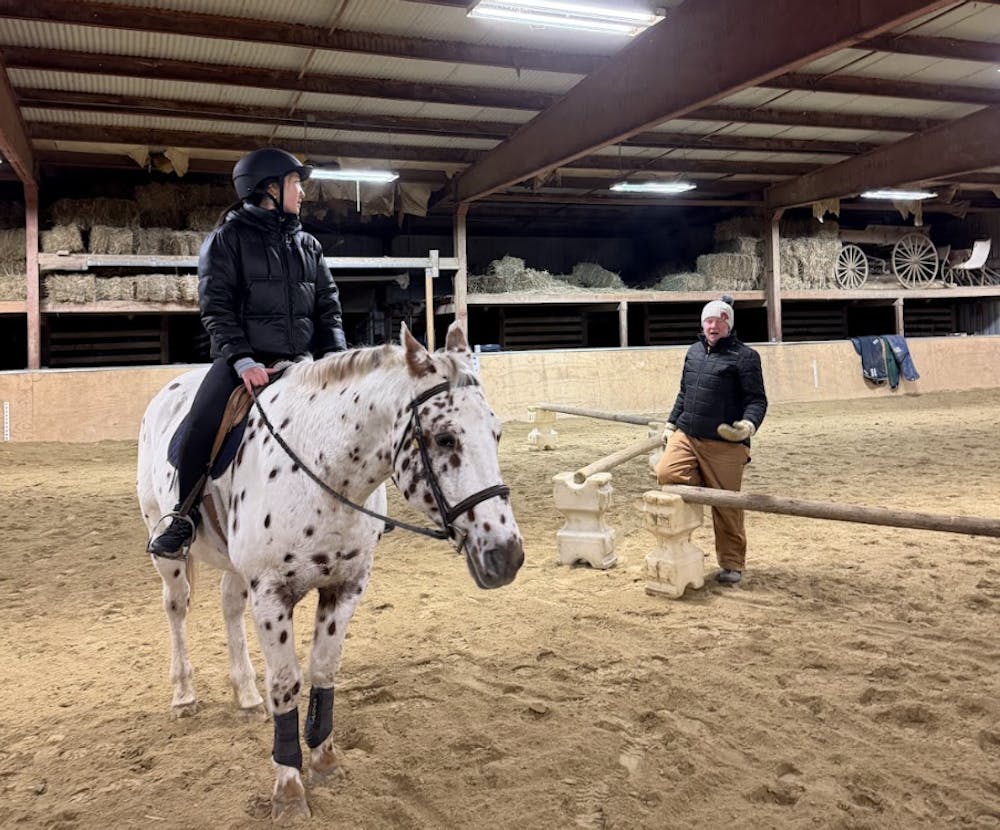
My mount was Joseph, known as “Joe” to his friends, a cream-colored horse with warm brown spots and hazel eyes. Getting onto Joe was perhaps the most ungraceful I have ever looked in my life. Once mounted, the first thing I noticed was the height. As someone who figure skates and knows how to fall properly, the fear of falling off a horse was still intense. Unlike skating, where I can control my edges, riding felt like surfing a restless wave beyond my control. Joe's movements shifted me side to side, up and down – the motion intensifying dramatically as he broke into a trot.
Hegarty remarked that the contour of Joe's back is particularly flat and comfortable to sit on — a memo I didn’t quite get as I bounced around on top of him. Despite his calm demeanor and reputation as an excellent lesson horse for beginners, Joe refused to move forward for me. Assistant Coach Margaret assured me that Joe actually enjoyed his work, often returning to his stall happier after being ridden. He just needed some initial convincing.
Once he began to walk, the corrections arrived rapid-fire from Coach Margaret: “Toes up! Hands up and floating! Legs locked! Eyes ahead! Don't forget to breathe!” That last one in particular felt like she was reading my mind. I was using muscles I didn't know existed — my adductors hugging Joe's sides, sitbones engaged, my core and back working to maintain posture. The counterintuitive lesson: being stiff makes you more likely to fall. You need to be strong and relaxed simultaneously, moving with the horse rather than against it.
What looked effortless when the team rode was anything but. Steering Joe wasn't as simple as driving a car. Turning right meant pressing my inner left leg into his ribs while turning my head in that direction, keeping my torso square. To halt, I learned to apply gentle leg pressure, sit deeper in the saddle, and pull the reins back a few inches toward my waist, using my entire body to signal the command.
The Middlebury team competes through the Intercollegiate Horse Shows Association (IHSA) in the hunter seat equitation style, an English discipline where judges evaluate the rider's form and communication with the horse. According to IHSA rules, riders never compete on their own horses. Instead, they're assigned unfamiliar mounts at each show through a random draw, eliminating the expense of horse ownership and leveling the playing field.
Even with this format, equipment costs remain significant. Saddles cost upwards of $2,000, bridles around $200-300, and quality boots running $200-$300.The team's scholarship program supports students who couldn't otherwise afford the equipment, while the club offers inventory loans, group trips to consignment tack stores, and subsidizes all club and team rider lesson fees. All show fees (entry, coaching, transportation) are also covered by the club budget.
This creates an opportunity for riders to thrive. This season was particularly strong for Middlebury's 18 riders, who compete in Zone 1, Region 2.
“Our last show was my personal favorite because it was my last show with Midd Eq,” Hegarty said. “We came away with three first places, two seconds, and some overall awesome results. That made me super proud and excited for the future of the team. This is sort of the end of my competitive career, so it was super fun to come away from that last show winning high point.”
By the end of my 10-minute test ride, Joe finally started listening. Nuzzling his head after was both validating and sweet. We had formed a connection. Despite the freezing temperatures, the initial bite from Dan, and my thoroughly cumbersome mount and dismount, I understood what draws these athletes to the barn every week and what keeps them coming back to work with these powerful and kind animals.
My first time on a horse was daunting, ungraceful, and cold. And I'd absolutely do it again.
Ting Cui '25.5 (she/her) is the Business Director.
Ting previously worked as Senior Sports Editor and Staff Writer and continues to contribute as a Sports Editor. A political science major with a history minor, she interned at the National Press Club in Washington, D.C. as a policy analyst and op-ed writer. She also competed as a figure skater for Team USA and enjoys hot pilates, thrifting, and consuming copious amounts of coffee.


