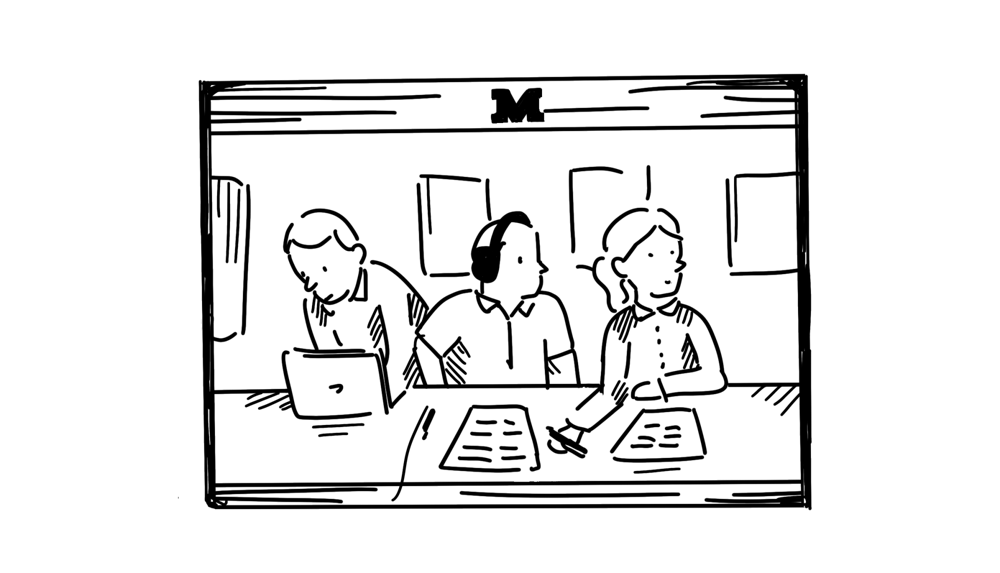
In Chip Kenyon ‘85 Arena, all eyes are trained on the ice, waiting for Middlebury to slip by the defenders and score a goal. But if you happened to look up to the press box behind the away team’s bench, there’s a complex operation taking place.
The Middlebury statistics team funnels onto their perch about an hour before the 7 p.m. start time of the Middlebury women’s ice hockey game against Williams on Feb. 14. A box of Vanilla Kempswich waits for them, a gift from Phil, who is part of the ice rink crew. To their right sits Rich Haskell, a celebrated 40-year veteran of the radio industry. The group includes Director of Athletic Communications Nick Lewis and two students, both of whom have been well-trained for the job.
The complete stats team consists of Assistant Director of Athletics Ali Paquette and Athletic Communications Associates Dain McKee and Ben Blakely. In addition, there are 30 paid student staffers — half of them varsity athletes — who rotate working the games, even during school breaks.
“We literally could not do our job without student workers,” Lewis said. “Anything we can do to get them some shine — that’s the goal.”
At Kenyon, Lewis’s group was laser-focused throughout the entire first period. Working in tandem, one of the staffers called out the sequence of plays on the ice. Lewis entered the information into a touchscreen laptop, which then automatically uploaded to the Middlebury athletics website. A sequence sounds like this: “Faceoff won, home 18. 17 has the puck…shot home 20, blocked number 24, shot home 3…”
"If I'm calling, my voice is usually gone by the end of a game because you end up talking for nearly two hours," Paquette said.
The biggest challenge for any new staff is learning how to call the sequence in the right order. It’s even harder in basketball, where you have to call shots, rebounds, steals, turnovers, fouls, and technicals.
“There is a lot of back and forth between the teams, so having to call everything in a short amount of time is challenging,” Caroline Deleon ’26 said in an interview with the Campus.
The focus is so intense that "half the time the callers have no clue what the score is," Paquette added. If you miss a play, however, you can always check the video recording.
Hockey is more manageable, but the team still tracks every time a player touches the puck to build possession maps for the coaches to analyse after the game. In hockey, volleyball, football, and basketball, the statistics crew also prints data at the end of each period for coaches to review during breaks. The work is intense, and by the time there’s a sufficient break in the action, Lewis is resigned to eating a half-melted Vanilla Kempswich.
One downside of the job is that you’re not allowed to cheer. “We are working for the benefit of both teams in that we’re creating a neutral experience. So us openly rooting for Middlebury would be frowned upon,” Lewis said.
“Although you might have a subdued fist pump under the desk,” Lewis admitted. There was no dilemma on this particular occasion, though, as the Panthers lost a scoreless game in overtime.
But the job doesn’t end at the final buzzer. Throughout the game, the staff keeps their own detailed notes — ranking scoring chances on a scale of 1 to 10 or putting a star next to a great save, for instance — so they have the raw material for a compelling story. After the game, the stats team writes up recaps to post to the athletics website. This is standard for every athletic event, even if they don't record the stats for every game. In sports like skiing, for example, a third party does the timing.
“There are 31 varsity teams, and we try to provide equitable coverage to all of them,” Paquette said. “Even if we’re not doing stats, we think about how to provide more detail to their story beyond the results.”
Weeks before competitions, the stats team compiles long Google Docs on each team to use in the write-ups. They track every player’s personal records and the history of games between the teams. There are even spreadsheets for each skier’s individual performances, and another to track runners' times against the rest of the country.
“It might seem little to us, but it's a really big deal for the athletes,” Paquette explained. “Being able to note that someone had their first goal, swam a personal best, or leads the country in an event adds depth to our stories and allows us to highlight more athletes than simply the home-run hitters or goal scorers.”
Their work doesn't go unnoticed.
“I appreciate the athletics communication community and how much effort they put into making the home games go smoothly,” Deleon told The Campus.
For some student workers, the reward goes beyond the numbers.
“I really enjoy following the teams across the season and watching them develop,” student staffer Richard Liang ’28 added. “I also appreciate the connections I have made within the athletic department and our impassioned conversations about sports.”
As the Spring season starts, the stats team will move to the outdoor fields, tracking every shot, every save, every assist — and quietly counting down to championship season, hoping to host NCAA competition and see trophies hoisted. If it happens, they might even allow themselves more than a subdued fist pump — maybe even a Vanilla Kempswich.