
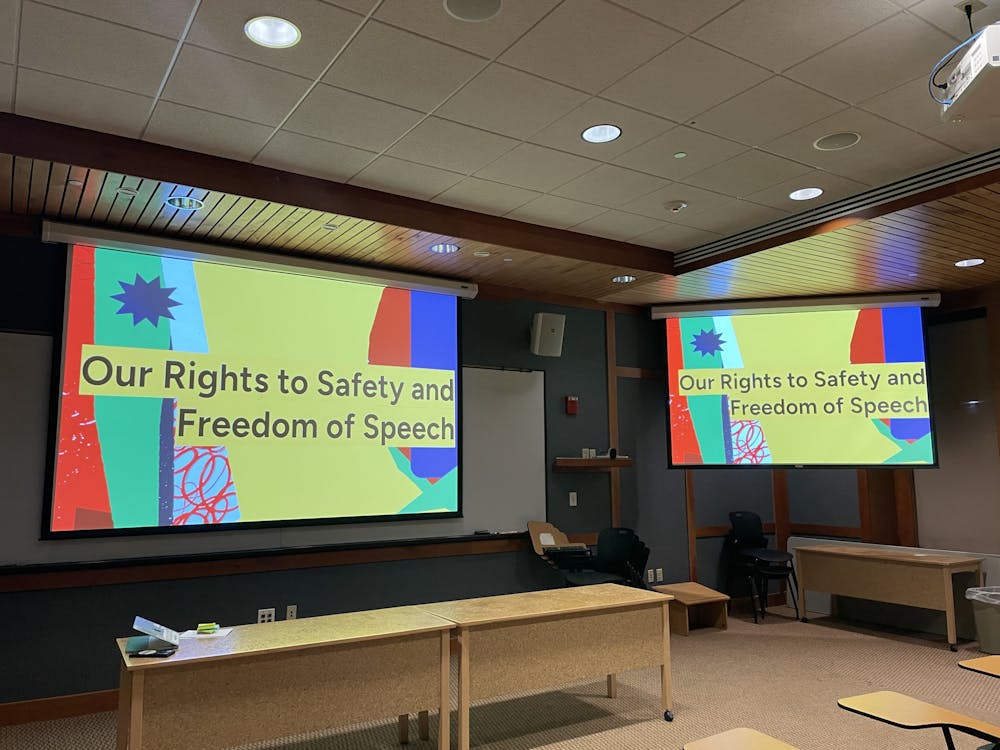
On Nov. 5, the senate of the Student Government Association (SGA) voted to reject a student-led referendum concerning rights for protection and free expression on Middlebury’s campus, instead announcing alternative solutions to the issues it raises. In response, the writers of the referendum have organized a non-SGA affiliated petition for students to sign.
The referendum, first introduced to the SGA on Oct. 15, initially delivered five demands of the college administration: To explicitly reject the Trump administration’s funding compact; prohibit the college from sharing resources, including staff time and data collected on students and faculty, with federal law enforcement; provide the Middlebury College community with the resources needed to be safe, including legal assistance with immigration-related matters; revise the Middlebury Handbook to require Middlebury officials to provide proof of their own identity before asking students for identification; and clarify that pamphleting and posting on social media are expressions of free speech, rather than activities that fall under the categories of ‘demonstration’ and ‘protest’ as explained in the Handbook policy.
These demands come in the context of increased federal scrutiny of colleges and universities and disciplinary action the Middlebury administration threatened on two students for handing out protest pamphlets on campus over the summer. If passed through SGA, the referendum would have moved on to the entire student body for a vote.
Over the course of further deliberations and debate as the month went on, the five demands shrunk to three. When the referendum went in for the final vote, it was rejected by SGA Senators during a closed door discussion.
In an email from SGA president Nicole Meyers ’26.5 to the authors of the referendum after the vote on Nov. 5, she explained the SGA’s reasoning for voting against the bill.
“Referendums can be a powerful way to affirm community-wide values. Despite this, the SGA Senate believes that a combination of widespread student engagement, education, and specific topical legislation is a better avenue for change in this case,” the email reads.
Senators argued that passing the referendum would be “disingenuous,” suggesting that doing so “would imply that work to address these concerns is not ongoing.”
“In reality,” the email stated, “the administration is actively engaging in the issues outlined in the proposed referendum and is already pursuing policy changes.”
SGA told The Campus in a previous article that its leadership had recently met with Vice President for Student Affairs Smita Ruzicka, who shared with them the near-final draft of a new protest and free expression policy for the Student Handbook.
The email also raised concerns about the potential scrutiny a public referendum might draw to the college.
“[A public referendum] could lead to unwanted harm towards vulnerable student groups. Less public, college-community based forms of engagement and education, such as our planned information session, could help address these issues without additional risk,” the email read.
The SGA will host an event on Monday, Nov. 17 titled “An Open Forum with General Counsel and Student Affairs,” from 4 p.m.-5 p.m. in the Dana Auditorium aimed at facilitating direct communication between students and administrators.
The senate plans to vote on a resolution generally addressing the referendum's concerns later this semester. It will also draft a bill addressing legal support for international students, also to be voted on later in the semester.
In an interview with The Campus, the organizers and authors of the referendum expressed their frustration with the SGA’s vote. They think it gestures towards broader issues with the role of the SGA as a mediating body between students and college administrators.
“We never worked with SGA before, so we've been trying to figure out, like, how does SGA work? What's the difference between a referendum and a resolution? And what are the institutional processes through which students, if we have something that we care about, can work with the senators that are supposed to represent us?” Sophia Kahn ’26, a co-author of the referendum, said.
“Our goal with it was to engage the broader Middlebury community on these issues that affect us because we know that Middlebury College is making decisions that are affecting our lives, whether it's decisions about giving out student information to the federal government or what counts as a protest or signing on to Trump's Compact or not,” Kahn continued. “We believe that students should have a voice at the decision making table, and so we thought a referendum would be one of one way to do that, because by having a vote that every single student can like express their voice through — what else is SGA for? And what we learned throughout this process kind of made us question whether the systems that currently exist for students to express their voice really work.”
Kahn and other organizers also expressed frustration over a feeling that the SGA excluded them from key parts of their deliberations over the referendum.
“[The deliberation] was like a back and forth dialogue, which we were glad about. We got to come back to their meetings, and they asked questions and raised concerns, and we responded and we explained why we still believe each point is so necessary. And then they began to have closed meetings where we weren’t even allowed to be in the room to represent ourselves,” Kahn said.
The organizers of the referendum were particularly surprised by the SGA expressing fear that it would draw unneeded attention to the college.
“We feel like by suppressing student voices out of fear, we're already passively complying. Because if we live in a state of fear where we're afraid of drawing attention so we don't say anything, what does that say about the college community that we're living in right now?” Kahn said.
Charlie Fisch ’26, another organizer behind the referendum, framed the need to speak out in terms of accessing students on campus who may feel like this issue does not affect them personally.
“It's true that there are people that are more difficult to access and I think one of our greatest challenges is figuring out how to do that, because it's so hard for all of us to imagine not feeling impacted,” Fisch said.
Kahn and Fisch have composed the petition in the hopes of keeping these issues present and circulating in the college community.
The petition, titled “Defend Our Rights to Safety and Speech,” is available at go/ourvoice/ and explained at go/ourrights/. It lists the same five demands as the original referendum the organizers originally presented to SGA.
As of Tuesday night, the petition had 126 signatures.

Cole Chaudhari '26 (he/him) is the Senior News Editor.
Cole is a senior at Middlebury, where he serves as The Campus's Senior News Editor and studies English literature and history. This past summer, Cole taught high schoolers in New Hampshire, which he is seeking to do after graduation.


