
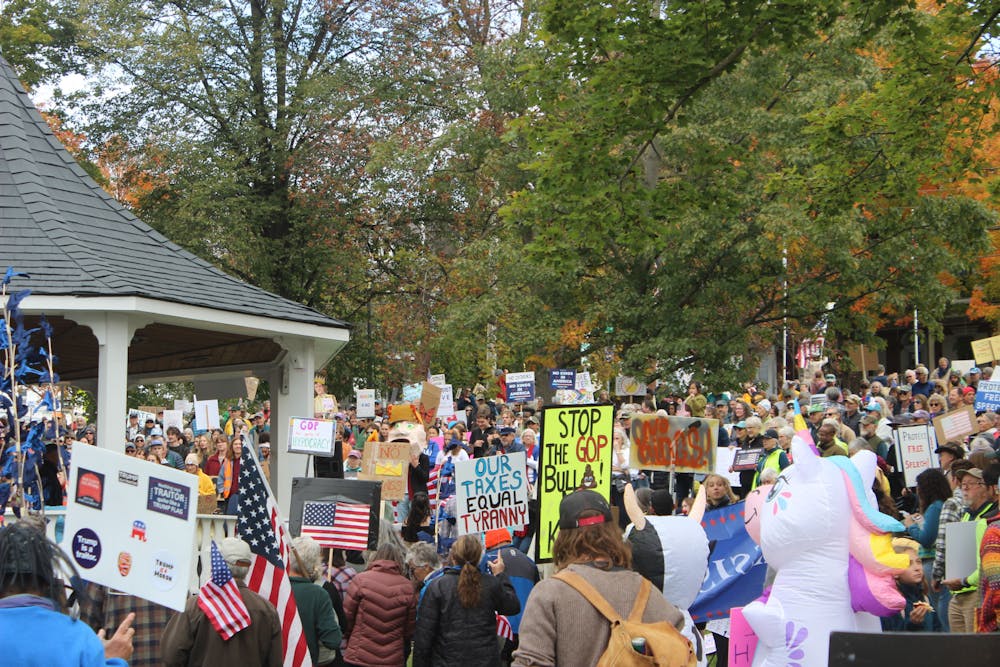
A student-led motion for a referendum on rights to protections and free expression on campus faced a vote by the Student Government Association (SGA) on Wednesday, Nov. 5 to decide its fate after weeks of debate. The votes had not yet been cast by the time The Campus went to print on Wednesday.
The proposed referendum’s first draft was introduced on Oct. 15 by a group of student organizers. Its original five demands have since been parred down to three: that the college prohibit employees from providing assistance to federal authorities in seeking information about students, revise the Middlebury Handbook policy to require Middlebury officials to provide identification proof before demanding the same from students and clarify that pamphleting and social media posts are expressions of free speech that must go unrestricted by the college.
The preamble cites concerns about government overreach, campus safety and potential ambiguity in institutional policies related to protest and identification, drawing from both local and national developments. If the the motion passes through SGA, the entire student body will be able to vote on the referendum.
According to an Oct. 2 op-ed in The Campus, Ryan Ulen ’26 and Violet Gordon ’26 were investigated and retroactively threatened with disciplinary action after distributing pamphlets about the CIA when it held an information session at Middlebury Language Schools. The charges were dropped after pressure from both faculty and students, and Gordon was issued an apology for a process that “should have never happened,” according to the op-ed.
Another situation cited was UC Berkeley’s sending of 160 names of students, faculty and staff as part of an antisemitism investigation to Trump administration officials. This move sparked heavy backlash, including an open letter condemning the act signed by 600 university professors.
Sophia Kahn ’26, one of the lead organizers, said the referendum effort was inspired by student-driven campaigns across the country supported by organizations including the ACLU and Amnesty International under the initiative Firewall for Freedom.
“Learning about that movement sparked the idea to do something like a referendum at Middlebury, given the current political climate,” Kahn said.
In the original draft shared with The Campus, organizers grounded the referendum in Middlebury’s own institutional commitments, quoting the Student Handbook, President Baucom’s public commitments and the college’s mission statement devoted to open inquiry and freedom of speech.
To move a referendum forward, organizers first needed Student Government Association (SGA) sponsorship.
“We wrote out our ideal referendum with our five demands, and then we presented it two weeks ago at the Senate Assembly to explain to senators that this is something that we care about and why we want each of these five things,” Kahn said.
The resolution received unanimous sponsorship from the senators when it was initially presented, according to Kahn.
A vote was initially scheduled for the Oct. 29 SGA Meeting, during which Speaker of the Senate Jeffrey Teh ’28 relayed updates from a discussion with Vice President of Student Affairs Smita Ruzicka, and opened the floor to discussion with student organizers who were also present. The vote would determine whether the referendum would be turned to a resolution instead.
“Only the SGA passes the resolution, and then they show that to administration… which would only result in an email update to the student body,” organizer Natalie Martinez ’28 in an interview with The Campus. “A referendum, on the other hand, would be voted on by the whole study body whose involvement is enough action and activism within campus to have administration ask what are students worried about… and have a conversation about that.”
Kahn listed two main aims for the referendum.
“One is education and the other is putting pressure on the Board of Trustees and [administration] to enact policy change, and they’re both very interconnected,” Kahn said. “There’s an amazing history of student activism at Middlebury and at this moment, the most powerful thing we can do as students is show up and not be complicit.”
In the Oct. 29 session, the Senate removed two provisions: The call for the college to reject the Compact for Excellence in Higher Education was removed entirely and a provision to expand access to immigration-related legal and financial support was separated from the referendum and will be developed as a stand alone SGA initiative.
In a statement to The Campus, Teh, representing the SGA, said that the Senate’s decision to remove the first demand was informed by President Baucom already signing on an open letter rejecting the compact. However, organizers questioned whether President Baucom’s signature alone constituted institutional rejection.
“Neither of the statements that he has signed on are an explicit rejection of that compact, and it's not clear if he is representing our [college] or he as an individual,” organizer Charlie Fisch ’26 said. “The student voice was also not included in that and so our concern is accepting that those statements count as a rejection is not entirely true.”
Senators decided to postpone the vote until Nov. 5 in order to refine language in the legislation, gather constituent feedback and coordinate a nonpartisan education plan before a campus-wide vote.
In an update to The Campus, SGA leadership communicated that the Executive team had recently met with Ruzicka, who shared a near-final draft of the new protest and free expression policy for the Student Handbook. The revisions were developed in consultation with General Counsel Hannah Ross, with whom the SGA is planning on hosting a student event on Nov. 17.
“The revisions at first glance appeared to almost completely address articles 4 & 5 around identification and pamphleting/non-disruptive protest, as well as clarifying the timeline to register protests to 48 hours in advance,” Teh wrote. “Depending on how Senators respond to this new information, it may result in the referendum being made obsolete or taken off the table, given that nearly all of the articles have been addressed.”
If the Senate votes to hold a referendum, it would be held before Thanksgiving Break during the week of Nov. 17.
Student organizers will host a teach-in on Nov. 7 in the Franklin Environmental Center at Hillcrest at 4:30 p.m., focused on national events shaping campus life and how Middlebury is responding to them. Organizers said the event aims to examine how institutional decisions are made and to offer students guidance on how to engage in those processes.
Editor's Note: Managing Editor Mandy Berghela ’26 contributed reporting to this article.
Met Ly '28 (he/him) is a News Editor.
Met is a UWC Davis Scholar majoring in International Politics and Economics with a Creative Writing minor. He is also a fellow at the Rohatyn Center for Global Affairs. He hails from Siem Reap, Cambodia and spent his gap year there as a digital marketing manager and events coordinator. Outside the newsroom, he line dances in his cowboy boots and jams out to the Arctic Monkeys.


