
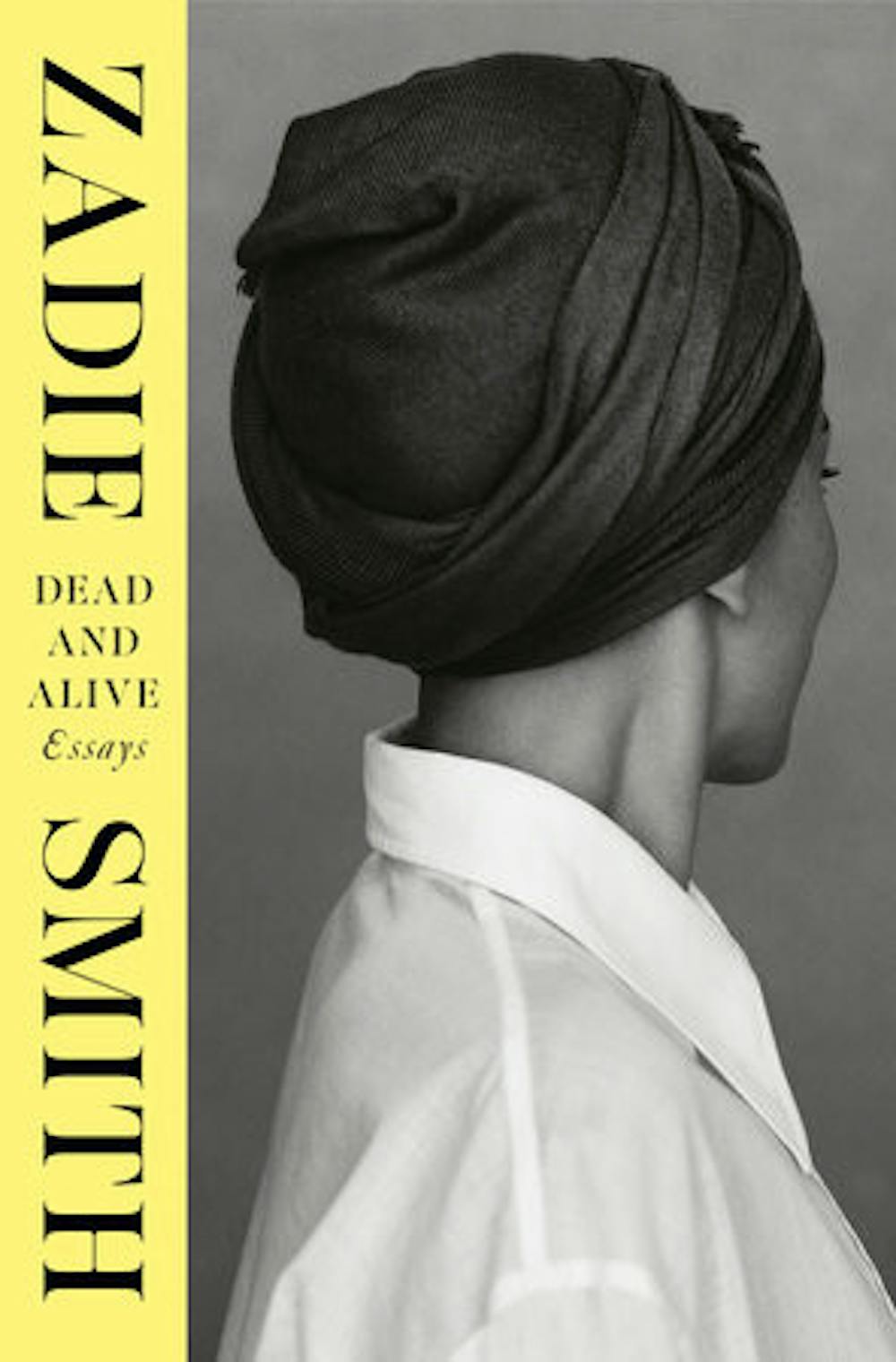
“But perhaps I am asking the question the wrong way around,” Zadie Smith writes at one point in her essay “Fascinated to Presume: In Defense of Fiction,” which can be found in her new collection, “Dead and Alive.” It’s a typically Smithian line: an expression of self-doubt signalling the arrival of a new insight whose veracity you, the reader, will likely not doubt at all. What follows, you know, will only further illuminate the subject at hand (and will only be followed by another moment of illumination). The many “but”s in Smith’s essays — the “though”s and “what if”s and “maybe”s — are what you come for, the mark of a writer who stands in pointed opposition to the kind of thinking rewarded in the social media discourse which has become the only real stand-in for our public one.
In a time when a lot of essays — even those that appear in the once-vaunted magazines with elegant names — read like extended X posts, reading Smith can feel like interfacing with a consciousness from sometime before the Fall, before the 2004 day when that one Harvard sophomore launched that one website. Hers is a voice in contact with, but untarnished by, all the intimate bullshit of the current moment. We hear the sound of a legitimately vibrant, socially-conscious mind — the kind of mind we all want, and want to know in others, and deal a hammer blow to every time we take our phone out of our pocket and congeal in the glow of its “deathly Palo-Alto-Late-Capitalist-consciousness-colonizing-sickly-blueish-light” (as Smith’s phrase goes). To write a big-subject magazine piece that’s not just “deeper than an X post,” but everything an X post is not — something that indulges every impulse X discourages — how about more people try that?
Author Claire Messud wrote of Virginia Woolf’s approach to essay writing that it is “the more authoritative for never being authoritarian.” So it is with Smith, on whom Woolf’s essays are a clear and stated influence. What both writers offer is not so much the verdict as the hearing — not the consciousness unfolded, but the actual process of its unfolding. When it comes to hot-button issues (cultural appropriation in “In Defense of Fiction,” warring generational ideas about art in her piece on the film “Tár”), Smith doesn’t so much “cut through the shit” as circumnavigate it, touching only the edges, grace intact. Sometimes a bit of righteousness breaks through — and sometimes you want more of it; grace-before-all-else can be annoying — but the rigor is always in the self-effacement. After ending one sentence with an exclamation mark, Smith writes: “And immediately, within that bumptious exclamation mark, an internal voice notes the tell-tale whiff of Baby Boomer triumphalism, of Generation X moral irresponsibility.”
Or take a condensed version of a few pages from “Some Notes on Mediated Time,” one of three new essays in the collection, in which the self-propelling nature of Smith’s doubt is on full display. First, a fatalistic assertion about the effects of social media on young people: “Soon a teen boy, like a teen girl, will be nothing more or less than what can be seen and judged externally by a camera, and presumably will then develop the same embattled, fragile sense of self that is by now native to teenage girls, and ripe for exploitation by data sets . . . ” Then, a challenging of that assertion: “And yet. I do think that pretty much anything can be metabolized by humans . . .” Then an obvious dissatisfaction with that idea: “And whatever is lost in the transition? The capacity to be bored, alone, private, un-nudged. . . ” Then a pulling out of the spiral, and a kind of surrender: “. . . in the end what’s the difference? Besides, cats do not go back in bags. Nothing is going to get un-inverted here . . .” But then another push, couched in a footnote: “Although there does seem to be a paradigm shift here. Most mediating devices, after a while, are metabolized by the majority . . . while leaving a smaller proportion of people behind, locked in for life. The thing about the phone is that it’s everybody. One hundred per cent capture . . . ” And then, soon enough, a return to the point she made nine pages ago: “Anyway, I digress.”
If this sounds tedious, it’s mostly not. Smith isn’t so much flip-flopping between positions as weighing them in her palm, trying to get a good look at them. One can see Smith as someone walking through a mental hillscape, finding new amalgamations of earth, tree and sky as her sightline changes. Many writers choose one spot and describe the view. Others, envious of Smith’s style, might seek to demonstrate their range of movement, but mistake the task as picking a single hill and climbing it — better to get the highest view and achieve the ultimate, complete perspective. But that’s not often the perspective in which Smith is interested. And besides, with the uphill struggle towards the single peak comes the feeling of a certain kind of dumb, single-minded effort — the sound of panting. Reading Smith, the pleasure is in the sense of effortlessness.
All of this, for Smith — the self-doubt, the absence of snark, the roving perspective — is a natural result of her day job as a novelist, as she would be the first to tell you: “Fiction—at least the kind that was any good—was full of doubt, self-doubt above all,” she writes. Her disposition isn’t an affect deployed for the appearance of open-mindedness, but a result of her constitution, bolstered by years spent at her desk imagining other lives. It’s as if she can’t do it any other way. Humanism — a mushy word in any time, but regarded as particularly antiquated, if not risible, by many today — is the strain that runs through all of these essays, repeatedly making the case for itself in varying guises, reminding us what exactly it means, how exactly it might be applied.
For more than a decade now (see: her 2012 essay “Some Notes on Attunement,” which orbits around Joni Mitchell) Smith has been making a case in her essays about how this particular “ism” is perhaps more important than others when it comes to questions of art and identity, and she seldom misses an opportunity to take it up. Even in what could have been a brief introduction to the section of the book comprised of obituaries, Smith reminds us that, while she didn’t always share the same beliefs as some of her late friends and influences — she points to Martin Amis’s view of “The War on Terror,” Joan Didion’s musical taste, Phillip’s Roth’s vision of women, Toni Morrison’s committed Catholicism — “Whenever I consider the very many writers who have left their mark on my writing in one way or another, I am reminded that you do not need to be perfectly aligned with someone to be in their debt.”
While Smith seems to see her mode of essay-writing as the one she is “stuck with,” she also knows that its shadow mode of thinking is in particular need of defending these days, that the forces working against it — whether they come from Palo Alto or the Trump White House or (and no suggestion of equivalence here) the progressive college campus — are increasingly strong.
It’s that first camp with which she is understandably most concerned. As Smith writes in a recent New Yorker piece: “My essays tend to employ a lengthy and sometimes oblique way of thinking that can appear out of step with the more direct forms of address presently favoured by the algorithm. I think this is why I’ve ended up writing so many of them, despite never setting out to be an essayist. They have been my own small way of resisting it. I mean, the algorithm. If not thinking through it, with it, or on it.” You might call it a simple idea, a narrow effort — but who could say it’s not a necessary one? Who could say, actually, that it’s not as vital as any right now?


