Aurelie Floret is an architectural designer and an Assistant Professor of Architecture at Auburn University in Auburn, Ala. This past week, from March 9-13, she visited Middlebury through the Cameron Visiting Architect Program. The program offers a short-term residency for architects and designers, bringing together real-world professionals and college students.
Throughout the week Floret was in Vermont, she visited studios and guided students in their project development. She also gave a lecture about her work on Thursday, focusing on the relationship between infrastructure and water systems.
Floret was born in Paris but moved to Atlanta early in her childhood, alternating between Atlanta during the school year and her grandmother’s house in southern France during the summer. The village she stayed in in France, Seillans, was hot and dry, which made her think a lot about water.
Floret also traces her interest in water systems back to these hot summers, when she would run down to the source with her siblings to dip their feet in some water to cool off.
“On the way to the source, there was a lavoir, a public wash house. That lavoir really stuck with me. It was a ruin from another era, now abandoned and overlooked, yet it revealed a way of thinking about water and infrastructure,” Floret said.
After contextualizing her initial interest in water systems, she moved on to talk about how it has influenced her work. Floret currently has four grants funding various projects.
“I'm interested in water infrastructure in general and kind of spatializing water infrastructure, architecturalizing it. And I'm interested in drinking water infrastructure. That's like one bucket. Wastewater infrastructure, that's another bucket. And then coastal resilience is another bucket. So I have three different lenses through which I look at the problem, and so the solution is slightly different for everything,” Floret added.
One of her projects began as a master's thesis while Floret was at Cornell and was later published in the “Cornell Journal of Architecture.”
“This is proof that your theses can have a life after graduation!” she exclaimed during the lecture.
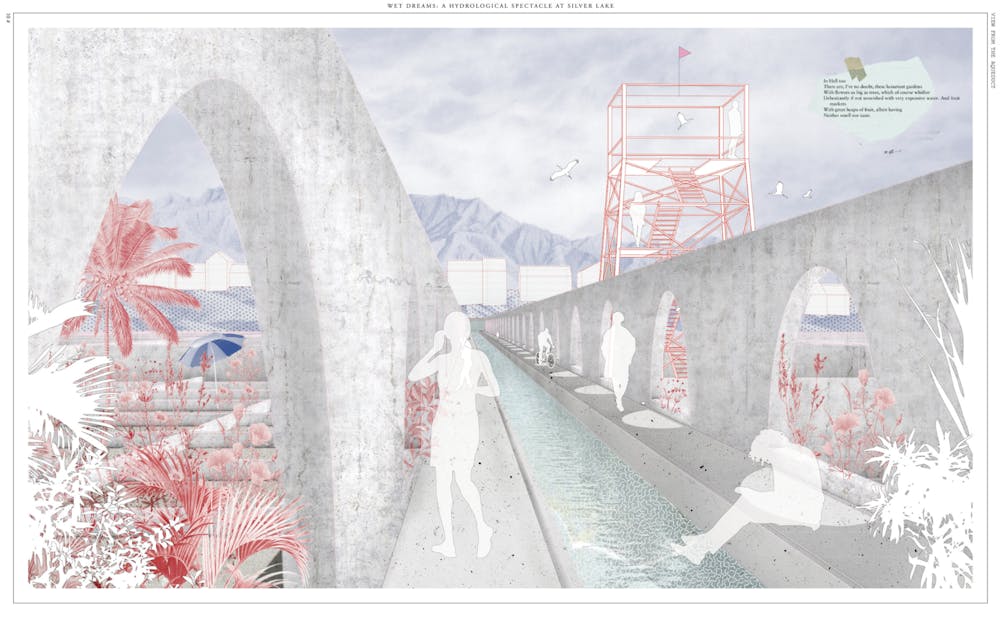
In the project, Floret focuses on the scarcity of drinking water in Los Angeles. The project is a design around the Silver Lake reservoir in the center of the Silver Lake neighborhood. In 2006, strict water quality standards were set, resulting in various water sources being removed from service or hidden underground. One of these was Silver Lake. In her proposal, Floret reactivates this currently deactivated water source and incorporates it into the urban landscape of the neighborhood, making the drinking water a part of the urban experience.
“You have to hide pipes because that's how you ensure their longevity and that they don't get contaminated by surface water discharge, et cetera. So it is important that they're hidden. But are there moments of this infrastructure coming up and being celebrated in the way that, you know, in Rome, sometimes water infrastructure would sort of come back out of the depths and announce itself. When things are hidden, people sort of forget. So, in a landscape where water scarcity is real, when a lot of places are facing water scarcity, can we start to visualize these things to create a relationship between people and their water infrastructure? And maybe people will invest in it a little bit more. They're also paying taxes for it, right? So how do they start to be more aware of what's going on? How do they start to, like, be in conversation with the infrastructure in a more active way?”
The effect of the French lavoir — an open, visible water source — on Floret’s current work is evident in her desire to make water more present and visible in our lives. Floret presented sectional drawings of her work about Silver Lake on Thursday. Sectional drawings are technical illustrations that show a three-dimensional building as if it were cut in half vertically or horizontally. Most of her works were sectional in the vertical, in which she drew the infrastructure, the water, and people going about their daily activities. While this project is very important for conveying an idea about water infrastructure and starting a conversation about these issues, it has not yet been realized.
Another project Floret is working on is a SOM Foundation Research Prize Project with Rural Studio. It concerns wastewater in Alabama’s Black Belt region. Rural Studio is a design-build program within Auburn University based in Alabama’s rural Black Belt. The Black Belt is a crescent-shaped area of about 20 counties in Alabama’s midsection, known for its rich, dark, fertile soil. Most residents in these areas manage wastewater using septic tanks. However, the septic system is incompatible with the land, as the water has trouble draining in the unique soil.
Failing septic systems cause residents to struggle for extended periods due to the high cost of replacing tanks. Floret is working with other researchers, professors and engineers to create a manual for the residents of this area.
"It's sort of explaining that condition, drawing it so people understand it. It's giving them different media to help them understand the problem. Talking about wastewater alternatives, like showing different types of things you can do if your septic tank is no longer working. And then, how a town could be affected by a renovated septic tank. So if your town is now hooked up and you have wastewater capabilities, businesses can move in. Dollar General can move in because there's this whole new infrastructure now that was originally preventing economies from developing. So, once you have a place like Dollar General move in, something like that usually, how does that start to change the atmosphere of the town? How does it start to sometimes maybe take away the town's identity or architectural identity, urban identity? And how do citizens kind of maintain control over that stuff, too, right? How do they still have control over the future of their town based on these new updates?” Floret explained.
Many of Floret’s projects, she explained, spark important conversations, but are simultaneously quite conceptual.
“That's the next step in my research — how do I start to architecturalize these things? I want to be able to propose a structure, and that's what I'm working on. That's the kind of tension I'm interested in exploring. And maybe one manifestation of that could be, for the Rural Studio Wastewater Project, is there a way that cleaning tanks can be celebrated and visible because it's an investment for the town? How do you create a kind of architectural space around it to celebrate it?” she said.