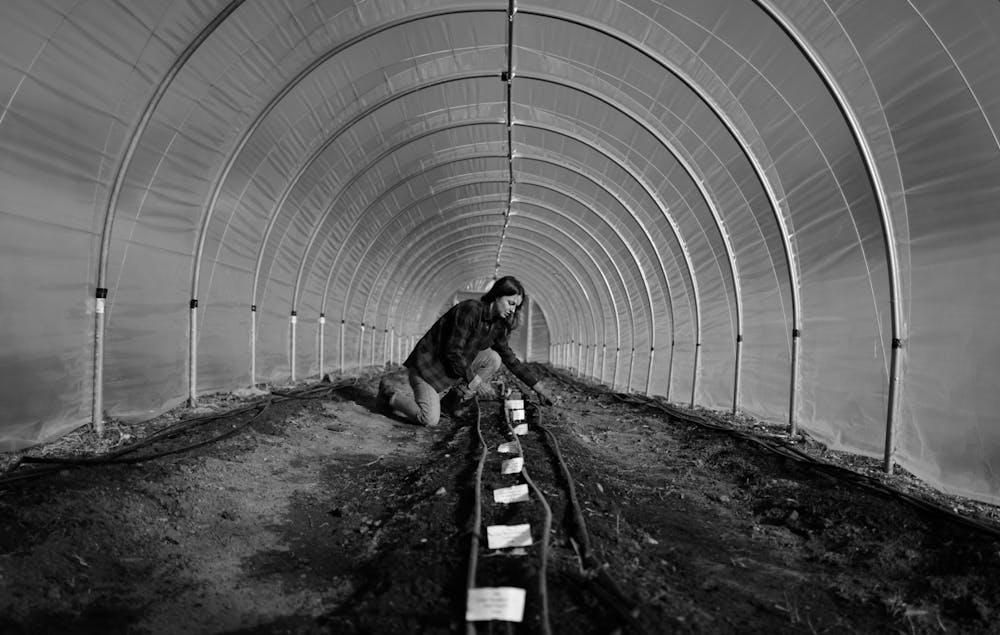
In Vermont, about 40% of farms are owned by women — a truth not recognized by many, according to photographer JuanCarlos Gonzalez. Originally from Maunabo, Puerto Rico, Gonzalez spent two years photographing and chronicling the stories of 46 female farmers in Vermont, culminating in a photography collection that is being displayed at the Henry Sheldon Museum in Middlebury until January.
The collection, titled “Vermont Female Farmers,” opened at the Sheldon Museum this past Friday, Oct. 3. Curated by interim curator Kelly Hickey, items from the museum’s collection are displayed alongside the photographs, working to weave together the past and present of Vermont farming. These items include a set of bonnets from the 19th century and a variety of antique farming tools.
The photographs, black and white and color, span the walls of the museum. Hung next to each picture is the “story in a nutshell” of the woman pictured.
Gonzalez shared in an interview that his grandmother was a farmer in Puerto Rico and was constantly asked the name of the man who ran her farm. While out to dinner at a farm-to-table restaurant in Woodstock, Vermont, the photographer overheard a very similar conversation that transported him back to those childhood memories.
“[We] overheard someone, the neighboring table, asking the staff who is the guy they get their veggies from, who is the guy they get the meat from,” Gonzalez said. “It was a flashback of growing up with my grandmother, when people used to assume that it was a guy that ran the farm or assume that it was a guy who ran the business.”
He decided that if he could use his art to amplify the stories of female agriculturalists, he would. Originally, the project was only supposed to include 10 farmers, but his work snowballed as each farmer referred him to more women to photograph and interview.
“They are so passionate about what they do, and not only passionate, but they believe in it, which shows when they talk about it. Out of the 46 farmers, not even one of them was negative about [their work],” Gonzalez said.
Ariel Krolick, one of the farmers chronicled in the collection, reflected this passion in an interview with The Campus. She runs Ariel’s Honey Infusions, which sustainably harvests raw Vermont honey.
Krolick got involved with the project because she loved the mission of Gonzalez’s work in supporting female farmers.
“I connect with people through bees, basically. That’s why I have my business, is to educate people. JuanCarlos appreciates that in all of the farmers, so it meant a lot to me to keep supporting him and what he is doing,” Krolick said.
The collection came to the museum after Executive Director Coco Moseley invited Gonzalez to exhibit his work following a showing at the Fleming Museum in Burlington. Gonzalez readily agreed, noting that while the project had been featured in northern and southern Vermont, it had not yet reached the state’s center.
Hickey said curating the exhibit was a collaborative process involving museum staff, American Studies professor Ellery Foutch and other community members. She inherited the project from former curator Emily Bryant, who had already researched items to pair with the photographs.
“It was great to work in a collaborative format like that, I think there were six of us in total… I would love to work like that all the time,” Hickey said.
Among her favorite artifacts are the colorful antique fair ribbons and the delicate bonnets, which complement the photos’ textures and tones. Hickey hopes the exhibit shows how historical museums can also be homes for contemporary art.
“It allows people to have this nice kind of flow, and to allow people to understand the way that time and stories move,” Hickey said. “These stories collide at some point. We are creating our own history, and stepping off and leaving that behind us — hopefully, some of that will be collected too.”
The collection has also been compiled into a book that was recently incorporated into the Library of Congress’ archives and is currently being sold at the museum.
“I feel that with this achievement of having the book in the Library of Congress, if the show were to stop travelling, that’s fine. The fact that everyone will be able to go in and read about these farmers, that for the rest of my life these farmers will be on permanent record is surreal,” Gonzalez shared.
Gonzalez thinks that, by educating themselves about what farmers do and the stories behind food, people can learn to better support farmers in their communities.
“Go in, learn about them and support them,” Gonzalez said. “They need the support, especially now more than ever.”
Students interested in learning more can visit the exhibit, peruse the website, or purchase the Vermont Female Farmers book. They can learn more about Gonzalez’s work through his Instagram account @JuanKasFoto or on his website.
Katrina Schwarz '26 (she/her) is a Senior Local Editor.
Katrina has been a local editor for the three semesters, recently becoming the section's senior editor. She is a Psychology and Italian double major and was a marketing intern at Penguin Random House this past summer.