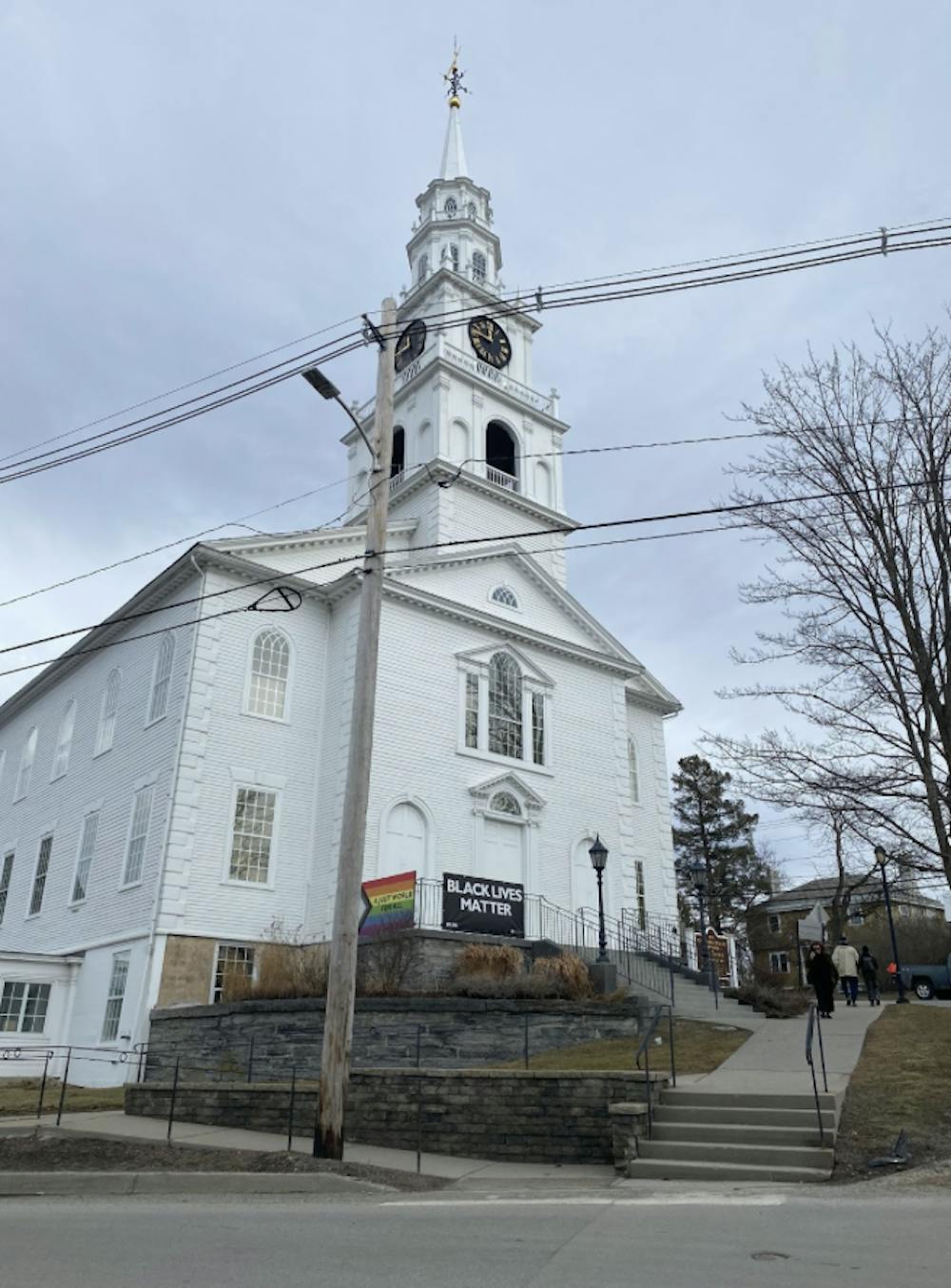
“Nothing to Hide: Mental Illness in the Family,” a photo-text exhibit showcasing images and stories of families affected by mental illness, recently opened at the Congregational Church of Middlebury (MiddUCC). The exhibit is on display outside of the church’s offices and its Unity Hall, where viewers can see the work on Monday-Friday from 9:00 a.m.–12:00 p.m. “Nothing to Hide” is open until March 31st.
The exhibit, created by artists Gigi Kaeser, Jean J. Beard, and Peggy Gillespie, seeks to destigmatize mental illness by displaying photographs and interview transcripts showcasing families as they navigate their lives.
Gillespie is one of the co-founders of Family Diversity Project (FDP), a national nonprofit based in Northampton, Massachusetts, dedicated to dismissing harmful stereotypes and reducing prejudice based on sexual orientation, gender identity, race, national origin, religion, or disability through storytelling and photography. The organization was founded in 1995, after Gillespie’s adopted daughter, Jay, had a negative experience in her preschool classroom.
“Jay came in from Christmas with a new brown doll, and some other kid in the class said, ‘Why do you have a doll with such ugly skin color?’” Gillespie said in an interview with The Campus. “At that point, I realized, as an adoptive mom, I needed to learn more about what beyond love was going to help my kid navigate through the real racism that was going to affect her,” she said.
Working with photographer and FDP co-founder Gigi Kaeser, who was Gillespie’s daughter’s preschool teacher at the time, the two created what would become FDP’s first exhibit, “Of Many Colors: Portraits of Multiracial Families.” The process, which involved Gillespie’s interviews and Kaeser’s photographs, was the beginning of many more collaborations between Gillespie and Kaeser, including works such as “Love Makes a Family: Portraits of LGBTQ People and their Families,” “Building Bridges: Portraits of Immigrants and Refugees,” and “Nothing to Hide.”
As Gillespie and Kaeser’s exhibits continued to rise in popularity, Gillespie met Jean Beard, who suggested creating an exhibit on mental illness in the family.
“[Beard] had read all about [the exhibits], and we became friendly,” Gillespie said. “She proposed to us that we do one on mental illness, because there was such a stigma. That’s how ‘Nothing to Hide’ got started.”
Gillespie, Kaeser, and Beard set out to create the exhibit, which involved traveling across the country to find families willing to be photographed and to share their experiences with mental illness. The trio found more than 30 families who were willing to participate. After an initial opening at Fountain House, a mental health nonprofit based in New York City, “Nothing to Hide" has travelled around the country, appearing in workplaces, universities, and now the MiddUCC until March 31st.
Judy Albright, a co-founder of the church’s Art in Unity team (the major sponsor of the exhibit) and a member of the church’s Justice, Compassion, & Love team, assisted in the exhibit’s opening event. In an interview with The Campus, she discussed the process of bringing “Nothing to Hide” to MiddUCC.
“The Justice, Compassion, & Love team had put together a panel discussion and community conversation on teen mental health in this changing world,” Albright said. “When we decided to do that, I had just recently gotten something in my email about this group, the Family Diversity Project; they have traveling art exhibitions, and they currently have one on mental health. I thought it would be a really wonderful collaboration.”
MiddUCC hosted an opening reception on March 1, which began with a panel on teen mental health. Following the conversation, viewers were invited to view “Nothing to Hide.” This combination of a discussion followed by a viewing of the exhibit further inspired many conversations about mental health, according to Albright.
“What was so nice for me to see at the opening reception was when the panel discussion was over, we opened the doors to the hallway where the exhibit is, and we had some refreshments,” Albright said. “And what was so nice is that the conversations that started with the panel discussion continued as people were looking at the exhibit, sipping cider and eating a cookie. A lot of connections, I think, were made between people, [and] that's something I think that our world needs more today – just talking to each other.”
Since the reception, members and non-members of MiddUCC alike have come to view the exhibit, looking at the family images and reading through the interviews. Albright mentioned that many people come into the church multiple times and are actively working their way through the exhibit.
“Every time [people are] in the building, they read a few more of the stories, and the reaction I've gotten is profoundly touching,” Albright said. “It makes us realize that our neighbors, the people we pass on the street, so many people and families as a unit, are dealing with someone with mental health issues. It's all different for every family, but I think in some ways it's hopeful when you read stories of how families have managed and how they're coping and helping the family member deal with mental health problems.”
As an exhibit, “Nothing to Hide” spreads awareness about the ways mental illness can appear in families, and it works to erase the stigma that has surrounded this topic for so many years. Gillespie expressed her hope that after seeing the exhibit, individuals would get, “an education and understanding of what mental illness, which is a broad category of illnesses, can be and why, there is nothing to be ashamed about either having one or having somebody in your family who is mentally ill.”
Similarly, Albright mentioned how moved attendees of the March 1 event were by both the panel and the exhibit, specifically highlighting how one panelist’s story about her personal journey with mental health and how the support of her family helped her as she navigated those challenges.
“When we all saw her and heard her speak, it gave you great hope that while some of these, mental health conditions can be ongoing, that there are ways through and ways to manage, and with strong family support, you can live a relatively happy life,” Albright said. “I'm hoping that people saw that in, in, in the exhibit, but also heard it at the community conversation. And I'm really hoping that other conversations will begin from this, almost as a kickoff to other events that will happen in our communities regarding mental health.”
“Nothing to Hide” is on display in the Middlebury Congregational Church, right outside of the church’s offices and its Unity Hall, where viewers can see the exhibit on Monday-Friday from 9:00 a.m.–12:00 p.m. The exhibit is open until March 31.